Invisible banana skins thrown at black people every day, says John Barnes

Is racism in sport something that the education sector can tackle?

The football charity Kick it Out, football’s equality and inclusion organisation, work extensively with clubs and fan community groups to reduce racism, homophobia and other forms of discrimination through its education programmes.

However, by targeting a captive audience, so to speak, can schools, colleges and universities help organisations, like Kick it Out, challenge racism in sport? As an experienced educator, I am confident that racism is comprehensively challenged in classrooms up and down the country. However, if our educational institutions challenge racism when they hear it… it asks further questions as to why sports professionals are still subjected to racism from people who have been through our educational system. That said, as an experienced equality, diversity and inclusion professional, I am not confident that all workplaces in England would effectively challenge racist attitudes if they heard it in the workplace. As such, if racism is not challenged in the workplace as much as it should be then it is left solely to our educational institutions to drive an zero tolerance policy on racial abuse and racism in general.

More importantly, education is what is needed to help dispel racist attitudes and negative stereotypes amongst those learning skills for the workplace. In that way, we slowly influence the workplace where old fashioned racist attitudes can be challenged and hopefully diminished. A further knock on effect of this would be the impact it has on those who attend sporting events. That said, will sports fans themselves ever be in a position to feel suitably empowered to challenge racist abuse when they hear it in the stands?

Racism in sport recently hit the headlines again with extensive national press coverage when Raheem Sterling was allegedly on the receiving end of racial abuse during his side’s 2-0 defeat at Chelsea. It’s worth noting that in this situation Raheem Sterling is at work and as such is entitled to protection from harassment under the Equality Act 2010. Subsequently, if the allegations are found to be true, the player was racially abused at work and Chelsea football club are duty bound to investigate the incident and report there findings, taking appropriate action where appropriate.

Below is an thought-provoking article from Mandeep Sanghera, BBC Sport, highlighting the similarities between Raheem Sterling’s recent experience at Stamford Bridge and that of fellow Jamaican-born England international John Barns. Barnes famously back heeled a banana skin off the pitch in a game at Everton in 1988 and tells BBC Sport that the problem has not gone away since his playing days.

https://www.bbc.co.uk/sport/football/46504433

JD

Grammar schools given £50m diversity cash have only 2% poor pupils

The Governments drive to demonstrate its commitment to diversity in our schools has rather lost its way in recent years. For example, 16 grammar schools have won a share of a £50 Million expansion fund and yet, according to an analysis by the House of Commons Library, they have some of the worst records of admitting disadvantaged pupils.

The schools in receipt of the extra funding were announced last week and in order to qualify for the additional funding they had to submit a plan that would demonstrate how they would increase the proportion of poorer pupils in their schools. It’s worth remembering that grammar schools are not supposed to be for the privileged only, the private education sector is there to cater for those privileged enough to be able to pay for their children’s education.

However, figures on the schools’ admission of poor children has cast doubt on whether they were as committed to diversifying their intake as they claimed. These figures demonstrated that, on average, only 2% of pupils at the 16 approved schools were eligible for free school meals, which is generally considered the measure of child poverty in schools. For balance, it’s worth noting that, on average, pupils claiming free school meals at all schools in England is around 15%, with annual variations around this figure.

So, how do we tackle the lack of diversity in our grammar schools? Do we allow them to continue to be elitist institutions where entry is based on privilege rather than ability? To those who would argue that grammar schools have an entrance test and so are selective only on ability and not financial circumstances I would ask in that case how do you defend the position that only 2% of pupils in these schools come from a poor background? Is there a suggestion that poor pupils are not bright, are not academic, or not capable of learning at a grammar school level? Or, is this further evidence that the entry system to some of our grammar schools is flawed and based, in some cases, more on privilege that we like to admit?

If we are to ensure that our schooling system, both grammar schools and the academies, are to meet the needs of future generations then we need to ensure that school pupils experience diversity from a young age so they are adequately prepared for the work force of the future.

If we continue to endorse an elitist grammar system, where only the privileged can attended, then we further perpetuate the problems that we currently have in our society. As such, rather than challenge issues of inclusion, ignorance, acceptance and tolerance we naively allow the problems to carry on for a future generation to resolve.

What are your thoughts on this? Should grammar schools be forced to increase diversity in their ranks or should the grammar school system continue to be a stronghold of the well off in society? Answers on a postcard….

JD

University friends: By chance or by design?

It’s well known that students often end up making lifelong friendships with the fellow “freshers” they find themselves placed next to in their accommodation. But as Martin Rosenbaum, BBC Freedom of information specialist, asks ‘what determines who lives along side each other?’

According to the article below, a BBC research initiative has uncovered how some universities have surprising policies on how student rooms are allocated.

One of the significant benefits of going to university is the opportunity to interact with a more diverse range of people than students may be familiar with. That said, starting university, much like any large undertaking, can be a stressful event which is made easier if new students are mixed with people they are familiar with, or more likely to get on with. As such, higher education institutions have to help resolve the dilemma of student integration and happiness as part of their accommodation policies.

Some institutions, such as Bristol University, have an unashamedly explicit policy when it comes to housing their students – one that aspires “to create diverse, balanced communities within the residences with particular reference to nationality, gender, faculty, school type”.

Take a look at the article by Martin Rosenbaum below and let me know what you think… do you think social engineering in student accommodation will aid diversity or would a lack of intervention lead to social norms being further perpetuated?

https://www.bbc.co.uk/news/education-46430204

JD

Part-time students ‘down by more than half’

The government is scheduled to publish its review of higher education tuition fees and post-18 funding in the new year. Coupled with the recent introduction of the Office for Students to hold the sector to account, Universities in England are facing significant change.

As a result of these changes, widening participation has become one of the primary focuses of the newly established Office for Students. Subsequently, Higher Education providers who want to charge the maximum course fee of £9,250 per year will be expected to have an access and participation strategy designed to support the recruitment of students from under represented groups.

Part-time study has traditionally supported under represented groups by allowing, those whose outside commitments restrict their ability to undertake Higher Education full-time, an avenue to study at this level. However, significantly, part-time study also offers an opportunity for higher education to those returning to education after a period out of full time education. In my experience, part-time study is often taken up by those returning to learning after an absence from full time education and it’s this return to study where adults can retrain or gain new industry skills to further employment opportunities.

The Confederation of British Industry (CBI) says university should not only be for young people, and adults need to be able to re-train for new skills. However, as since 2010.

The CBI and Universities UK have requested more support for students to take short, flexible part-time courses and they warn of a generation of “lost learners” who might previously have gone back to study for part-time degrees or other qualifications. Subsequently, in light of the governments drive to improve the employability of graduates – where Destination of Learners in Higher Education (DLHE) data will be measured by the Office for Students – it is a worrying trend and Universities must adapt in order to be responsive to the needs of part-time students.

That said, the report highlights the significant “rise in tuition fees” which has been a particular deterrent for part-time students, who might have jobs and family responsibilities and were reluctant to take on such levels of debt. So, the question has to be, what can Universities in England do to provide a higher education service to part-time students that is short, flexible and provides either academic or industrial updating. Ultimately, before any decisions are made its important to establish what part-time learners actually want from studying in higher education. Are they studying for personal interest reasons or are they trying to upskill themselves for employability purposes? That said, having seen a 50% decline of part-time learners in eight years it begs the question… what have Universities done differently in the past eight years that has contributed to this decline? If the rise in tuition fees is a contributing factor then what support can be put in place to make part-time fees more affordable with flexible payment options to spread the cost in a similar way to full-time learners.

In the BBC article, Matthew Fell, the CBI’s policy director, said: “Too often we think of universities as being just for young people, but as this work shows, adult education and lifelong learning matter just as much.”

“Universities need to play a critical role in responding to the changing world of work by offering education and training for learners for whom a three-year bachelor’s degree doesn’t quite fit their circumstances,” he said.

https://www.bbc.co.uk/news/education-45979230

JD

BTEC snobbery and class prejudice is alive in our moribund HE sector

Alice Barnard, Chief Executive of Edge, wrote an interesting article for fenews.co.uk which references Nick Hillman, HEPI Director who is quoted as saying: “It is a good thing that these people [BTEC students] are going into higher education. But they do have clearly a slightly different background to people who have done A-levels.”

There has been a historic snobbery in this country,  one where the A-Level is perceived as the course for the ‘bright kids’, one could argue that is euphemism for ‘privileged kids’. However, the establishment, another euphemism for universities, has often viewed the BTEC with suspicion, its something ‘poor people’ undertake. That said, in light of Government aims to further embed employability into higher education a vocational education at college may be the ideal start for the modern learner. Certainly, A-levels are hard and so they should be as they are the elite L3, post compulsory qualification in this country. On the other hand, we have employability based BTECs and it is true that entry criteria is not as high, candidates still need 4 good GCSEs to be enrolled but the qualification is highly embedded with employability skills relevant to the sector. These two different qualifications are aimed at two very different audiences.

For example, the fundamental difference between an A Level in Media, for example, and BTEC in Media is actually very simple… the A Level student can write you an excellent essay comparing the opening sequence from Baz Lurhman’s Romeo + Juliet (1996) and Franco Zeffirelli‘s Romeo and Juliet (1968) where as the BTEC Media student can put you together a multi-camera live broadcast using industry standard professional equipment. At best, the A-Level Media student might be able to put together something via a handheld camera and Microsoft movie maker but work in TV they won’t.

Now, as Alice points out, HEPI consistently make the case for widening access to Higher Education – and yet comments such as those by Nick Hillman simply perpetuate the unhelpfully simplistic stereotype that the clever kids take A levels while ‘these people’ from a ‘slightly different background’, study BTECs or other vocational qualifications.

Interestingly, according to UCAS, the number of university applicants with BTECs has been increasing in recent years, by 6,300 (18 per cent proportionally) from 2014, and by 13,970 (50 per cent proportionally) since 2011. That is significant numbers and it indicates that opportunities for widening participation are working in UK Universities and those who might not normally aspire to higher education, such as BTEC learners, are getting the opportunity.

However, Nick Hillman goes on to suggest that Further Education colleges should be providing better support for BTEC students, such as extra essay writing classes to bring them up to speed with their A-Level counterparts

“I haven’t met an employer yet who has said that the ability to write an essay is top of their recruitment criteria.”  Well said Alice.

If learners need more support then why are Universities not putting on additional study workshops? If learners need more support why are Universities allowing them onto these courses that they may fail without further support? Is it because of the money? Are ‘bums on seats’ more important to them?

The Further Education sector is very good at supporting learners something that the higher education sector could learn from, as indicated recently by the Universities Minister.

For balance, Nick Hillman has subsequently clarified his position on BTECs “I think BTECs can provide a good preparation for higher education and I think universities should do all they can to support BTEC students once they are in.”

Take a look at Alice’s article via the link below?

https://www.fenews.co.uk/featured-article/17516-btec-snobbery-and-class-prejudice-is-alive-in-our-moribund-he-sector

JD

Ethnically mixed schools lessen hostility

Interesting article here

Now, as an experienced teacher and manager in education I can confidently say that this is no surprise to those of use who work in state funded education. However, if learners benefit from an ethnically diverse schooling, as the research here indicates, what does that say for selective education? It’s well known that private, Grammar and faith schools select on the basis of a range of specific criteria and that these schools are not as diverse environments as those found in state funded education. As such, through selection, are we not hindering the ability of students from selective backgrounds to effectively engage with a diverse work force when they leave education.

http://www.bbc.co.uk/news/education-44196646

JD

University racism ‘complacency’ warning

Interesting article here from the BBC regarding the startling lack of diversity in senior leadership across our Universities. Remarkably, only 3.2% of academic managers, directors and senior officials are from ethnic minorities and there is an average 16% pay gap between UK-domiciled white and ethnic minority academic managers, directors and senior officials. That makes for interesting reading in its own right, however, what further compounds the issue is the higher dropout rates for black undergraduates. The newly formed Office for Students has its work cut out ensuring equality, diversity and inclusion is high on the agenda for all Universities and higher education providers. From a student perspective, the Teaching Excellence Frame work (TEF) will certainly help contribute to improvements in EDIMS (Equality and Diversity Impact Measures) data through measurement of outcomes. However wider issues surrounding social mobility, the slow pace of change and on-going ‘rhetoric’ or ‘lip service’ by Universities need to be addressed by Government.

That said, they very same conclusions could be drawn from ‘widening participation’ and the achievement of students from poor backgrounds. In that situation, often, (which is supported by national statistics) students form poorer backgrounds who undertake higher a education programme at further education colleges rather than a University appear to achieve better overall.

http://www.bbc.co.uk/news/education-44125777

JD

The arts have the opportunity to lead the way in adopting more innovative measures of gender balance

Take a moment to read Cath Sleeman’s blog post here where she discusses why so many women still feel invisible in the arts – underpaid and under-represented. So how much has really changed? To properly answer this question, she explains, we need to adopt more innovative ways of tracking gender balance.

As an educational manager in the arts with responsibility for equality, diversity and inclusion its concerning to see an industry still dominated by outdated and old fashioned attitudes. However, whilst things are moving forward progress appears to be slow but innovation in how assess data may be more fruitful.

https://www.nesta.org.uk/blog/pressforprogress-evidencing-gender-inequality-arts

JD

Do faith schools harm integration?

Writer and broadcaster Afua Hirsch argues faith schools lead to segregation.

Writer and broadcaster Afua Hirsch argues faith schools lead to segregation. Her compelling, if potentially polarizing, video can be viewed here.  Her commentary on the subject is below but I am interested in what readers think about this. Certainly, on face value it feels like state sponsored segregation which leads to further to inequality in our communities. 

“Britain has a problem with integration, all political parties agree. But, instead of serious long term policies the response has been confined to contrived and often patronising measures.  Ethnic minority and immigrant communities are lectured about British values and we might all have to start swearing an oath of allegiance.

The glaring hypocrisy of our integration agenda is that our most important public institutions actively encourage segregation.  Faith schools make up one third of all schools in Britain. Our government is proposing that they have even more power to discriminate by selecting more of their places based on religious belief.  Public funds are being used to separate children by faith.

What could be more damaging to integration?

Faith schools are also segregating children by class. A quarter of faith primary schools have fewer disadvantaged students than those of no faith. Faith schools are the antithesis of a secular society but have never been so popular. Some parents are strategically using religious identities as a proxy for ethnicity, deliberately educating their children with others from a similar background. But the main reason for the popularity of faith schools is that many outperform other state schools in academic results.

We would never accept this kind of segregation in any other public service. Why is it acceptable in schools? We need to be honest about the role of faith and education in an integrated society and keep the two separate.” 

Afua Hirsh

Young black men don’t grow up thinking they’ll make it {at Cambridge}. They should.

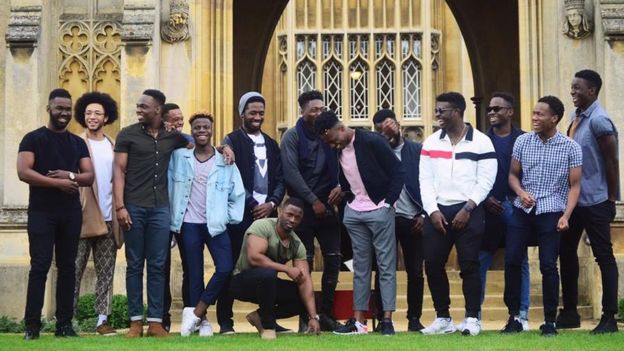
Interesting article from BBC highlighting the work of the Cambridge University African-Caribbean Society who are trying to change how Cambridge is perceived by young black men.

According to Cambridge’s own statistics, of 3,449 students accepted into Cambridge during the 2015/2016 academic year, 38 defined themselves as black, fractionally over 1%. For a highly traditional, elitist institution such as Cambridge this is a real shift in the right direction, certainly there is still much work to be done as 1% is hardly representative of the wider community. That said, many of our most famous academic institutions have always been dogged by questions of inclusion, diversity and ultimately inequality.

Here, the Cambridge University African-Caribbean are trying to change that.  A recent article, bhis was the intended message behind a photo of 14 black male students from the University that has been liked more than 2,000 times on Facebook. The group posed for several images that were shared in a bid to encourage more black students to apply to the university.

Accusations of inequality have dogged Cambridge University for many years, as they have Russell Group Universities. The high standard for entry to such prestigious institutions practically bars entry to those who’s formative years were economically or socially deprived. Statistically, those from economically or socially deprived areas are less like to do well at school and subsequently less likely to meet the high standards of a University like Cambridge. So, when such institutions brag about scholarships and bursaries for the under privileged the recipients still need to meet the university’s high entrance criteria. As such, these underprivileged students still need the support at home in order to attain the grades needed to enter Cambridge. It is statistically supported, though controversial, for me to say learners who have a stable and supportive home life achieve better than their disadvantaged peers. So, the really underprivileged learners who have challenging economic or social difficulties have, statistically, very little chance of meeting the entrance criteria for our elite institutions, let alone play polo or compete in dressage. What then are the Russell group and Oxbridge doing about this? How can they better support learners from really disadvantaged backgrounds over come that disadvantage and get in to Cambridge on talent alone, not grades and not on extra curricula pursuits.

However, there is some light at the end of the tunnel when groups such as the Cambridge University African-Caribbean can show case the positive steps taken. On the other hand, our prestigious institutions need to demonstrate that inequality is important to them by working with education providers in economically deprived parts of the country.

JD