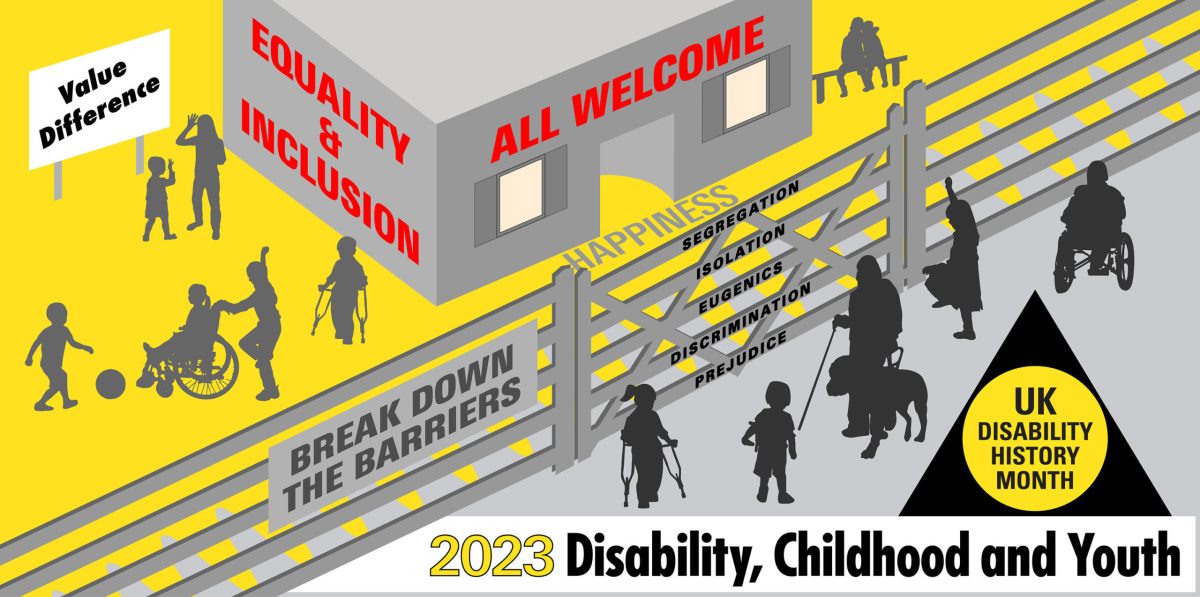
Celebrating UK Disability History Month (UKDHM)

From Thursday 16 November to Saturday 16 December 2023, we will be celebrating UK Disability History Month (UKDHM). This provides a platform for highlighting the struggle disabled people continue to face for equality and human rights.

This year’s UKDHM explores the experiences of disabled children and young people in the past, present, and future. In the UK, there are 16 million disabled people, and 11% of children are disabled. Even though 80% of adults become disabled once they reach working age, some suffer from delayed diagnoses or hidden conditions since childhood.

In recognition of Disability History Month, organisations should reflect on their policies and practices concerning disabled people. Identifying areas for improvement and developing strategies for ensuring the highest quality of care for disabled people can be done by examining the historical context. Involving disabled individuals in decision-making processes, establishing disability-friendly policies, and implementing training programs may be part of this process.

In order to ensure that all children and young people with long term impairments are not subjected to social exclusion due to stigma, stereotypes, negative attitudes, and socially created barriers in the environment and in the way things are organised, Disability History Month draws upon the Social Model/Human Rights approach.

During Disability History Month, disabled individuals are celebrated for their achievements and contributions at work. By celebrating inclusion, stereotypes can be challenged and barriers broken down, leading to a more diverse and equal society.

What can workplace leaders do to better support their disabled staff?

Employee Resource Groups

Staff Disability Networks can play a crucial role in promoting diversity and inclusion in the workplace. Discrimination and inequality in the workplace can be addressed through it as a platform for employee interaction. It is through such networks that a more inclusive and equitable work environment can be created.

Executive sponsors

Executive sponsors can play a crucial role in supporting disability inclusion in the workplace by advocating for, promoting, and implementing policies and practices that enable individuals with disabilities to thrive.

As an executive sponsor, you can have a significant impact on fostering disability inclusion in the workplace. By taking actions such as raising awareness, promoting diversity, supporting employees, and leading by example, you can create a more inclusive and equitable work environment for all employees. Remember that disability inclusion is not just the right thing to do; it is also good for business, as it attracts top talent, enhances employee engagement, and promotes innovation and productivity.

Awareness and Education

1. Educate yourself: Familiarise yourself with disability-related terminology, laws, and regulations.

2. Encourage education and training: Provide opportunities for employees to learn about disability inclusion and accommodations.

3. Promote disability awareness: Organise workshops, conferences, or events to raise awareness about disability inclusion.

Recruitment and Selection

1. Advertise inclusive opportunities: Highlight your commitment to disability inclusion in your job postings and recruitment materials.

2. Encourage diversity: Encourage recruiting managers to consider qualified individuals with disabilities for open positions.

3. Provide accommodations: Offer reasonable adjustments to applicants with disabilities during the recruitment process, such as accessible interview venues or interpreters for interviews.

Employee Support and Accommodations

1. Establish an adjustments process: Develop a formal process to request and provide reasonable workplace adjustments to employees with disabilities.

2. Promote accessible workplace: Ensure that the workplace is physically and technologically accessible, including accessible entrances, elevators, and assistive technology.

3. Provide equal access to benefits: Ensure that individuals with disabilities have equal access to employee benefits, such as training, flexible working and professional development opportunities.

Leadership and Communication

1. Lead by example: Model inclusive behaviour and actively support individuals with disabilities.

2. Include disability in diversity initiatives: Include disability in your overall diversity initiatives, such as employee resource groups or diversity training programs.

3. Actively communicate: Keep employees informed about disability inclusion efforts, policies, and progress.

Collaboration and Engagement

1. Partner with disability organisations: Collaborate with disability organisations, advocacy groups, and individuals with disabilities themselves to gain insights and best practices.

2. Empower employees: Encourage employees with disabilities to share their perspectives and actively participate in decision-making processes.

3. Recognition and rewards: Recognise the contributions of individuals with disabilities and celebrate their achievements.

Time to Act

During UKDHM, leaders should take the opportunity to work with their disabled colleagues and hold up a mirror to the organisation and ask yourself what you are doing to be more inclusive of those with a disability or long term condition.

JD

Managing neurodiversity in the workplace

According to Harvard HealthNeurodiversity refers to diversity in the human brain and cognition, for instance in sociability, learning, attention, mood, and other mental functions. It provides an inclusive view of cognitive diversity, highlighting the differences at a neuro-biological level while considering the socio-cultural contexts of a human’s lived experience.  

Employers need to be mindful as to how the business set up helps support those with different neurological conditions to create a diverse workforce. This includes:

  • · Understanding the importance of managing neurodiversity at work.
  • · Understanding how to manage neurodiversity at work, and 
  • · Being better able to support those with different neurological conditions. 

In 2021, a Harvard Health report described the idea that people experience and interact with the world around them in many different ways; there is no one “right” way of thinking, learning, and behaving, and differences are not viewed as deficits

The report explains how neurodiversity advocates encourage inclusive, non-judgmental language. While many disability advocacy organizations prefer person-first language (“a person with autism,” “a person with Down syndrome”), some research has found that the majority of the autistic community prefers identity-first language (“an autistic person”).  

Therefore, rather than making assumptions, it is best to ask directly about a person’s preferred language, and how they want to be addressed. Knowledge about neurodiversity and respectful language is also important for clinicians, so they can address the mental and physical health of people with neurodevelopmental differences. 

According to Professor Amanda Kirby, CEO of Do-it Solutions Limited and Campaigner for Neurodiversity, Neurodiversity is the way we think, move, act, communicate and process information. 

She explains, “we are all different. Some people have challenges and strengths associated with conditions such as Attention Deficit Hyperactivity Disorder (ADHD), Dyslexia, Autism, Dyscalculia, Developmental Coordination Disorder/Dyspraxia, Developmental Language Disorder. 

There is not one person or one condition that defines our differences ( or our similarities). We are too often defined by what we can’t do and not by what we can. 

The reality is that some people will gain a diagnosis of Dyslexia, for example, and others diagnosed as having Autism or ADHD. However, who gains a diagnosis often can be a bit of a lottery. It can depend on whether difficulties are identified as a child by a teacher who spots some signs of Dyslexia or Dyspraxia (also known as Developmental Coordination Disorder) or by a parent who knows something about one of these conditions.

It often requires tenacity on the part of the parent or individual and also depends on local waiting lists and service availability. For many people it can be a lengthy and at times costly process in terms of stress. Some people are paying for assessments as an alternative at a high cost. 

For most people the starting position is to understand their challenges and gain some practical strategies to help as soon as possible. By understanding their unique spiky profile, you have a starting point to help to support them to be their best. 

A person-centred approach means that strategies are tailored to EACH PERSON. It also importantly means harnessing strengths, to build confidence, self-esteem and become resilient.” 

Professor Kirby’s research produced an effective guide for employers to making different adjustments for neurodivergent people, where three elements can be easily changed. Take a look at the graphic below and consider what your organisation can do to better understand how to manage neurodiversity at work, and how to support those with different neurological conditions.

I’d love to hear where you are on your journey to becoming an neurodiverse workplace. Let me know in the comments…

Race Equality Week

February 6th marks the start of Race Equality Week. The theme for Race Equality Week 2023 is #ItsEveryonesBusiness. This theme was chosen as 79% of respondents believe it would have a meaningful impact on tackling race inequality.

Race Equality Week is an annual UK-wide movement uniting thousands of organisations and individuals to address the barriers to race equality in the workplace. The events of 2020, including the Black Lives Matter movement and the disproportionate impact of COVID-19 on ethnic minority communities, has heightened public consciousness of race inequality

Since the flurry of pledges many organisations were making back in 2020 to become more inclusive, which for many included black squares, signing charters and race action plans, progress in addressing racial inequality is proving to be a challenge.

Race Equality Matters’ survey highlighted that the majority of respondents felt very little had changed in the last 12 months. Whilst some organisations are now taking a nudge approach, which is starting to impact change. Many have struggled to know where to start.

Thanks to Sy Joshua at Race Equality First for these actions to ensure you are on top of your game when it comes to Race Equality in the Workplace: 

1. Book your team onto Anti-racism training

It’s not enough to be ‘not racist’, what is your team doing to be Anti-racist? Are you taking active steps to remove racial barriers and obstacles from the workplace.

2. Review your diversity & inclusion policy

Too many Diversity and Inclusion policies are a ‘copy & paste’ job. Does your policy contain your organisation’s DNA around EDI? If not, a full review may be overdue!

3. Encourage employee-led initiatives promoting racial equality

Empowering employees towards coproduction and including ‘lived experience,’ is a must in ‘moving the dial’ towards more inclusive spaces.

4. Ensure inclusive initiatives are outcome focused

Don’t forget to measure the impact your initiatives are having on attitudes, behaviour and workplace culture.

I’d love to hear where you are on your journey to becoming an anti-racist workplace. Let me know in the comments…

Voice, Power, Advocacy and Change – Effective Staff Networks

Staff networks provide a safe and practical space where generating and sharing new ideas, and exchanging information can be expressed in an informal environment. They also provide peer support, networking opportunities and social activities. Their activities can help to open the door to changing the culture of an organisation.

Effective staff networks are self-governed, and their terms of reference, leadership and membership arrangements are determined by their own members. However, these networks should operate with the full support of the organsaition and a framework is recommended so there is clarity, coherence and consistency of approach in the operation of all staff network groups.

Staff networks can be a powerful tool for empowering minority groups to have an effective voice in an organisation. In the context of diversity and inclusion, a minority group is a group of individuals who are known to have been discriminated against on the basis of a shared characteristic. It is worth noting that these groups may not be a minority in terms of numbers as in the case of women, who are a minority group, despite comprising over half of the UK population.

According to Advance H.E. (formally the Equality Challenge Unit), staff networks may not work in every workplace and/or for all minority groups, and their viability and success will depend on the culture and demand within individual organisations.

Networks need to be led by the staff groups that they represent. However, there is a role for institutions to facilitate and support the development of networks:

  • Involve staff and discuss the need for staff networks. This could be linked to specific times of year to maximise impact, for example discussing the possibility of a women’s network on international women’s day. A specific event gives the opportunity to discuss whether it is viable and to look for volunteers to take the network forward.
  • Provide a budget. From refreshment for meetings, to organising specific events or training and development, a budget of any size helps to ensure the network is sustainable and effective.
  • Ensure senior management are open to dialogue. Networks can provide a useful perspective on institutional practice. Consultation should be genuine and views of the network taken seriously.
  • Publicise networks to all staff. A dedicated area on your website/intranet means that all staff are aware of support and opportunities. Promote the networks during staff inductions to maximise membership and ensure all staff are able to benefit.
  • Create a culture of acceptance for participation. It can be intimidating to join a network and there can be a perception that members of networks are ‘troublemakers’.
  • Ensure line managers encourage staff to attend meetings in work hours. Senior management engagement can help to legitimise the group, and positive endorsement can underline that taking part is worthwhile.

Aims and Objectives

1. Sharing experiences and providing advice and support in a confidential safe space

Often a staff network is the opportunity staff members have to discuss the challenges they have faced at work. To meet this aim, it is likely that membership will be limited to people with the particular shared characteristic. Organisations need to carefully consider how, when and where the group will meet, and how to get a balance between giving an opportunity to share personal experiences while retaining momentum and developing positive solutions.

2. Working collectively towards improving institutional policies and practices and implementing change

Networks with this aim can be useful for their members and their institution. They can raise concerns from members, act as a consultation group for policies and practice and help to generate ideas and solutions. However, to be successful and to maintain momentum, the organisation has to listen to the network and genuinely involve them in decision making and policy review.

Terms of Reference

Networks can have a variety of terms of reference, depending on their aims and context. These may also develop over time as the group evolves. The language used in describing and naming networks can also be crucial in their success and who joins.

However you approach staff networks in your organisation it is important to remember that an effective staff network is one that is run by staff for the benefit of staff.

JD

The Business Case for Diversity

Increasingly, the term ‘Equality’ (and what used to be referred to as Equal Opportunities) is making way for discussions on ‘diversity’ as this term is much broader in its scope and gets to the heart of the integration challenges facing the UK workforce.

Over the past five decades our society has become increasingly complex and multicultural as population growth continues, subsequently becoming more diverse and with an aging population. Furthermore, changes to employment law coupled with an increase of the age at which an employee can retire and draw a pension means we now have increased competition in the workplace for fewer and fewer jobs.

As Vijay Eswaran, Executive Chairman, QI Group of Companies, explains: ‘In this era of globalization, diversity in the business environment is about more than gender, race and ethnicity. It now includes employees with diverse religious and political beliefs, education, socioeconomic backgrounds, sexual orientation, cultures and even disabilities. Companies are discovering that, by supporting and promoting a diverse and inclusive workplace, they are gaining benefits that go beyond the optics.’

In the UK, it’s common for staff, when surveyed in the workplace, to perceive diversity as being a focus on ethnicity and race whereas issues of religion, education or culture are often overlooked or misunderstood. Subsequently, diversity is actually a much broader term than a few labels and includes those other – difficult to define – human qualities that are dissimilar to our own perceptions or those of our communities but are widely prevalent in other communities. It is this fundamental difference that diversity looks to both celebrate and include alongside our own perceptions.

Vijay Eswaran argues that workplace diversity leads to greater innovation. ‘The coming together of people of different ethnicities with different experiences in cities and societies is a key driver of innovation. The food that we eat every day is a result of this blending of cultures. The most successful musical genres, such as jazz, rock’n’roll or hip-hop, are the products of cultural amalgamation.’

Whilst recent equality laws have helped to challenge discrimination and prejudice we still face equality gaps in the workplace, some larger than others. In response to the increasingly diverse needs of our communities the government have delegated a duty of responsibility – known as the Public Sector Equality Duty – on councils and their partners, including publicly funded bodes, such as the education and health care sectors, to be more accountable for ensuring everyone has an equal chance in life regardless of background or start in life.

To this end, in order to meet both government legislation as well as the diverse needs of our workforce, organisations must ensure they build an inclusive culture where diversity and equality of opportunity work hand in hand. This is referred to as the business case for diversity, an organisational wide understanding of how diversity can benefit both the business aims of the organisation and the needs of the community.

JD

Equality, Diversity & Human Rights Week 2019, 13-17 May

From 13-17 May 2019 the NHS will be celebrating the eighth Equality, Diversity and Human Rights Week #EQW2019. Co-ordinated by NHS Employers, #EQW2019 is a national platform for organisations to highlight their work to create a fairer, more inclusive NHS for patients and staff.

EQW2019

This week of activity aims to raise awareness of equality, diversity and human rights issues in the NHS and celebrate best practice. As the largest employer in Europe, with over 1.3 million staff, the NHS has a responsibility to remain at the forefront of the inclusion and fairness agenda for patients and staff.

Diverse, inclusive, together

The theme is diverse, inclusive, together and has been chosen to reflect the move across the health and social care sector towards even greater collaboration and integration – as reflected in the publication of the recent NHS Long term Plan. At the heart of the plan is changing culture, with a commitment towards ensuring respect, equality and diversity within the NHS.

Working together makes the NHS stronger, we meet standards, enable change and collectively invest in the creation of a diverse and inclusive NHS workforce to deliver a more inclusive service and improved patient care.

To celebrate the event, my organisation has a range of interactive and informative events across the week.  Throughout #EQW2019, we will have a daily equality and diversity bulletin, each examining a different aspect of equality and diversity; furthermore we have a video webinar on the importance of diversity in the workplace as well as an interactive Q&A session with the Trusts own Equality, Diversity and Inclusion Lead. 

Take a look at the informative video series from John Deffenbaugh (NHS Leadership Academy) who leads a discussion panel on the equality challenges faced by the NHS and the steps that can be undertake to overcome them, discussion 1 is shown below.

https://www.youtube.com/watch?v=5dJB4Hm3zVs

JD


Discrimination in the Workplace

Discrimination is where an individual or group of individuals are treated differently due to their perceived membership of a certain group or social category. For example, an individual or group of individuals may suffer discrimination because they are from the Travelling Community. Under the Equality Act 2010, is it unlawful to discriminate against any individual (or group) based upon any of the protected characteristics.  In the workplace, this can take many forms including, for example,  black workers not being offered the same opportunity as white workers, women being paid less than men for doing the same job but can include age, colour, convictions, height, disability, ethnicity, family status, gender identity, genetic characteristics, marital status, nationality, race, religion, sex or sexual orientation.

Direct Discrimination

Direct discrimination is where an individual is treated differently or worse than others for certain reasons, it is often easy to spot such as being refused entry to a hotel because you are gay. The Citizens Advice Bureau describes direct discrimination through the following example: ‘You’re a saleswoman and you inform your employer that you want to spend the rest of your life living as a man. As a result of this, you’re moved to a role without client contact against your wishes. This is less favourable treatment because of gender reassignment. It would still be less favourable treatment even if your employer were to increase your salary to make up for the loss of job status.’

Indirect Discrimination

However, there are other times when you appear to be treated equally and in the same way as others but it actually has a worse impact on you because of who you are. This is known as indirect discrimination where a workplace practice, policy or rule applies to all but it has a worse effect on some than others. The Citizens Advice Bureau describes indirect discrimination through the following example: ‘A health club only accepts customers who are on the electoral register. This applies to all customers in the same way. But Gypsies and Travellers are less likely to be on the electoral register and therefore they’ll find it more difficult to join. This could be indirect discrimination against Gypsies and Travellers because of the protected characteristic of race. The rule seems fair, but it has a worse effect on this particular group of people.’

Justifying Discrimination

Not all discrimination is unlawful, if an employer treats you unfairly because of who you are they might have a good enough reason but may have to justify their discrimination. The Citizens Advice Bureau describes justifying discrimination through the following example: ‘A hospital advertises a surgeon’s job for which it requires at least ten years’ experience. You can’t meet this requirement because you’ve taken time off work to care for your children. As you’re a woman, this looks like indirect discrimination because of sex. But the hospital may be able to justify this, if it can show that the job can’t be done properly without that amount of experience. This is likely to be a legitimate aim.’

JD

Political Correctness? A Tick-Box Exercise? What is Equality and Diversity?

When leading Equality, Diversity and Inclusion (EDI) in an organisation it is not unusual to face challenges and barriers to achieving your targets from a common misconception as to what equality and diversity is all about. First and foremost, equality, diversity and inclusion is about people and not a ‘tick box’ exercise to satisfy government/employer statistics or legislation.

Perhaps the most common misconception reported by equality and diversity trainers is that EDI is often said – behind closed doors of course – to be ‘just political correctness’ or sometimes ‘political correctness gone mad’. Political correctness can be defined as ‘the avoidance of forms of expression or action that are perceived to exclude, marginalize, or insult groups of people who are socially disadvantaged or discriminated against’. It is often the term ‘forms of expression’ from definitions such as this which some interpret to mean jokes or work place banter. However, where someone is offended by your words it is not open to your interpretation it is open to theirs, as such if your opinion, jokes or workplace banter offends people then it is time keep such options, jokes or work place banter out of the workplace. To those who question whether equality and diversity is merely ‘political correctness gone mad’ I would ask the question whether it is acceptable for woman to be paid less than men for the same job, for part time staff or shift workers to have less opportunities in training, for the LGBTQ+ community to face harassment at work or for those from a minority to be excluded from jobs because of a different place of birth?  Sometimes, EDI needs to focus the minds of those not affected to understand how a lack of EDI impacts those who are affected and demonstrate how they can help bring fairness to their workplace.

However, even when supported, EDI can still be viewed by some in the workplace as ‘box to tick’ exercise or just another thing on a long list of other things that they are required to do by government. This fundamental lack of understanding as to the need for EDI practices often leads to a misunderstanding of intended actions and their outcomes which in its self often leads to a compartmentalised, tick-box approach. Nevertheless, what we are talking about here is implementing good EDI practice across an organisation rather enforcing a legal obligation on the workforce. It is this perception of enforced legislation that increases the risk of compartmentalisation and a tick-box approach. As such, it is this false perception of equality, diversity and inclusion that needs removing and this is where effective communication, workforce training and raising the profile of EDI can have a positive impact on its acceptance.

Hence, improving the understanding of EDI becomes about the message and vision set out by senior leaders. Essentially, EDI is about people and it focuses on treating all people fairly and ensuring there is equality of opportunity across the workforce. Naturally, isn’t this something we should all get on-board with? Unquestionably, fairness and equality of opportunity should be a priority for every organisation. As a result, the message needs to be very clear that EDI impacts on us all whether we be employees, employers, customers or other stakeholders including the communities we serve. For these reasons, we can see why good EDI practices must be embedded in all that we do.

JD

The Equality Act 2010 – The Protected Characteristics

Through the ‘Protected Characteristics’ the Equality Act 2010 ensures that it is unlawful to discriminate against someone because of any of these characteristics which are defined by the University of Sheffield as:

  1. Age – The Act protects people of all ages. However, different treatment because of age is not unlawful direct or indirect discrimination if you can justify it (for example if you can demonstrate that it is a proportionate means of meeting a legitimate aim). Age is the only protected characteristic that allows employers to justify direct discrimination.
  2. Disability – The Act has made it easier for a person to show that they are disabled and protected from disability discrimination. Under the Act, a person is disabled if they have a physical or mental impairment which has a substantial and long term adverse effect on their ability to carry out normal day-to-day activities, which would include things like using a telephone, reading a book or using public transport.
  3. Gender reassignment – The Act provides protection for transsexual people. A transsexual person is someone who proposes to, starts or has completed a process to change his or her gender. The Act no longer requires a person to be under medical supervision to be protected– so a woman who decides to live as a man but does not undergo any medical procedures would be covered.
  4. Marriage and civil partnership – The Act protects employees who are married or in a civil partnership against discrimination. Single people are not protected.
  5. Pregnancy and maternity – A woman is protected against discrimination on the grounds of pregnancy and maternity during the period of her pregnancy and any statutory maternity leave to which she is entitled. During this period, pregnancy and maternity discrimination cannot be treated as sex discrimination. You must not take into account an employee´s period of absence due to pregnancy-related illness when making a decision about her employment.
  6. Race – For the purposes of the Act `race´ includes colour, nationality and ethnic or national origins.
  7. Religion or belief – In the Equality Act, religion includes any religion. It also includes no religion, in other words employees or jobseekers are protected if they do not follow a certain religion or have no religion at all. Additionally, a religion must have a clear structure and belief system.
  8. Sex – Both men and women are protected under the Act.
  9. Sexual orientation – The Act protects bisexual, gay, heterosexual and lesbian people.

JD

The Equality Act 2010 – An Introduction

The Equality Act 2010 came into force on 1st October 2010 and was introduced to bring together a complex set of overlapping legislation into one simplified and harmonious Act. This new Act brought together previous legislation including the Equal Pay Act 1970, the Sex Discrimination Act 1975, the Race Relations Act 1976, the Disability Discrimination Act 1995 and additional delegated legislation which prevented discrimination in employment on the basis of religion, belief, sexual orientation and age.

Whilst in general the Act covers employment and strengthens laws to give greater protection to employees from discrimination it does also cover some aspects of discrimination outside of employment. Most significantly, the Equality Act 2010 sets out a requirement for employers to assure equal treatment in access to employment as well as private and public services, regardless of the individuals ‘protected characteristics’, which are listed below.

  • Age
  • Disability
  • Gender Reassignment
  • Marriage and Civil Partnership
  • Pregnancy and Maternity
  • Race
  • Religion or Belief
  • Sex
  • Sexual orientation

These ‘protected characteristics’ represent a defining guide to safeguard employees from unfair treatment or discrimination but in the case of disability, employers and service providers are under a duty to make reasonable adjustments to their workplaces to overcome barriers experienced by disabled people.

Through the Equality Act 2010 employees are explicitly protected from discrimination and bias as well as bullying or harassment in the workplace. Consequently, employers must be mindful of how their procedures, policies and practices impact on their employees and where necessary review accordingly.

In order for an organisation to ensure it is meeting the requirements of the Act it is highly recommended, but not legally required, that an equality & diversity policy is in place, especially for larger organisations. In fact, for larger organisation, the publishing of an equality & diversity policy on the company website will demonstrate that the organisation is meeting its legal and moral obligations towards being a diverse employer. Furthermore, by having the policy in place and publically available it can contribute towards making its employees more comfortable and encourage everyone in the organisation to treat others equally.

JD