
Employers should work harder to engage LGBT+ allies, say experts

I wanted to share a recent article by Emily Burt, from People Management, who attended the Stonewall Workplace Conference, 26 April 2019, in which she discusses the need to engage LGBT+ allies in the workplace. The article is both thought-provoking and relevant during Pride Month, particularity if you work in HR or are engaged in improving workplace equality and diversity. What is made abundantly clear by the conference speakers is the need for further support to improve LGBT+ inclusion in the work place and often people are not looking in the right place.

Stonewall conference urges better communication, with 35 per cent of LGBT staff having hidden their sexuality at work
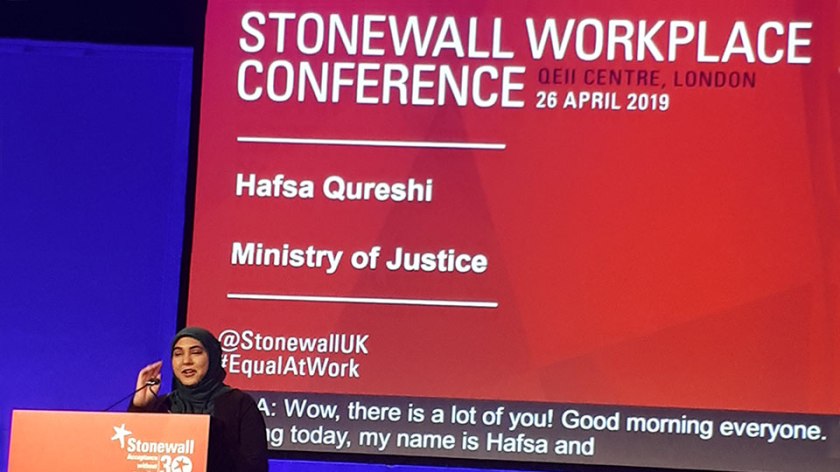
Organisations must work to encourage, support and empower their LGBT+ members of staff and recognise the business case for inclusive cultures in order to drive genuinely diverse workplaces, experts have told delegates at the 2019 Stonewall Workplace Conference.

stonewall2_tcm27-57012_w1228_n

Hafsa Qureshi (pictured), recruitment specialist at the Ministry of Justice and Stonewall’s bisexual role model of the year, said engaging people who do not identify as LGBT with the challenges faced by the community was an important part of creating inclusivity at work.

Speaking to People Management, Qureshi said: “One of the biggest hurdles is reaching people who don’t identify as LGBT to be allies. Too often, people assume that because someone is not from a visible protected characteristic, they don’t have any issues at work.”

Qureshi added that it was imperative for LGBT allies to promote inclusive cultures at every level of a business.

“Having worked with smaller and larger organisations, the ones that struggle with diversity and inclusion often do so because they fail to communicate it beyond management level,” she warned.

“The culture stops before reaching the employees who have face-to-face interactions with customers or clients.”

More than 1,000 people attended the opening session of the conference, with the theme ‘Equal At Work’, where CEO Ruth Hunt delivered her final keynote ahead of departing from her role at the charity later this year.

“We sometimes forget that it wasn’t that long ago that being LGBT meant you could be fired from work or denied service because of who you are,” she said, adding: “While it’s important to celebrate how far we’ve come, we cannot be complacent.”

A 2018 survey from the charity found almost one in five LGBT staff (18 per cent) were the target of negative comments or conduct from work colleagues because of their sexuality. More than a third (35 per cent) had hidden or disguised the fact they were LGBT at work for fear of discrimination.

The community has also faced a series of rows on an international scale over the last 12 months, including President Trump’s policy to prohibit some transgender people from serving in the US military, and schools in Birmingham dropping classes that include discussion of LGBT relationships following protests from parents.

In a speech to conference delegates, Penny Mordaunt, Minister for Women and Equalities, reaffirmed the government’s commitment to LGBT-inclusive workplaces, stating: “Organisations cannot afford to exclude talented people, or to limit their potential.”

She said the Government and Equalities office (GEO) would continue to provide targeted interventions seeking to improve the experiences of LGBT people at work and announced that the GEO would coordinate a series of events to gather employer views, and share expertise and experiences this coming autumn.

Mordaunt acknowledged the GEO was asking HR departments to commit to a number of significant initiatives – including gender pay reporting and the Race at Work charter – which were “not remotely joined up or coordinated”.

But she added: “In order to build the businesses of tomorrow, we need workforces that are able to authentically be themselves.”

Speaking to delegates, Qureshi concluded: “Sometimes, all it takes is one person to step forward in order to make a workplace culture feel more accepting.

“I encourage you all to use your voices and platforms to raise awareness for your LGBTQ community. Your voice is more important than you know – and you may say something that a person like me has waited their whole life to hear.”

JD

Political Correctness? A Tick-Box Exercise? What is Equality and Diversity?

When leading Equality, Diversity and Inclusion (EDI) in an organisation it is not unusual to face challenges and barriers to achieving your targets from a common misconception as to what equality and diversity is all about. First and foremost, equality, diversity and inclusion is about people and not a ‘tick box’ exercise to satisfy government/employer statistics or legislation.

Perhaps the most common misconception reported by equality and diversity trainers is that EDI is often said – behind closed doors of course – to be ‘just political correctness’ or sometimes ‘political correctness gone mad’. Political correctness can be defined as ‘the avoidance of forms of expression or action that are perceived to exclude, marginalize, or insult groups of people who are socially disadvantaged or discriminated against’. It is often the term ‘forms of expression’ from definitions such as this which some interpret to mean jokes or work place banter. However, where someone is offended by your words it is not open to your interpretation it is open to theirs, as such if your opinion, jokes or workplace banter offends people then it is time keep such options, jokes or work place banter out of the workplace. To those who question whether equality and diversity is merely ‘political correctness gone mad’ I would ask the question whether it is acceptable for woman to be paid less than men for the same job, for part time staff or shift workers to have less opportunities in training, for the LGBTQ+ community to face harassment at work or for those from a minority to be excluded from jobs because of a different place of birth?  Sometimes, EDI needs to focus the minds of those not affected to understand how a lack of EDI impacts those who are affected and demonstrate how they can help bring fairness to their workplace.

However, even when supported, EDI can still be viewed by some in the workplace as ‘box to tick’ exercise or just another thing on a long list of other things that they are required to do by government. This fundamental lack of understanding as to the need for EDI practices often leads to a misunderstanding of intended actions and their outcomes which in its self often leads to a compartmentalised, tick-box approach. Nevertheless, what we are talking about here is implementing good EDI practice across an organisation rather enforcing a legal obligation on the workforce. It is this perception of enforced legislation that increases the risk of compartmentalisation and a tick-box approach. As such, it is this false perception of equality, diversity and inclusion that needs removing and this is where effective communication, workforce training and raising the profile of EDI can have a positive impact on its acceptance.

Hence, improving the understanding of EDI becomes about the message and vision set out by senior leaders. Essentially, EDI is about people and it focuses on treating all people fairly and ensuring there is equality of opportunity across the workforce. Naturally, isn’t this something we should all get on-board with? Unquestionably, fairness and equality of opportunity should be a priority for every organisation. As a result, the message needs to be very clear that EDI impacts on us all whether we be employees, employers, customers or other stakeholders including the communities we serve. For these reasons, we can see why good EDI practices must be embedded in all that we do.

JD

The Equality Act 2010 – The Protected Characteristics

Through the ‘Protected Characteristics’ the Equality Act 2010 ensures that it is unlawful to discriminate against someone because of any of these characteristics which are defined by the University of Sheffield as:

  1. Age – The Act protects people of all ages. However, different treatment because of age is not unlawful direct or indirect discrimination if you can justify it (for example if you can demonstrate that it is a proportionate means of meeting a legitimate aim). Age is the only protected characteristic that allows employers to justify direct discrimination.
  2. Disability – The Act has made it easier for a person to show that they are disabled and protected from disability discrimination. Under the Act, a person is disabled if they have a physical or mental impairment which has a substantial and long term adverse effect on their ability to carry out normal day-to-day activities, which would include things like using a telephone, reading a book or using public transport.
  3. Gender reassignment – The Act provides protection for transsexual people. A transsexual person is someone who proposes to, starts or has completed a process to change his or her gender. The Act no longer requires a person to be under medical supervision to be protected– so a woman who decides to live as a man but does not undergo any medical procedures would be covered.
  4. Marriage and civil partnership – The Act protects employees who are married or in a civil partnership against discrimination. Single people are not protected.
  5. Pregnancy and maternity – A woman is protected against discrimination on the grounds of pregnancy and maternity during the period of her pregnancy and any statutory maternity leave to which she is entitled. During this period, pregnancy and maternity discrimination cannot be treated as sex discrimination. You must not take into account an employee´s period of absence due to pregnancy-related illness when making a decision about her employment.
  6. Race – For the purposes of the Act `race´ includes colour, nationality and ethnic or national origins.
  7. Religion or belief – In the Equality Act, religion includes any religion. It also includes no religion, in other words employees or jobseekers are protected if they do not follow a certain religion or have no religion at all. Additionally, a religion must have a clear structure and belief system.
  8. Sex – Both men and women are protected under the Act.
  9. Sexual orientation – The Act protects bisexual, gay, heterosexual and lesbian people.

JD

Equality and Diversity in the Workforce

Increasingly, the term ‘Equal Opportunities’ is making way for discussions on ‘Diversity’ as this term is much broader in its scope and gets to the heart of the integration challenges the country faces.

Over the past five decades our society has become increasingly complex and diverse. The UK population is growing rapidly and subsequently becoming more diverse and with an aging population. Changes to immigration laws and better health care are contributing factors to the changing makeup of Great Britain and our subsequent workforce.

When asked, staff often perceive diversity as being a focus on ethnicity and race whereas issues of gender equality are often overlooked or misunderstood. Subsequently, diversity is actually a much broader term than a few labels and includes those other – difficult to define – human qualities that are dissimilar to our own perceptions or those of our communities but are widely prevalent in other communities. It is this fundamental difference that Diversity looks to both celebrate and accept alongside our own perceptions.

Whilst recent equality laws have helped to challenge discrimination and prejudice we still face equality gaps in the workplace, some larger than others. In response to the increasingly diverse needs of our communities the government have delegated a duty of responsibility on councils and their partners, including publicly funded bodes, such as the education and health care sectors, to be more accountable for ensuring everyone has an equal chance in life regardless of background.

To this end, in order to meet both government legislation and the diverse needs of our workforce, organisations need to ensure they build an inclusive culture where diversity is celebrated and everyone has equal opportunity. That said, this is clearly easier said than done, so here are six values that can help an organisations better promote a culture of equality and diversity.

  1. Value Feedback – Seek regular opportunities for staff feedback to impact on organisational practices and change behaviours.
  2. Value Experience – Create an inclusive culture by including staff in both strategic and operational planning ensuring they have equal access to opportunities to enable staff to fully participate.
  3. Value Fairness – equality comes when staff are confident their employer’s policies, procedures and practices are fair to all and don’t discriminate.
  4. Value Development – enable all staff to develop to their full potential though equal opportunities for training, empowerment and progression.
  5. Value Planning – make certain that staff resources do not discriminate against any individuals, groups or reinforce negative stereotypes.
  6. Value Collaboration – through effective training equip all staff with the skills to challenge inequality and discrimination in their workplace.

JD

Grammar schools given £50m diversity cash have only 2% poor pupils

The Governments drive to demonstrate its commitment to diversity in our schools has rather lost its way in recent years. For example, 16 grammar schools have won a share of a £50 Million expansion fund and yet, according to an analysis by the House of Commons Library, they have some of the worst records of admitting disadvantaged pupils.

The schools in receipt of the extra funding were announced last week and in order to qualify for the additional funding they had to submit a plan that would demonstrate how they would increase the proportion of poorer pupils in their schools. It’s worth remembering that grammar schools are not supposed to be for the privileged only, the private education sector is there to cater for those privileged enough to be able to pay for their children’s education.

However, figures on the schools’ admission of poor children has cast doubt on whether they were as committed to diversifying their intake as they claimed. These figures demonstrated that, on average, only 2% of pupils at the 16 approved schools were eligible for free school meals, which is generally considered the measure of child poverty in schools. For balance, it’s worth noting that, on average, pupils claiming free school meals at all schools in England is around 15%, with annual variations around this figure.

So, how do we tackle the lack of diversity in our grammar schools? Do we allow them to continue to be elitist institutions where entry is based on privilege rather than ability? To those who would argue that grammar schools have an entrance test and so are selective only on ability and not financial circumstances I would ask in that case how do you defend the position that only 2% of pupils in these schools come from a poor background? Is there a suggestion that poor pupils are not bright, are not academic, or not capable of learning at a grammar school level? Or, is this further evidence that the entry system to some of our grammar schools is flawed and based, in some cases, more on privilege that we like to admit?

If we are to ensure that our schooling system, both grammar schools and the academies, are to meet the needs of future generations then we need to ensure that school pupils experience diversity from a young age so they are adequately prepared for the work force of the future.

If we continue to endorse an elitist grammar system, where only the privileged can attended, then we further perpetuate the problems that we currently have in our society. As such, rather than challenge issues of inclusion, ignorance, acceptance and tolerance we naively allow the problems to carry on for a future generation to resolve.

What are your thoughts on this? Should grammar schools be forced to increase diversity in their ranks or should the grammar school system continue to be a stronghold of the well off in society? Answers on a postcard….

JD

Teacher recruitment a ‘significant challenge’, say MPs

According to MP’s ‘Encouraging teachers in England to stay in the profession will “remain a significant challenge” for the coming years, a committee of MPs stresses.’

Wow, does it really take. a select committee to highlight that issue? The article goes on to highlight that ‘The Education Select Committee says the next government will have to ensure recruitment targets are improved.’ Really!? To anyone who has worked in the primary or secondary sector in recent years then this is not really news, the crisis in teacher recruitment has been an issue for a considerable period of time. The previous government failed to improve teacher numbers and still a large number of those who join leave the professsion due to work load.

The article goes on to state ‘The government says it is committed to addressing the challenges schools face.’ Again, really!? We have had successive Conservative governments and they have utterly failed to address this problem.

In reality, this is an example of government stating the obvious and having no history of addressing this problem. In education, we would have an action plan to address the problem and then highlight its impact in 2 weeks, 4 weeks, 6 weeks… etc. Yet, the government just get to reinvent themselves with every election, despite failure to evidence what impact they have made.

The article can be found here – Teacher recruitment a ‘significant challenge’, say MPs

JD