Too many firsts risk universities’ credibility, says think tank

Interesting article here from the BBC regarding grade inflation at UK Universities and Reform’s recommendations on how to tackle it.

The report is fascinating for several reasons, firstly, Universities are under increasing pressure with the Teaching Excellence Framework (TEF) to award ‘good’ degrees and have high levels of students satisfaction. Well, fundamentally, the concern with that is students will be very satisfied if they get a ‘good degree’ and those who get a third or a 2:2 might well be unsatisfied, especially as many higher education students have a perception that they are buying a degree for £30, 000. Furthermore, anyone who has studied marketing or customer service will tell you that an unsatisfied customer is more like to be vocal bout that than a satisfied customer, satisfaction becomes the expectation not the extraordinary. Hence, unsatisfied students will vocalise their unhappiness in students surveys.

Secondly, the report states that ‘since 1995 the proportion of 2:1 degrees rose from 40% to 49%’, which in its self is not a shocking rise, but has anyone pointed out that number of students accessing higher education since the mid nineties has more than doubled. However, for me, the really stand out statistic is that ‘in more than 50 universities the proportion of first class degrees has doubled since 2010’.

Universities have always been the guardians of their own standards. However, with increased importance being put on student outcomes has the pressure of students satisfaction been a factor in grade inflation? Previously, if  University staff wanted to move up the pay scales then they focused on research which brought in money and prestige to the university. Now, that focus is rapidly shifting towards the learner or as University staff are now learning – the customer. Higher education staff across the country are currently being asked about their non-continuation rates, retention, attendance and the number of ‘good’ degrees they get. This is more like the further education sector, at this rate universities will be adopting performance management processes in line with schools and colleges.

If, as the report recommends, the government step into ensure only the top 10% get a first class degree this will throw a spot light on the actual quality of teaching and learning that goes on in our higher education classrooms. That in itself can’t be a bad thing as Universities have been the custodians of this for a very long time, whereas in  schools and the further education sector OFSTED have had the final say on matters of teaching, learning and assessment.

The Office for Students may have some impact on this, however, their preferred quality inspection partner, the QAA, don’t observe teaching and learning during inspection… instead they look at data and if student satisfaction is high and the number of ‘good degrees’ are high then the quality of teaching and learning is ‘assumed’ to be good or better.

So, when your inspection regime exclusively fits around students satisfaction and the number of ‘good degrees’ awarded by an institution is anyone really surprised that Universities will do what ever it takes to make sure they have satisfied learners with good degrees? Interestingly, the report does not comment of ‘satisfaction inflation’. I wonder what the percentage increase since 2010 is on student satisfaction, I suspect that has likely increased in line with grade inflation as well.

However, that said, if the Government intervene and follows Reform’s suggestions whereby ‘the top 10% of students would receive a first, the next 40% a 2:1, and the 40% after that a 2:2. The bottom 10% would get a third.’ Then it will mean one year 70% is enough to be awarded a first class degree and another year it will not, which leads us to a point where gaining a first class degree is more about what year you join a programme, or more importantly an accident of birth. When you were born will determine if you can gain a first class degree, regardless of ability. Where is the equality in that system? It’s called a bell curve, where the top 10% get awarded the highest grades but that boundary changes with each cohort that takes the exam and has been criticised in GCSE’s for many years.

Don’t get me wrong. I want to see a degree as a highly valued qualification and a first even more so. A degree awarded at one institution should be comparable to a degree awarded another institution, regardless of the designer label that comes with some of our more prestigious higher education institutions. However, is artificially restricting the grade a students can achieve the right idea?

Take a look through the article below, I would be very interested in peoples thoughts on how the government should progress with this.

https://www.bbc.co.uk/news/education-4454832

JD


Why is Hinds suddenly letting teachers ‘get on with the job’?

Interesting article here from tes.com. Whilst the academisation of our school system was heralded as giving heads more autonomy over how their school were run it has ended up with greater centralised control, especially when you introduce multi-academy trusts. As such, the education secretary’s recent announcement of the dramatic changes to school accountability is made all the more interesting… are Whitehall admitting defeat, such is the complete change in direction of recent policy.  What do we think of Damian Hinds proposals?

https://www.tes.com/news/long-read-why-hinds-suddenly-letting-teachers-get-job

Arts education is a postcode lottery. Britain must invest for post-Brexit theatre.

Great commentary here from Nicholas Hytner, Arts correspondent for the Guardian.

Arts education is disappearing from our state funded schools in favour of STEM subjects. Admittedly, STEM subjects are vital for jobs and will further support the British manufacturing industries which in turn will contribute to the Governments strategy to improve Britain’s Industrial capabilities. However, by leaving arts education almost exclusively to private schools we run the risk of the arts becoming an elitist activity. Already, we see almost all of our Oscar nominated actors having come from a privileged, privately educated background. If art is to thrive in this country then it must not just come from a place of privilege otherwise it will not become a representative form and will lose touch with the very people it is designed to connect with.

The arts in Britain should be cherished, they are highly regarded across the world and its a large export industry… certainly they are worth investing in. After all, for the most part our free time is spent consuming the products of a wide range of artists, whether that be music, film, television, theatre, dance, gaming, reading or contributing to its creation… we all use the arts in one way or another.

https://www.theguardian.com/commentisfree/2017/jun/05/post-brexit-britain-need-theatre-public-investment-creative-economy

JD


Why do schools have a massive pay gap?

Interesting article here by

As someone who worked in secondary school management for almost a decade I find it astonishing that a gender pay gap still exists. After all, pay scales are well published for teachers, managers and leaders across the education sector. However, in all reality, negotiation of your own personal pay scale is a private conversation between employer and employee. If you are headhunted then a better offer is likely to be on the table than if you fill out an application form. I agree that if two people start the same role, with equal skills and experience then they should be paid the same but what if one candidate has more experience? Should that count towards pay? Of course it should and unfortunately the reality is that staff, both male and female, need to be confident that that they are in demand and in that way some negotiation over pay can happen.

That said employers must become more transparent in how they pay their staff and better able to justify those differences in scales to ensure equality and fairness across the sector.

http://www.bbc.co.uk/news/uk-politics-43484831

JD

Universities and independent schools to run poorly performing state schools? The Conservatives have got it wrong on education again.

What on earth do universities and independent schools know about running state funded education?

One of the Conservatives key manifesto polices on education is to “ask universities and independent schools to help run state schools”. As a former state school teacher myself, and as someone who currently works in the further and higher education sector, I have to ask one question… what on earth do universities and independent schools know about running state funded education?

For a start, I can tell you they have never experienced an inspection regime like Ofsted and this will not change with university or independent school leadership, this is how state funded schools are judged. It’s a cut throat business, school and academy Principals come and go based upon the Ofsted rating they get their school, sometimes they don’t get very much time to prove themselves. Then there is the suggestion that Universities can help, however they are inspected by the Quality Assurance Agency for Higher Education (QAA) which is a desk based inspection where they look at policies and paperwork. Independent schools are inspected by the Independent Schools Inspectorate (ISI) which is again a soft touch process when compared to the rigger of Ofsted. Neither QAA nor ISI reflect the hard process that is a full Ofsted inspection that can make or break a senior management team. Remember, leaders lose their jobs over poor Ofsted outcomes.

The differences in these inspection methodologies can be explained in the following analogy. Ofsted would physically check to see if a fire door works, to check if your learners are safe in the event of a fire, if that door does not open (it happens!) then the school would get an inadequate grade for safeguarding and fail the inspection. Whereas the QAA or ISI would simply ask, from an office, if you had a policy on fire door usage but not actually test the fire door itself.

Furthermore, independent schools, by their very nature, have students who come from supportive homes, if someone pays £8000 a year for schooling then they care about what it’s being spent on. In fact, in order to pay £8000 per year tuition fees parents need to have a good job for such a high disposable income. However, contrast that with a state funded school in a deprived postcode where parents don’t work, parent’s evenings have a turnout of 35% or less. Where children turn up having not had breakfast, every day. Where children look after brothers and sisters because parents are incapable through drink and drugs. Where children are victims and at risk, every day. Where they come to school just for the free hot meal as they don’t get one at home. This is modern Britain and this happens in deprived postcodes across the country, don’t kid yourself that it doesn’t.

So my question to the government is… how many independent schools (and universities) do they think have ever faced children with these challenges? Private schools throw money at problems and this Conservative government have reduced school budgets relentlessly, so where will the money come from. Independent schools make a profit, state funded schools do not. Yet, the government are asking for their help in running states funded schools… good luck. How can a private school in an affluent part of the country run a school in a deprived part of the inner city where gang culture rules, or deprivation is so high families have not worked in generations? What do they bring to the party?

The vast majority of this current Conservative government are amongst the 7% of the country who attended private school. As such, what do they know about the problems facing schools in deprived areas?  The people making policy have never experienced poverty, never lived in a deprived area and have never seen the challenges faced by some of our poorest children. In fact, most of the Conservative government come from privilege and that’s who they want to trust our schools to. People who don’t understand the challenges faced by the very learners they will be working for.

On a final point, in my experience as an educator, when I have spoken to independent school teachers and leaders I don’t  think they would survive in the cut throat business of state funded schooling and its inspection regime. I am not suggesting that they are not very capable educators and professionals but independent school heads last for years, decades in many cases, whereas in state schools they are like football managers and don’t last more than a few years before moving on, or being moved on.

University and independent schooling clearly has its place but what they know about the challenges faced by some of the poorest children in this country could be written on the pack of a postage stamp and I say that with every respect. The children they will have to work with do not attend university and do not attend independent schools because of massive economic or social inequalities. It’s is the polar opposite of what universities and independent schools are used to.

It’s about time the government listened to the teaching profession rather than their friends in high places.

JD

Conservative government will stop free hot lunches for all infant pupils causing further inequality

For the Conservative government to make a manifesto promise to rescind the policy where by all infants get free hot lunches is contributing to further inequality.

For some school children in this country the free hot meal they get at school is the only hot meal they get that day. Far too many children in this country dread the summer holidays because a hot meal is, at best, sporadic and in some cases none existent. That is the inequality in our country, that not all children get a hot meal each and every day. So for the Conservative government to make a manifesto promise to rescind the policy where by all infants get free hot lunches is contributing to further inequality. Yet again, the hardest hit will again be the poorest and most vulnerable in our society.

In his analysis of today’s Conservative manifesto release, Sean Coughlan, Education Correspondent for BBC News, highlights “Head teachers across England have been making increasingly strident protests about schools running out of cash.” But, to stave of this criticism the Conservatives have responded by reshuffling about £1bn a year extra into the day-to-day running budgets of schools. However, it would appear that “most of this would come from stopping free hot lunches for all infant pupils – a policy only launched a few years ago.”

In reality, will schools use this money to continue to offer free hot lunches for all infants?In that case there is no benefit for school whatsoever, so no investment and they will continue to struggle. On the other hand if they use it for other purposes then the children loose out. I don’t imagine head teachers will see this as an acceptable alternative to real, hard investment.

JD

Privilege and inequality – a question for my Member of Parliament

I don’t think the governments perception of under privilege is necessarily the same as that of the under privileged themselves. Certainly, the majority of our Education Secretaries over the past three decades had a private education, so in the main they came from privilege.

How many students from really challenging backgrounds get into our elite institutions? In short, not many… but that’s nothing new. However, more often than not, these institutions will highlight their scholarship and bursary schemes, designed for the under privileged, as an answer to questions of inequality.

But, what is under privileged? Who is defining what is and what is not under privileged?  I don’t think the governments perception of under privilege is necessarily the same as that of the under privileged themselves. Certainly, the majority of our Education Secretaries over the past three decades had a private education, so in the main they came from privilege.

Privilege is usually associated with extreme financial wealth and the range of opportunities exclusively available to privileged people. But privilege for some is what others would call the norm, the ‘nothing to write home about’. For some members of our community a stable upbringing, a loving and supportive family, friends, food on the table, schooling and a feeling of self-worth are privilege. Privilege is no longer just about mobile phones, money, cars, homes, holidays and clothes… it’s about opportunity or the lack of it. Too many of our children live in homes without this privilege. Some don’t call this privilege some call it basic needs, either way it impacts massively on their future opportunities.

How can a bright and capable student who comes from a background without these basic needs meet the entrance requirements for an elite institution when they are 18 years old? It’s hard enough to gain the entrance requirements for Cambridge, for example, when you come from a well-supported, loving family who are right behind you and provide you with every encouragement. What if your home life is not so ‘picture post card’ perfect? You can’t get a bursary or scholarship if you don’t get the grades. So again, the very people who truly need the support to reach the top… can’t get access to it.

To my mind, this says very clearly… if you want to get access to an elite institution in the UK then you need to come from a good home, if you don’t it’s not going to happen.

So, my question to government is, what are we doing for those young people who are bright and capable but don’t come from perfect homes? How can we help them over come being born into challenging circumstances and navigate our elitist culture?

I would urge you to contact your local MP, or as we approach a general election your prospective party candidates, and ask the question – what will you do for our young people, born into economic and social hardship, to ensure they have equal opportunity for success in a post Brexit Britain?

JD

Do faith schools harm integration?

Writer and broadcaster Afua Hirsch argues faith schools lead to segregation.

Writer and broadcaster Afua Hirsch argues faith schools lead to segregation. Her compelling, if potentially polarizing, video can be viewed here.  Her commentary on the subject is below but I am interested in what readers think about this. Certainly, on face value it feels like state sponsored segregation which leads to further to inequality in our communities. 

“Britain has a problem with integration, all political parties agree. But, instead of serious long term policies the response has been confined to contrived and often patronising measures.  Ethnic minority and immigrant communities are lectured about British values and we might all have to start swearing an oath of allegiance.

The glaring hypocrisy of our integration agenda is that our most important public institutions actively encourage segregation.  Faith schools make up one third of all schools in Britain. Our government is proposing that they have even more power to discriminate by selecting more of their places based on religious belief.  Public funds are being used to separate children by faith.

What could be more damaging to integration?

Faith schools are also segregating children by class. A quarter of faith primary schools have fewer disadvantaged students than those of no faith. Faith schools are the antithesis of a secular society but have never been so popular. Some parents are strategically using religious identities as a proxy for ethnicity, deliberately educating their children with others from a similar background. But the main reason for the popularity of faith schools is that many outperform other state schools in academic results.

We would never accept this kind of segregation in any other public service. Why is it acceptable in schools? We need to be honest about the role of faith and education in an integrated society and keep the two separate.” 

Afua Hirsh

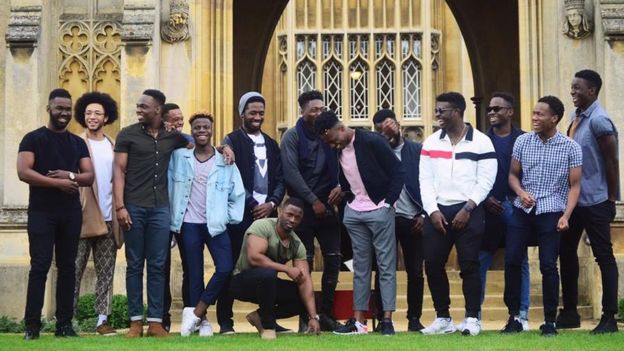
Young black men don’t grow up thinking they’ll make it {at Cambridge}. They should.

Interesting article from BBC highlighting the work of the Cambridge University African-Caribbean Society who are trying to change how Cambridge is perceived by young black men.

According to Cambridge’s own statistics, of 3,449 students accepted into Cambridge during the 2015/2016 academic year, 38 defined themselves as black, fractionally over 1%. For a highly traditional, elitist institution such as Cambridge this is a real shift in the right direction, certainly there is still much work to be done as 1% is hardly representative of the wider community. That said, many of our most famous academic institutions have always been dogged by questions of inclusion, diversity and ultimately inequality.

Here, the Cambridge University African-Caribbean are trying to change that.  A recent article, bhis was the intended message behind a photo of 14 black male students from the University that has been liked more than 2,000 times on Facebook. The group posed for several images that were shared in a bid to encourage more black students to apply to the university.

Accusations of inequality have dogged Cambridge University for many years, as they have Russell Group Universities. The high standard for entry to such prestigious institutions practically bars entry to those who’s formative years were economically or socially deprived. Statistically, those from economically or socially deprived areas are less like to do well at school and subsequently less likely to meet the high standards of a University like Cambridge. So, when such institutions brag about scholarships and bursaries for the under privileged the recipients still need to meet the university’s high entrance criteria. As such, these underprivileged students still need the support at home in order to attain the grades needed to enter Cambridge. It is statistically supported, though controversial, for me to say learners who have a stable and supportive home life achieve better than their disadvantaged peers. So, the really underprivileged learners who have challenging economic or social difficulties have, statistically, very little chance of meeting the entrance criteria for our elite institutions, let alone play polo or compete in dressage. What then are the Russell group and Oxbridge doing about this? How can they better support learners from really disadvantaged backgrounds over come that disadvantage and get in to Cambridge on talent alone, not grades and not on extra curricula pursuits.

However, there is some light at the end of the tunnel when groups such as the Cambridge University African-Caribbean can show case the positive steps taken. On the other hand, our prestigious institutions need to demonstrate that inequality is important to them by working with education providers in economically deprived parts of the country.

JD

How much you achieve in life should not be determined by how much your parents earn – Teach First.

When battling inequality in the classroom any offer of support is greatly received. However, as an experienced secondary teacher I must take umbrage with Teach First. Whilst the concept is a great idea, it is basically flawed because of ambition.

Teach First claim ‘Each year, a new group of participants joins us and our university partners for six weeks of intensive training before teaching in one of our partner schools for at least two years while completing our Leadership Development Programme. Their training and their passion for educational equality means that they are dedicated to raising the aspirations of the young people in their classrooms.’

That is a great sentiment… really it is and I say it with out a hint of sarcasm. However, when Teach First trainees are delivered to a school with a first class degree and six week training under their belt they are full of enthusiaum. Yet, the real problem lies in that ‘Leadership Development Programme’ where Teach First trainees are told how they are going to revolutionise the teaching profession, they will be the future leaders of the profession. Subsequently, there lay the fundamental problem – leadership deveopment.

From my own experience, Teach First trainees arrive in a school, normally in a deprived part of the country, and have, again in my experience, been a mix of excellent teachers with a great future and those who are not so sure the profession is for them. However, the staff who are very capable teachers are encouraged, as part of the ‘Leadership Development Programme’, to be heads of department, then on to senior leadership as soon as possible.

So, ultimately, what happens, again in my experience, is that if you are lucky you get a great teacher for a year or two at best, beyond that they have moved on to be a head of department at different school with a 50% teaching timetable. Beyond that they señor leadership roles have less and less teaching commitment these days so a great teacher is no longer teaching. Then we are back to needing teaching staff again…

Some may say, if they are good enough… However, it takes away from the fact that Teach First claim to be offering excellent classroom teachers and what they really offer is ambitious teachers who want to move up the ladder as quickly as possible.  Really, they offer the heads of the future, in fact, Teach First seem rather proud of their record of developing those in senior leadership. But, what about the learner… I thought it was about them and equality.

Really, what is Teach First’s true purpose? Is it to provide classroom practitioners or future leaders? I only ask as the laster already has its own process known as Future Leaders.

However, despite me complaining about the longevity of Teach First candidates their enthusiasm and commitment to equality is always welcome.

JD