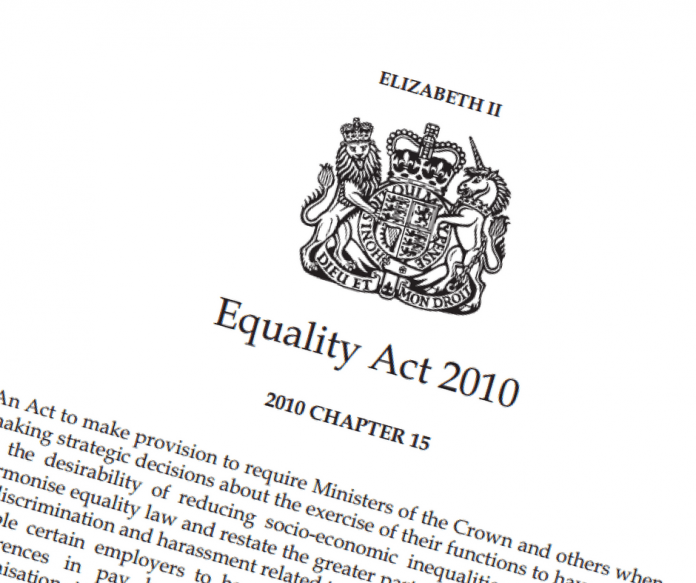
Discrimination in the Workplace

Discrimination is where an individual or group of individuals are treated differently due to their perceived membership of a certain group or social category. For example, an individual or group of individuals may suffer discrimination because they are from the Travelling Community. Under the Equality Act 2010, is it unlawful to discriminate against any individual (or group) based upon any of the protected characteristics.  In the workplace, this can take many forms including, for example,  black workers not being offered the same opportunity as white workers, women being paid less than men for doing the same job but can include age, colour, convictions, height, disability, ethnicity, family status, gender identity, genetic characteristics, marital status, nationality, race, religion, sex or sexual orientation.

Direct Discrimination

Direct discrimination is where an individual is treated differently or worse than others for certain reasons, it is often easy to spot such as being refused entry to a hotel because you are gay. The Citizens Advice Bureau describes direct discrimination through the following example: ‘You’re a saleswoman and you inform your employer that you want to spend the rest of your life living as a man. As a result of this, you’re moved to a role without client contact against your wishes. This is less favourable treatment because of gender reassignment. It would still be less favourable treatment even if your employer were to increase your salary to make up for the loss of job status.’

Indirect Discrimination

However, there are other times when you appear to be treated equally and in the same way as others but it actually has a worse impact on you because of who you are. This is known as indirect discrimination where a workplace practice, policy or rule applies to all but it has a worse effect on some than others. The Citizens Advice Bureau describes indirect discrimination through the following example: ‘A health club only accepts customers who are on the electoral register. This applies to all customers in the same way. But Gypsies and Travellers are less likely to be on the electoral register and therefore they’ll find it more difficult to join. This could be indirect discrimination against Gypsies and Travellers because of the protected characteristic of race. The rule seems fair, but it has a worse effect on this particular group of people.’

Justifying Discrimination

Not all discrimination is unlawful, if an employer treats you unfairly because of who you are they might have a good enough reason but may have to justify their discrimination. The Citizens Advice Bureau describes justifying discrimination through the following example: ‘A hospital advertises a surgeon’s job for which it requires at least ten years’ experience. You can’t meet this requirement because you’ve taken time off work to care for your children. As you’re a woman, this looks like indirect discrimination because of sex. But the hospital may be able to justify this, if it can show that the job can’t be done properly without that amount of experience. This is likely to be a legitimate aim.’

JD

The Equality Act 2010 – The Protected Characteristics

Through the ‘Protected Characteristics’ the Equality Act 2010 ensures that it is unlawful to discriminate against someone because of any of these characteristics which are defined by the University of Sheffield as:

  1. Age – The Act protects people of all ages. However, different treatment because of age is not unlawful direct or indirect discrimination if you can justify it (for example if you can demonstrate that it is a proportionate means of meeting a legitimate aim). Age is the only protected characteristic that allows employers to justify direct discrimination.
  2. Disability – The Act has made it easier for a person to show that they are disabled and protected from disability discrimination. Under the Act, a person is disabled if they have a physical or mental impairment which has a substantial and long term adverse effect on their ability to carry out normal day-to-day activities, which would include things like using a telephone, reading a book or using public transport.
  3. Gender reassignment – The Act provides protection for transsexual people. A transsexual person is someone who proposes to, starts or has completed a process to change his or her gender. The Act no longer requires a person to be under medical supervision to be protected– so a woman who decides to live as a man but does not undergo any medical procedures would be covered.
  4. Marriage and civil partnership – The Act protects employees who are married or in a civil partnership against discrimination. Single people are not protected.
  5. Pregnancy and maternity – A woman is protected against discrimination on the grounds of pregnancy and maternity during the period of her pregnancy and any statutory maternity leave to which she is entitled. During this period, pregnancy and maternity discrimination cannot be treated as sex discrimination. You must not take into account an employee´s period of absence due to pregnancy-related illness when making a decision about her employment.
  6. Race – For the purposes of the Act `race´ includes colour, nationality and ethnic or national origins.
  7. Religion or belief – In the Equality Act, religion includes any religion. It also includes no religion, in other words employees or jobseekers are protected if they do not follow a certain religion or have no religion at all. Additionally, a religion must have a clear structure and belief system.
  8. Sex – Both men and women are protected under the Act.
  9. Sexual orientation – The Act protects bisexual, gay, heterosexual and lesbian people.

JD

The Equality Act 2010 – An Introduction

The Equality Act 2010 came into force on 1st October 2010 and was introduced to bring together a complex set of overlapping legislation into one simplified and harmonious Act. This new Act brought together previous legislation including the Equal Pay Act 1970, the Sex Discrimination Act 1975, the Race Relations Act 1976, the Disability Discrimination Act 1995 and additional delegated legislation which prevented discrimination in employment on the basis of religion, belief, sexual orientation and age.

Whilst in general the Act covers employment and strengthens laws to give greater protection to employees from discrimination it does also cover some aspects of discrimination outside of employment. Most significantly, the Equality Act 2010 sets out a requirement for employers to assure equal treatment in access to employment as well as private and public services, regardless of the individuals ‘protected characteristics’, which are listed below.

  • Age
  • Disability
  • Gender Reassignment
  • Marriage and Civil Partnership
  • Pregnancy and Maternity
  • Race
  • Religion or Belief
  • Sex
  • Sexual orientation

These ‘protected characteristics’ represent a defining guide to safeguard employees from unfair treatment or discrimination but in the case of disability, employers and service providers are under a duty to make reasonable adjustments to their workplaces to overcome barriers experienced by disabled people.

Through the Equality Act 2010 employees are explicitly protected from discrimination and bias as well as bullying or harassment in the workplace. Consequently, employers must be mindful of how their procedures, policies and practices impact on their employees and where necessary review accordingly.

In order for an organisation to ensure it is meeting the requirements of the Act it is highly recommended, but not legally required, that an equality & diversity policy is in place, especially for larger organisations. In fact, for larger organisation, the publishing of an equality & diversity policy on the company website will demonstrate that the organisation is meeting its legal and moral obligations towards being a diverse employer. Furthermore, by having the policy in place and publically available it can contribute towards making its employees more comfortable and encourage everyone in the organisation to treat others equally.

JD