Staff Equality Networks

Staff networks can be a powerful tool for empowering minority groups to have an effective voice in an organisation. In the context of diversity and inclusion, a minority group is a group of individuals who are known to have been discriminated against on the basis of a shared characteristic. It is worth noting that these groups may not be a minority in terms of numbers as in the case of women, who are a minority group, despite comprising over half of the UK population.

According to Advance H.E. (formally the Equality Challenge Unit), staff networks may not work in every workplace and/or for all minority groups, and their viability and success will depend on the culture and demand within individual organisations.
Networks need to be led by the staff groups that they represent.

However, there is a role for institutions to facilitate and support the development of networks:

  • Involve staff and discuss the need for staff networks. This could be linked to specific times of year to maximise impact, for example discussing the possibility of a women’s network on international women’s day. A specific event gives the opportunity to discuss whether it is viable and to look for volunteers to take the network forward.
  • Provide a budget. From refreshment for meetings, to organising specific events or training and development, a budget of any size helps to ensure the network is sustainable and effective.
  • Ensure senior management are open to dialogue. Networks can provide a useful perspective on institutional practice. Consultation should be genuine and views of the network taken seriously.
  • Publicise networks to all staff. A dedicated area on your website/intranet means that all staff are aware of support and opportunities. Promote the networks during staff inductions to maximise membership and ensure all staff are able to benefit.
  • Create a culture of acceptance for participation. It can be intimidating to join a network and there can be a perception that members of networks are ‘troublemakers’.
  • Ensure line managers encourage staff to attend meetings in work hours. Senior management engagement can help to legitimise the group, and positive endorsement can underline that taking part is worthwhile.

Aims and Objectives

1. Sharing experiences and providing advice and support in a confidential safe space

Often a staff network is the opportunity staff members have to discuss the challenges they have faced at work. To meet this aim, it is likely that membership will be limited to people with the particular shared characteristic. Organisations need to carefully consider how, when and where the group will meet, and how to get a balance between giving an opportunity to share personal experiences while retaining momentum and developing positive solutions.

2. Working collectively towards improving institutional policies and practices and implementing change

Networks with this aim can be useful for their members and their institution. They can raise concerns from members, act as a consultation group for policies and practice and help to generate ideas and solutions. However, to be successful and to maintain momentum, the organisation has to listen to the network and genuinely involve them in decision making and policy review.

Terms of Reference

Networks can have a variety of terms of reference, depending on their aims and context. These may also develop over time as the group evolves. The language used in describing and naming networks can also be crucial in their success and who joins.

However you approach staff networks in your organisation it is important to remember that an effective staff network is one that is run by staff for the benefit of staff.

JD
The Public Sector Equality Duty

Equality, Diversity and Inclusion is not just about compliance with legislation, it’s about leading change, improvement initiatives, engaging, motivating and improving the potential of staff. The Public Sector Equality Duty (PSED) brings this into law for all public bodies in the United Kingdom.

According to ACAS (the Advisory, Conciliation and Arbitration Service) the Public Sector Equality Duty requires public bodies and others carrying out public functions to have due regard to the need to eliminate discrimination, to advance equality of opportunities and foster good relations. The duty applies to all nine areas of discrimination listed in the Equality Act 2010.

As such, it’s about ensuring all stakeholders are at the centre of the services offered to the public and positively impacting upon the context and culture of the organisation whilst supporting public sector staff to design and deliver great service.

The role of the Public Sector Equality Duty is to eliminate unlawful discrimination, harassment, victimisation and any other conduct prohibited by the Equality Act 2010. To advance equality of opportunity between people who share a protected characteristic and people who do not share it foster good relations between people who share a protected characteristic and those who do not.

It is a requirement in law that public bodies such as the NHS, local government, police, fire brigades, schools, colleges, universities and others carrying out public functions follow the Public Sector Equality Duty. The full list of employers required to follow the PSED can be found in Schedule 19 of the Equality Act 2010.

The duty applies to individual employees, workers, contractors and customer and all nine areas of discrimination listed in the Equality Act 2010 – referred to as protected characteristics – meaning that employers need to consider:

  • age
  • disability
  • gender reassignment
  • pregnancy and maternity
  • race
  • religion or belief
  • sex
  • sexual orientation
  • marriage and civil partnership

Note: For marriage and civil partnership, the Public Sector Equality Duty only requires employers to have due regard to the need to eliminate unlawful discrimination.

This ensures that public bodies consider the needs of all individuals in their day to day work – in shaping policy, in delivering services, and in relation to their own employees.
JD

Discrimination casts a shadow over football

The English Football League kicked of last week but the opening weekend was marred with a number of incidents of racist abuse. Like any other employer in the UK, a professional football club has a duty under the Equality Act 2010 to protect its staff from racial abuse. The Equality Act makes no distinction as to the type of workplace, a football player is a member of staff and the football pitch is a workplace.

On Saturday 3rd August, Southend United’s Jamaican striker Theo Robinson claims he was abused “in front of family, friends and their kids” at St Andrew’s, the first match Coventry have played in their ground-sharing arrangement with Birmingham City.  Similarly, Stoke City’s James McClean, Barnsley’s Bambo Diaby and the sister of Fulham’s Cyrus Christie were also victims of what’s been described as “unacceptable discriminatory abuse”.

Anti-racism charity Kick It Out said “On the first weekend of the season, these incidents should be a reminder for everyone in football that racism and discrimination cannot be ignored. Clubs and the football authorities must be relentless in calling out this disgraceful behaviour, and be prepared to issue strong sanctions and education sessions to any supporter involved. Discrimination casts a shadow over football in this country, and we will not stop highlighting the problem while it remains rife in the game.”

Whilst in this case the racial abuse is coming from a minority of fans in reality a football fan is a customer of the club and a consumer of the clubs product or service. As such, this is no different from hospital staff receiving racial abuse from a patient or service user. In such cases, NHS Trusts work to support staff and reduce racial abuse happening and football clubs must do the same. However, we hear much more outrage from the public and political leaders when NHS staff are racially abused. Why then are footballers, as well as other sports men and woman, seen as fair game to abuse at work?

Certainly, the money involved in football infuriates many fans, especially when they are being charged £40 a ticket and another £50 for a replica club shirt. They see the elite football players earning the big bucks and see themselves as effectively their employers. Oddly, if they were the employers then by law they should treat their staff better. That said, we know that when a football team is doing well the fans sign their praises from the stands but when things are not going well a minority of fans abuse the players, regardless of ethnic origin. This abuse from the stands has almost become a ‘norm’ but race is a protected characteristic under the Equality Act and harassment on the basis of it is illegal, just as would the abuse of a disabled member of staff, or an LGBT+ member of staff. In fact, I am sure the ongoing situation with racial abuse of players is contributing to the lack of any visible LGBT+ professional football players. Unfortunately, LGBT+ players are not confident enough in being accepted by all fans that they have to hide that aspect of their lives away and as such lead an unauthentic version of themselves, in itself this can lead to anxiety, depression and other mental health issues.

So what are clubs to do? In reality, expulsion from the ground and permanent exclusion from all football grounds is a strong deterrent. Clubs must demonstrate their commitment to stamping out racial abuse but those fans that do not racially abuse players must also be given the confidence to challenge the abusers and show them that this behaviour is not okay.

Either way, the Equality Act 2010 protects all staff from abuse in the workplace and unless clubs do more to protect their players from racial abuse they could be in breach of the Equality Act and subject to legal action.

JD

Positive Action for Under Representation

Positive action is very often a misunderstood or misrepresented term. Unfortunately, some still talk of it as a deliberate act by Human Resources to recruit more ethnic minority staff into an organisation.  Its misunderstandings such as this that show positive action must not be confused with positive discrimination, which is illegal.

Positive action is where you identify that your workforce is under represented in a specific area and do something about it. For example, as we have seen in recent years, many UK Company boards are under represented by women and companies have taken positive action to address this. Positive action in this case could be to promote board vacancies specifically to woman in the organisation, or to have a leadership programme for board members of the future that actively encourages participation by woman. However, you will notice that the example above does not dictate that UK Companies hire only woman and discriminate against male applicants to solve the issue – which would be illegal – it simply asks that we make the effort to involve woman, promote our board vacancies to woman and encourage them to apply. Though, it’s worth noting, despite much work to improve the representation of women on the boards of UK Company’s it has done little to increase representation of women of colour in these roles. As such, further work is still needed in this area for boards and governing bodies to be truly representative of the community we serve.

As such, positive action can be defined as the voluntary actions an employer takes to address an imbalance of opportunity or disadvantage that an individual with a protected characteristic could face in the workforce. Positive action can be used wherever your workforce is under represented or is not reflective of the community it serves including (but not limited to) age, disability, ethnic minority, LBGT+ or gender.

A good example of where positive action can look to redress an imbalance is in construction industry where there are only 3 female apprentices for every 98 male apprentices. As such, positive action here might be to better promote the construction industry to girls in schools and other educational settings, or to show progressive imagery on construction industry posters and advertisements which show woman in construction roles.

I often hear senior leaders actively supporting the business case for diversity in the workplace but I don’t always see an effective strategy of positive action to meet the business case. Diversity is the celebration of the differences between us and valuing the how those differences make our workforce stronger. Diverse experiences can lead to diverse solutions in the workplace. If you hire the same type of people all the time you will get the same outcome all of the time. As such, ensuring your business has diversity in its workforce can ensure that you have diverse solutions amongst your staff.

The first challenge then is to know where your workforce lacks diversity. The only way to do that is to examine the make-up of your own staff and ask yourself the following question: does your workforce represent the community it serves?  But this is a big picture situation. We need to examine the context of the community you serve. For example, if you generally serve a region of the UK then you need to look at the make-up of that region. If the latest Government Census indicates that the population of that region predominately – say 95% – identify as being ethnically white British then how does your workforce compare? Again, you can look at gender and establish what percentage of the community is female and what percentage are male and compare that to the make-up of your own workforce. The same applies to those members of the community who identify as disabled or LGBT+. Only when you know the make-up of the local community can you identify what aspects of diversity you actually need to improve.

Subsequently, only when armed with this knowledge can you then look to positive action to help recruitment build you a more diverse workforce.

JD

International Non-Binary People’s Day Celebrates Gender Non-Conforming People

I want to share an article here by Alexander Kacala – writing for Newsweek – in which he highlights ‘International Non-Binary People’s Day’ and the challenges faced by those who identify outside the gender binary. A recent report by Stonewall, the leading LGBT+ charity, highlights how members of the LGBT+ community are more likely to suffer poor mental health and are less likely to seek help from healthcare professionals. For example, the report highlights how half of LGBT people (52 per cent) experienced depression in the last year and that one in seven LGBT people (14 per cent) avoid seeking healthcare for fear of discrimination from staff. As such, good equality practice is essential in the workplace to ensure that people can be true to themselves and bring their authentic self in to the workplace without fear of discrimination.

International Non-Binary People’s Day is observed each year on July 14. Non-binary, also known as genderqueer, is a spectrum of gender identities that are not exclusively masculine or feminine‍ —‌ identities that are outside the gender binary.

Non-binary people may identify as having two or more genders, having no gender, moving between genders or having a fluctuating gender identity, or being third gender or other-gendered, a category that includes those who do not place a name to their gender.

Non-binary activist Jacob Tobia spoke to the Human Rights Campaign (HRC) about the significance of non-binary visibility and pride.

non-binary-day(Photo by Rich Fury/Getty Images for GLAAD)
“I think that having days where you get to talk about your community and honor the experiences of everybody that’s part of the community is wonderful,” Tobia told HRC’s online magazine Equality.

Tobias said of their coming out: “By the time I used the term non-binary, gender non-conforming or genderqueer to describe myself, it was like an afterthought. I was expressing my gender in a way that was gender non-conforming, I was learning about my gender and started wearing lipstick and putting on makeup… then figuring out what the label meant for it way after that.”

Last year, a study showed that more teenagers are identifying themselves with non-traditional gender labels such as transgender or gender-fluid.

Published in the journal Pediatrics, the research found that almost 3 percent of teens surveyed did not identify with traditional gender labels such as “boy” or “girl.” That number is higher than the researchers expected. A UCLA study from 2017 estimated that 0.7 percent of teens identified as transgender.

Lead researcher Nic Rider of the University of Minnesota said the main purpose of the study was to examine health differences between gender-nonconforming teens and teens who are cisgender, a person whose gender identity aligns with the sex assigned to them at birth.

The study supports prior research suggesting “that previous estimates of the size of the transgender and gender-nonconforming (TGNC) population have been underestimated by orders of magnitude,” wrote Daniel Shumer, a specialist in trans medicine at the University of Michigan, in an accompanying article.

The study also found that TGNC youth reported “reported significantly poorer health” — including mental health — than cisgender teenagers. TGNC teens also were less likely to get preventive health checkups and more likely to visit their school nurse, the study showed.

Many people took to social media to share photos of themselves to celebrate International Non-Binary People’s Day.

JD

Employers should work harder to engage LGBT+ allies, say experts

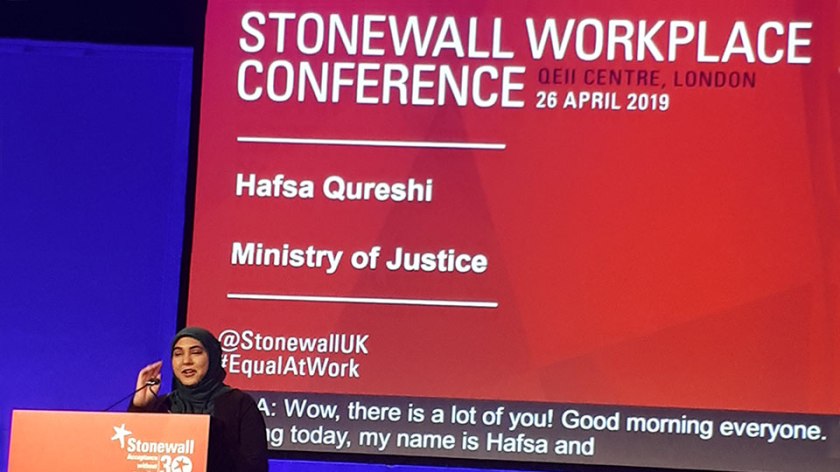
I wanted to share a recent article by Emily Burt, from People Management, who attended the Stonewall Workplace Conference, 26 April 2019, in which she discusses the need to engage LGBT+ allies in the workplace. The article is both thought-provoking and relevant during Pride Month, particularity if you work in HR or are engaged in improving workplace equality and diversity. What is made abundantly clear by the conference speakers is the need for further support to improve LGBT+ inclusion in the work place and often people are not looking in the right place.

Stonewall conference urges better communication, with 35 per cent of LGBT staff having hidden their sexuality at work

Organisations must work to encourage, support and empower their LGBT+ members of staff and recognise the business case for inclusive cultures in order to drive genuinely diverse workplaces, experts have told delegates at the 2019 Stonewall Workplace Conference.

stonewall2_tcm27-57012_w1228_n

Hafsa Qureshi (pictured), recruitment specialist at the Ministry of Justice and Stonewall’s bisexual role model of the year, said engaging people who do not identify as LGBT with the challenges faced by the community was an important part of creating inclusivity at work.

Speaking to People Management, Qureshi said: “One of the biggest hurdles is reaching people who don’t identify as LGBT to be allies. Too often, people assume that because someone is not from a visible protected characteristic, they don’t have any issues at work.”

Qureshi added that it was imperative for LGBT allies to promote inclusive cultures at every level of a business.

“Having worked with smaller and larger organisations, the ones that struggle with diversity and inclusion often do so because they fail to communicate it beyond management level,” she warned.

“The culture stops before reaching the employees who have face-to-face interactions with customers or clients.”

More than 1,000 people attended the opening session of the conference, with the theme ‘Equal At Work’, where CEO Ruth Hunt delivered her final keynote ahead of departing from her role at the charity later this year.

“We sometimes forget that it wasn’t that long ago that being LGBT meant you could be fired from work or denied service because of who you are,” she said, adding: “While it’s important to celebrate how far we’ve come, we cannot be complacent.”

A 2018 survey from the charity found almost one in five LGBT staff (18 per cent) were the target of negative comments or conduct from work colleagues because of their sexuality. More than a third (35 per cent) had hidden or disguised the fact they were LGBT at work for fear of discrimination.

The community has also faced a series of rows on an international scale over the last 12 months, including President Trump’s policy to prohibit some transgender people from serving in the US military, and schools in Birmingham dropping classes that include discussion of LGBT relationships following protests from parents.

In a speech to conference delegates, Penny Mordaunt, Minister for Women and Equalities, reaffirmed the government’s commitment to LGBT-inclusive workplaces, stating: “Organisations cannot afford to exclude talented people, or to limit their potential.”

She said the Government and Equalities office (GEO) would continue to provide targeted interventions seeking to improve the experiences of LGBT people at work and announced that the GEO would coordinate a series of events to gather employer views, and share expertise and experiences this coming autumn.

Mordaunt acknowledged the GEO was asking HR departments to commit to a number of significant initiatives – including gender pay reporting and the Race at Work charter – which were “not remotely joined up or coordinated”.

But she added: “In order to build the businesses of tomorrow, we need workforces that are able to authentically be themselves.”

Speaking to delegates, Qureshi concluded: “Sometimes, all it takes is one person to step forward in order to make a workplace culture feel more accepting.

“I encourage you all to use your voices and platforms to raise awareness for your LGBTQ community. Your voice is more important than you know – and you may say something that a person like me has waited their whole life to hear.”

JD

LGBT Inclusion Tips for the Workplace – Stonewall

I have recently been working with Stonewall, the leading lesbian, gay, bisexual and transgender rights charity in the United Kingdom, in order for my organisation to partner with their Diversity Champions Programme.

stonewall-diversitychampion-logo-black-250As I looked further into setting up my own staff networks for protected characteristics I came across the following ten tips to help build an LGBT inclusive culture in an organisation via Stonewalls website and wanted to share it.

People perform better when they can be themselves, and if you’re looking to make sure that lesbian, gay, bi and trans (LGBT) people are fully included in your workplace, Stonewall have got some tips to help.

  1. Ensure that your policies are fully inclusive of LGBT people

This includes pensions, family and leave policies, health insurance and relocation allowances. You should make sure your policies explicitly mention LGBT people.

  1. Get people involved across your organisation

This could include setting up a network group specifically for LGBT employees; they’ll help you know where you’re doing well and which areas may need a new approach.

  1. Reward those involved in your LGBT network group

Embed their involvement in their appraisals; make being part of the network a desirable thing to be.

  1. Decide upon a clear strategy and tactics

Whether you want to increase the number of staff who are open about being LGBT, or revise your policies to make them fully inclusive, it’s crucial to know where you want to be and how you’re going to get there.

  1. Engage staff members who don’t identify as LGBT

Allies, as we call them, are a crucial element of ensuring inclusion for all. They can help spread the message that diversity is celebrated by your organisation.

  1. Ensure senior support

Making certain your senior leaders actively communicate their support for LGBT inclusion sends a positive message of acceptance for all across your organisation.

  1. Speak to your staff

Consulting employees – both LGBT and non-LGBT – about what inclusion looks like in your organisation will help ensure your strategy is appropriate and that all staff share your vision.

  1. Understand your staff

Getting to know the make-up of your staff through techniques such as monitoring will help ensure you effectively cater to any needs they may have.

  1. Celebrate your successes

Making sure your organisation is LGBT-inclusive is an ongoing journey, so it’s important to celebrate your successes, whatever size they may be, along the way. Every step is a step towards acceptance without exception for LGBT people.

  1. Become a Stonewall Diversity Champion

Diversity Champions is Britain’s leading programme for ensuring that your workplace is truly inclusive.

JD

Flexible Working for New Dads

The role of the working mum is well-established; however in recent years we have seen the rise of the working dad. Increasingly, dads are making more requests for flexible working arrangements than ever before. In fact, a recent study by daddilife.com, produced in association with Deloitte, found that nearly two thirds (63%) of dads have requested a change in working pattern since becoming a father.

According to the study, modern day fathers are more involved in parenting than ever before. In fact, the study claims 87% of the dads surveyed are either mostly or fully involved in day to day parenting duties.  So much so that dads are increasingly putting fatherhood ahead of their careers, or at least accepting the need for a better balance between work and home life after the birth of a child.

Requests for flexible working patterns might include asking to spend a day or two working from home every week. Perhaps so they’re present for the nursery run, or for half an hour of play and interaction at lunchtime. Likewise, the need for flexible working could be for compressed or reduced hours, so new dads can spend more time with their children during those crucial early years. Whatever it is, new dads are asking for more flexible working in record numbers. This is because, more than ever, they value time spent with their young families.

Millennial-Dad-at-Work-SOCIALS13-1

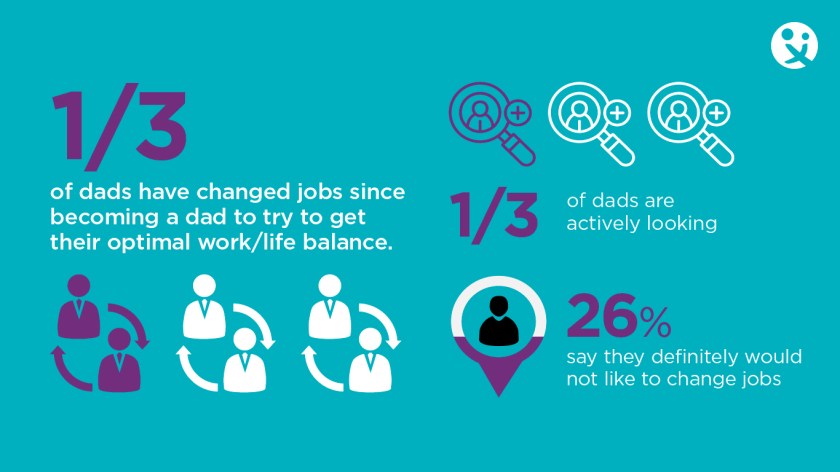
The study suggests that millennial dads are prepared to take drastic action to make sure they achieve a lifestyle that is good for work and good for their families. The research found that a third of dads had already changed jobs since becoming a father. In addition to that a further third were actively looking to change jobs. That’s an interesting finding as far as employers are concerned. It shows that offering flexible working for parents (both mums and dads) is likely to help them retain their top talent.

The study also suggests that, at the moment, too many organisations are letting good workers drift into the arms of other organisations. Specifically, the ones who are more sympathetic to the need for better flexibility at work.

Millennial-Dad-at-Work-BANNERS8-1

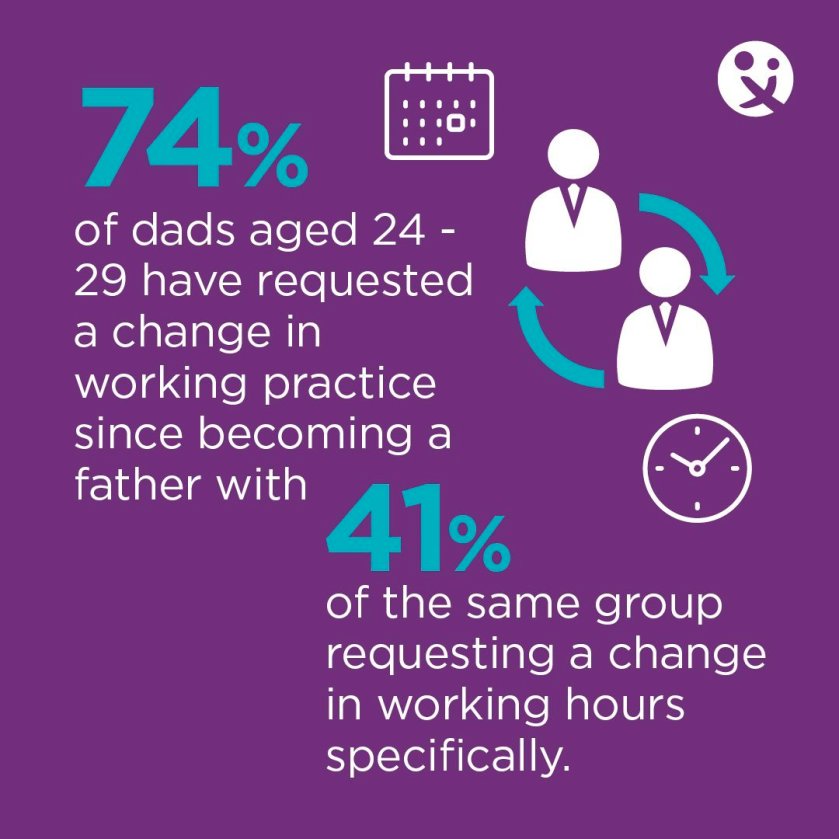
The worry is that not all employers are getting the message. For instance, the Deloitte research reveals that, while 14% of dads have requested to work from home on one or two days a week, less than one in five (19%) have had the request granted. Similarly, 40% of the dads interviewed have requested a change in working hours but nearly half of them (44%) have been turned down.

Millennial-Dad-at-Work-SOCIALS4

Dads are increasingly reporting  that the greatest life satisfaction comes from being an involved and present parent. Too often though, they bump up against a workplace environment that is sadly out of touch with that sentiment.

Millennial-Dad-at-Work-BANNERS3

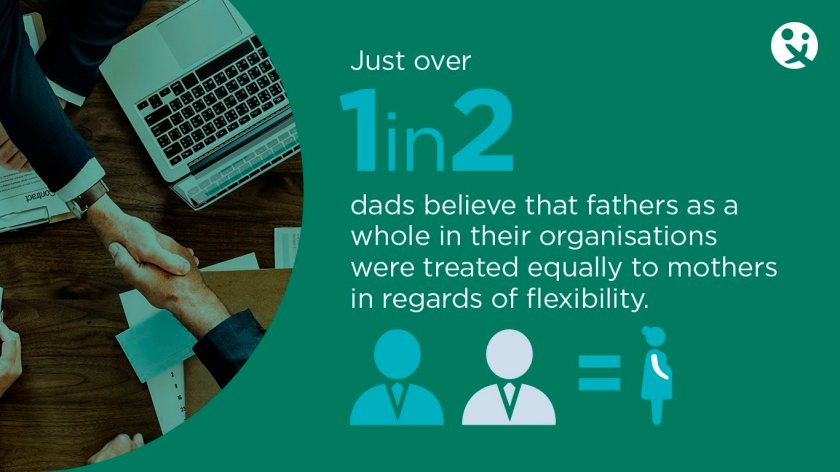
Nearly half (45%) of working fathers regularly experience tension from their employer when trying to balance work and family life, while 37% regularly experience tension from colleagues, and 45% with their partners.

Millennial-Dad-at-Work-BANNERS6-1

Society may be gradually more accepting of the fundamental role that fathers play in creating happy, well-adjusted children, but many workplaces are lagging behind.  As a result, dads are suffering because of that, and organisations are too. Unhappy workers are never at their most productive. As we’ve seen, businesses who fail to offer better work/life balance for parents risk losing top talent to more enlightened competitors.

Thanks to Hugh Wilson at daddilife.com for his excellent insight and commentary on the Millennial Dad at Work Report, which I have summarised here, to check out Hugh’s full article, click here. Hopefully reports such as this will lead to greater understanding and increased flexibility for working dads.

Logotype@2x

You can also check out the full published report by daddilife.com, in association with Deloitte, by clicking here.

JD

Improving Mental Health at Work

We know that work can have a positive impact on our health and well-being. In fact, it’s not a leap of faith to recognise that healthy and well-motivated employees can have an equally positive impact on the productivity and effectiveness of a business.

As part of Mental Health Awareness Week 2019, I wanted to examine health and well being in the workplace. As an equality and diversity advisor I often get requests for information or training regarding mental health and it’s often a subject managers are unsure of or avoid. It’s worth noting that the Mental Health at Work Report (Business in the Community, 2017) found that only 24% of managers had received any form of mental health training. Appallingly, the report also highlighted that 15% of employees who disclosed a mental health condition faced disciplinary procedures, demotion or dismissal.

In the public sector, adverts for jobs often highlight how an organisation has employee health and well-being at the heart of its organisational culture when, in truth, like most organisations they are actually on a journey to improving the health and well-being of staff, rather than being the finished article.

First and foremost it is important to understand that managing health, work and well-being is the responsibility of both the employer and the employee. To better understand the interaction between health, well-being and work it is important for organisations to recognise:

  • the relationships between line managers and employees
  • the importance of getting employees involved
  • job design, flexible working and the use of occupational health

The connection between health and work

Health and safety in the workplace has been with us for many years, most public sector organisations have a health and safety manager, or at least someone who is responsible for health and safety in the organisation. However, the growing awareness of work-life balance has also made us aware of the relationship between our mental and physical well-being and the job we do. As such, for many people, the connection between health and work is often restricted to concerns with physical hazards in the workplace. Employers are legally obligated to protect staff in their organisation by looking after their physical health and safety and whilst traditional health issues – such as noise, dust and chemical hazards – are vitally important… staffs mental well-being is an emerging priority.

Is work good for your health?

Absolutely, studies show that work is generally good for your health and most of us enjoy having a meaningful job of work. Additionally, as a financial reward, it gives many of us a feeling of self-esteem, companionship and status. The Macleod Review, published in July 2009, regarding employee engagement, highlighted how this ‘feel good’ factor is strongly influenced by:

  • leaders who help employees see where they fit into the bigger organisational picture
  • effective line managers who respect, develop and reward their staff
  • consultation that values the voice of employees and listens to their views and concerns
  • relationships based on trust and shared values.

However, although we know that the benefits of work can greatly outweigh some of the disadvantages; it is also clear that work can be bad for your health. According to Government figures, two million people suffer an illness they believe has been caused or made worse by their work (‘Choosing Health’ White Paper). This can take the form of stress, anxiety, back pain, depression and increased risk of coronary heart disease.

However, there are a number of misunderstandings with work related illness that continue to persist. For example, it’s often said that people in high status jobs are more at risk of heart disease due to stress. However, research by the Cabinet Office dispels this myth. The Whitehall II study, published in 2004, examined public sector workers and found that men in the lowest employment grades were more likely to die prematurely than men in the highest grades. In contrast, higher rates of absence, as well as illness, were associated with low levels of work demands.

Furthermore, according to research by the Confederation of British Industry, non-work related mental ill health is the most significant cause of long-term absence in the UK – and musculoskeletal problems are the second most significant cause.

How to recognise an unhealthy workplace

Often, an unhealthy workplace is quite easy to recognise and will likely share a number of the following traits:

  • poor management
  • a bullying culture
  • poor customer service
  • high levels of absence
  • reduced productivity
  • unreasonably high work demands

You may have experienced these kinds of workplaces – either as an employee or a customer. Sickness absence is often rife and habitually out of control and there is usually very little commitment to the organisation. Where there is an over reliance on expensive agency staff due to high levels of staff sickness or absence can be an indicator that a workplace is unhealthy. That said, in such situations, leaders will often point to a significant period of change, such as a major organisational restructure, as the reason and claiming things will get better in due course. In such situations you need a strong leader to rebuild a culture of health and well-being across the organisation.

What makes a healthy workplace?

Simply put, a healthy workplace is based upon good relationships. On the other hand, promoting a healthy and productive workplace is not just about being nice to each other, although this obviously helps. Positive employment relations are built upon:

  • effective policies for managing people issues such as communication, absence, grievances and occupational health
  • high levels of trust between employees and managers. Trust is often nurtured by involving employees in decision-making and developing an open style of communication.

Ultimately, where staff feel healthy and motivated they will certainly:

  • go that extra mile
  • give good customer service
  • take fewer ‘sickies’
  • provide commitment and creativity.

How can you tell how healthy your workplace is?

There are many stories out there where employers share the great practices that go on in their workplace to enhance employee’s health and well-being. However, in truth, if you want to see how an organisation values staff health and well-being you need to see what practices happen when the organisation is under pressure, whether that be financial pressure or as in the case with the public sector when it is under external inspection. Only then, during such challenging times, can the true value of supporting staffs health and well-being be seen.

Acas, the Advisory, Conciliation and Arbitration Service, believe that there are six indicators of a healthy workplace, these are:

  1. line managers are confident and trained in people skills
  2. employees feel valued and involved in the organisation
  3. managers use appropriate health services (eg occupational health where practicable) to tackle absence and help people to get back to work
  4. managers promote an attendance culture by conducting return to work discussions
  5. jobs are flexible and well-designed
  6. managers know how to manage common health problems such as mental health and musculoskeletal disorders.

JD

Equality, Diversity & Human Rights Week 2019, 13-17 May

From 13-17 May 2019 the NHS will be celebrating the eighth Equality, Diversity and Human Rights Week #EQW2019. Co-ordinated by NHS Employers, #EQW2019 is a national platform for organisations to highlight their work to create a fairer, more inclusive NHS for patients and staff.

EQW2019

This week of activity aims to raise awareness of equality, diversity and human rights issues in the NHS and celebrate best practice. As the largest employer in Europe, with over 1.3 million staff, the NHS has a responsibility to remain at the forefront of the inclusion and fairness agenda for patients and staff.

Diverse, inclusive, together

The theme is diverse, inclusive, together and has been chosen to reflect the move across the health and social care sector towards even greater collaboration and integration – as reflected in the publication of the recent NHS Long term Plan. At the heart of the plan is changing culture, with a commitment towards ensuring respect, equality and diversity within the NHS.

Working together makes the NHS stronger, we meet standards, enable change and collectively invest in the creation of a diverse and inclusive NHS workforce to deliver a more inclusive service and improved patient care.

To celebrate the event, my organisation has a range of interactive and informative events across the week.  Throughout #EQW2019, we will have a daily equality and diversity bulletin, each examining a different aspect of equality and diversity; furthermore we have a video webinar on the importance of diversity in the workplace as well as an interactive Q&A session with the Trusts own Equality, Diversity and Inclusion Lead. 

Take a look at the informative video series from John Deffenbaugh (NHS Leadership Academy) who leads a discussion panel on the equality challenges faced by the NHS and the steps that can be undertake to overcome them, discussion 1 is shown below.

JD