Discrimination in the Workplace

Discrimination is where an individual or group of individuals are treated differently due to their perceived membership of a certain group or social category. For example, an individual or group of individuals may suffer discrimination because they are from the Travelling Community. Under the Equality Act 2010, is it unlawful to discriminate against any individual (or group) based upon any of the protected characteristics.  In the workplace, this can take many forms including, for example,  black workers not being offered the same opportunity as white workers, women being paid less than men for doing the same job but can include age, colour, convictions, height, disability, ethnicity, family status, gender identity, genetic characteristics, marital status, nationality, race, religion, sex or sexual orientation.

Direct Discrimination

Direct discrimination is where an individual is treated differently or worse than others for certain reasons, it is often easy to spot such as being refused entry to a hotel because you are gay. The Citizens Advice Bureau describes direct discrimination through the following example: ‘You’re a saleswoman and you inform your employer that you want to spend the rest of your life living as a man. As a result of this, you’re moved to a role without client contact against your wishes. This is less favourable treatment because of gender reassignment. It would still be less favourable treatment even if your employer were to increase your salary to make up for the loss of job status.’

Indirect Discrimination

However, there are other times when you appear to be treated equally and in the same way as others but it actually has a worse impact on you because of who you are. This is known as indirect discrimination where a workplace practice, policy or rule applies to all but it has a worse effect on some than others. The Citizens Advice Bureau describes indirect discrimination through the following example: ‘A health club only accepts customers who are on the electoral register. This applies to all customers in the same way. But Gypsies and Travellers are less likely to be on the electoral register and therefore they’ll find it more difficult to join. This could be indirect discrimination against Gypsies and Travellers because of the protected characteristic of race. The rule seems fair, but it has a worse effect on this particular group of people.’

Justifying Discrimination

Not all discrimination is unlawful, if an employer treats you unfairly because of who you are they might have a good enough reason but may have to justify their discrimination. The Citizens Advice Bureau describes justifying discrimination through the following example: ‘A hospital advertises a surgeon’s job for which it requires at least ten years’ experience. You can’t meet this requirement because you’ve taken time off work to care for your children. As you’re a woman, this looks like indirect discrimination because of sex. But the hospital may be able to justify this, if it can show that the job can’t be done properly without that amount of experience. This is likely to be a legitimate aim.’

JD

Political Correctness? A Tick-Box Exercise? What is Equality and Diversity?

When leading Equality, Diversity and Inclusion (EDI) in an organisation it is not unusual to face challenges and barriers to achieving your targets from a common misconception as to what equality and diversity is all about. First and foremost, equality, diversity and inclusion is about people and not a ‘tick box’ exercise to satisfy government/employer statistics or legislation.

Perhaps the most common misconception reported by equality and diversity trainers is that EDI is often said – behind closed doors of course – to be ‘just political correctness’ or sometimes ‘political correctness gone mad’. Political correctness can be defined as ‘the avoidance of forms of expression or action that are perceived to exclude, marginalize, or insult groups of people who are socially disadvantaged or discriminated against’. It is often the term ‘forms of expression’ from definitions such as this which some interpret to mean jokes or work place banter. However, where someone is offended by your words it is not open to your interpretation it is open to theirs, as such if your opinion, jokes or workplace banter offends people then it is time keep such options, jokes or work place banter out of the workplace. To those who question whether equality and diversity is merely ‘political correctness gone mad’ I would ask the question whether it is acceptable for woman to be paid less than men for the same job, for part time staff or shift workers to have less opportunities in training, for the LGBTQ+ community to face harassment at work or for those from a minority to be excluded from jobs because of a different place of birth?  Sometimes, EDI needs to focus the minds of those not affected to understand how a lack of EDI impacts those who are affected and demonstrate how they can help bring fairness to their workplace.

However, even when supported, EDI can still be viewed by some in the workplace as ‘box to tick’ exercise or just another thing on a long list of other things that they are required to do by government. This fundamental lack of understanding as to the need for EDI practices often leads to a misunderstanding of intended actions and their outcomes which in its self often leads to a compartmentalised, tick-box approach. Nevertheless, what we are talking about here is implementing good EDI practice across an organisation rather enforcing a legal obligation on the workforce. It is this perception of enforced legislation that increases the risk of compartmentalisation and a tick-box approach. As such, it is this false perception of equality, diversity and inclusion that needs removing and this is where effective communication, workforce training and raising the profile of EDI can have a positive impact on its acceptance.

Hence, improving the understanding of EDI becomes about the message and vision set out by senior leaders. Essentially, EDI is about people and it focuses on treating all people fairly and ensuring there is equality of opportunity across the workforce. Naturally, isn’t this something we should all get on-board with? Unquestionably, fairness and equality of opportunity should be a priority for every organisation. As a result, the message needs to be very clear that EDI impacts on us all whether we be employees, employers, customers or other stakeholders including the communities we serve. For these reasons, we can see why good EDI practices must be embedded in all that we do.

JD

Leading Equality, Diversity & Inclusion – A Practical Guide for Managers

I am delighted to announce that my book ‘Leading Equality, Diversity & Inclusion – A Practical Guide for Managers’ is now available on Amazon.co.uk as an ebook download for Kindle.  The origins of this book come directly from this very blog and I will be sharing aspects of the book over the coming weeks. However, in the mean time, if you are involved with workplace EDI then please take a look at the book, it has a range of proven strategies that will hep build an inclusive culture in your workplace.

The books blurb goes something like this. ‘It’s easy to get lost in the rhetoric of equality and diversity, launching initiatives, giving training and explaining your vision. However, in truth, success is about what impact these initiatives, training and vision actually have. Have your actions made the workplace better for people? Getting traction for your initiatives is vital so that you can measure the success of equality actions. This ‘how to guide’ will help managers and those with responsibility for equality, diversity and inclusion make an impact in their workplace. Firstly, it explores the Equality Act 2010 before examining how you can effectively embed good practice in the workplace through a range of strategies that will help you to build an inclusive workplace.’

JD

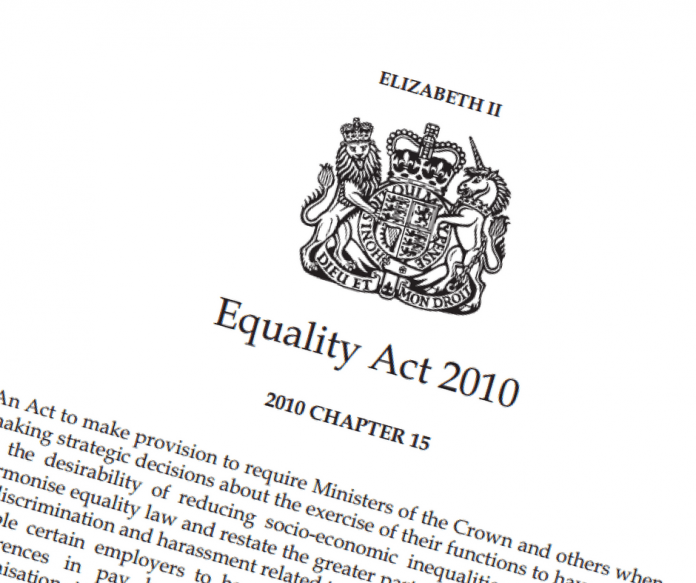
The Equality Act 2010 – The Protected Characteristics

Through the ‘Protected Characteristics’ the Equality Act 2010 ensures that it is unlawful to discriminate against someone because of any of these characteristics which are defined by the University of Sheffield as:

  1. Age – The Act protects people of all ages. However, different treatment because of age is not unlawful direct or indirect discrimination if you can justify it (for example if you can demonstrate that it is a proportionate means of meeting a legitimate aim). Age is the only protected characteristic that allows employers to justify direct discrimination.
  2. Disability – The Act has made it easier for a person to show that they are disabled and protected from disability discrimination. Under the Act, a person is disabled if they have a physical or mental impairment which has a substantial and long term adverse effect on their ability to carry out normal day-to-day activities, which would include things like using a telephone, reading a book or using public transport.
  3. Gender reassignment – The Act provides protection for transsexual people. A transsexual person is someone who proposes to, starts or has completed a process to change his or her gender. The Act no longer requires a person to be under medical supervision to be protected– so a woman who decides to live as a man but does not undergo any medical procedures would be covered.
  4. Marriage and civil partnership – The Act protects employees who are married or in a civil partnership against discrimination. Single people are not protected.
  5. Pregnancy and maternity – A woman is protected against discrimination on the grounds of pregnancy and maternity during the period of her pregnancy and any statutory maternity leave to which she is entitled. During this period, pregnancy and maternity discrimination cannot be treated as sex discrimination. You must not take into account an employee´s period of absence due to pregnancy-related illness when making a decision about her employment.
  6. Race – For the purposes of the Act `race´ includes colour, nationality and ethnic or national origins.
  7. Religion or belief – In the Equality Act, religion includes any religion. It also includes no religion, in other words employees or jobseekers are protected if they do not follow a certain religion or have no religion at all. Additionally, a religion must have a clear structure and belief system.
  8. Sex – Both men and women are protected under the Act.
  9. Sexual orientation – The Act protects bisexual, gay, heterosexual and lesbian people.

JD

The Equality Act 2010 – An Introduction

The Equality Act 2010 came into force on 1st October 2010 and was introduced to bring together a complex set of overlapping legislation into one simplified and harmonious Act. This new Act brought together previous legislation including the Equal Pay Act 1970, the Sex Discrimination Act 1975, the Race Relations Act 1976, the Disability Discrimination Act 1995 and additional delegated legislation which prevented discrimination in employment on the basis of religion, belief, sexual orientation and age.

Whilst in general the Act covers employment and strengthens laws to give greater protection to employees from discrimination it does also cover some aspects of discrimination outside of employment. Most significantly, the Equality Act 2010 sets out a requirement for employers to assure equal treatment in access to employment as well as private and public services, regardless of the individuals ‘protected characteristics’, which are listed below.

  • Age
  • Disability
  • Gender Reassignment
  • Marriage and Civil Partnership
  • Pregnancy and Maternity
  • Race
  • Religion or Belief
  • Sex
  • Sexual orientation

These ‘protected characteristics’ represent a defining guide to safeguard employees from unfair treatment or discrimination but in the case of disability, employers and service providers are under a duty to make reasonable adjustments to their workplaces to overcome barriers experienced by disabled people.

Through the Equality Act 2010 employees are explicitly protected from discrimination and bias as well as bullying or harassment in the workplace. Consequently, employers must be mindful of how their procedures, policies and practices impact on their employees and where necessary review accordingly.

In order for an organisation to ensure it is meeting the requirements of the Act it is highly recommended, but not legally required, that an equality & diversity policy is in place, especially for larger organisations. In fact, for larger organisation, the publishing of an equality & diversity policy on the company website will demonstrate that the organisation is meeting its legal and moral obligations towards being a diverse employer. Furthermore, by having the policy in place and publically available it can contribute towards making its employees more comfortable and encourage everyone in the organisation to treat others equally.

JD

Implementing Equality, Diversity and Inclusion Good Practice

We need to empower our workforce to be able to effectively challenge equality, diversity and inclusion issues and drive transformative change in their own organisation. As such, Rohini Sharma Joshi, Trust Housing Association’s EDI manager, asks that organisations consider the following four principals:

  1. EDI is about people

We need to think about equality in a different way. [Your workforce] is fundamentally a people business and EDI is all about people – about treating them fairly and ensuring equality of opportunity, so these should be priorities for every organisation. We need to deliver a clear message that EDI affects us all as employees, employers, our customers and the communities we serve. That is why it must be embedded in all that we do.

  1. Cultural change needs strong leadership

Embedding EDI in any organisation requires cultural change. It requires strong leadership and buy-in from the head of the organisation and senior management to take a meaningful step forward. There are several ways to amplify this message and to develop greater understanding of EDI issues including [organisational wide EDI strategic objectives, EDI charter or an initiative similar to] the Charted Institute of Housing’s ’10 by 20’ challenge to meet 10 EDI objectives by 2020.

  1. Engage with other organisations to share best practice

There are often valuable opportunities to learn from a variety of organisations within [any] sector, who also share a passion and commitment to achieving leadership excellence in EDI.  At Trust Housing Association, we share our experience as part of our role as founding members of the National Centre for Diversity’s new ‘national patrons’ network.

Trust was the first housing association in Scotland to achieve ‘investors in diversity’ status and, more recently, ‘leaders in diversity’ accreditation. This has enabled us to participate in a wider dialogue around issues that all kinds of organisations face in creating a diverse and inclusive working environment.

There are practical things the housing sector can do to address these issues. We have developed a training programme and we regularly discuss EDI issues in team meetings and with tenants, making it clear that discriminatory behaviour is not acceptable. We also publish case studies in our newsletters that underline the message that everyone is welcome and entitled to a safe and happy life.

  1. Make an action plan – not a wish list

A systematic approach to EDI does not show instant results but instead lays the foundations for change and develops well-informed and motivated staff who help build an inclusive organisation. If there is one thing [organisational] leaders must do to tackle EDI issues in [the next decade], it is to make sure that they are incorporated into a strategic action plan – not left languishing on a wish list.

JD

Workplace Inequality – Why Good EDI leadership is in Demand

Recent improvements to workplace equality and diversity practice have helped make UK employers more inclusive but we are still some way off seeing good practice embedded in all sectors. That said, nationally, we are certainly moving in the right direction and with continued support of organisations like the National Centre for Diversity, Stonewall, Diversity UK and Employers Network for Equality and Inclusion, there is no reason why this can’t continue.

In recent years, new job roles such as Equality, Diversity and Inclusion (EDI) Coordinator, EDI Lead or Head of EDI started to appear at the larger employers as they addressed the need for an equality and diversity specialist in their organisation. Clearly, these employers are starting to see the value in having strong equality and diversity leadership in their organisations, especially in light of the poor press high profile failures in EDI receive throughout news and social media reporting.

The need for organisational leaders to take ownership of EDI is still very much in demand because inequality and unfairness in the workplace has not disappeared and as the examples below demonstrate, provided by the Trade Union Congress (TUC), we still have some way to go for true workplace equality.

  • Black workers have fewer training opportunities than white workers and black women get an even worse deal.
  • Older Workers may have been in the job for longer but this may only mean that the longer you are in a job the less training you will receive.
  • Manual workers and/or workers with few qualifications are mainly overlooked for training as those who have a lot of education and training tend to benefit from any training on offer.
  • Part-time workers and temporary workers are often left behind when training is on offer as employers place a greater value on permanent or full-time workers at the cost of temporary or part-time workers. Women make up the majority of part-time workers.
  • Workers for whom English is a second language may find that the only jobs open to them are manual / low skilled jobs. Whilst some will have qualifications, these may have been achieved in another country and employers will often overlook them. A lack of spoken English is often a barrier to moving on.
  • Shift workers are least likely to participate in learning in colleges because of working patterns, or to be offered training by their employer.  They may need to be encouraged when learning is promoted and shift times taken into account when onsite learning takes place.
  • Discrimination often plays a role when access to job and training opportunities are based on negative stereotypes and perceptions of what people can and can’t do.

JD

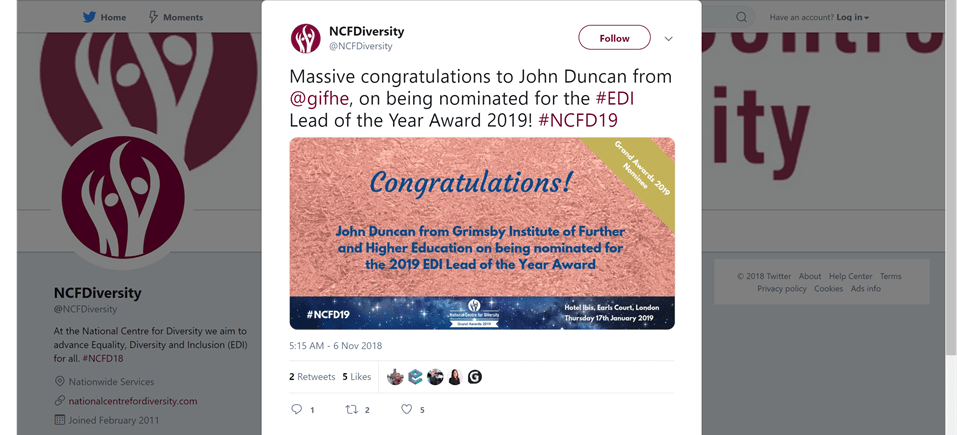
National Centre for Diversity – Grand Awards 2019

Tonight is the National Centre for Diversity’s Grand Awards 2019 where the Grimsby Institute of Further and Higher Education (GIFHE) have been shortlisted for the ‘Most Improved Organisation 2019’ Award.

Last year the Grimsby Institute was awarded Stage 2 Investors in Diversity by the National Centre for Diversity and listed at number 34 on their index of the Top 100 ‘Most Inclusive Organisations.’ This was a great celebration of the considerable efforts of staff across the Grimsby Institute had made to improve their equality and diversity practices.

It’s fantastic to see the improvements made to workplace equality and diversity being celebrated in this way as well as the individuals and organisations being awarded for their contribution. The very best of luck to all the the shortlisted individuals and organisations.

I was very proud to be nominated for the 2019 EDI Lead of the Year award and will be cheering on the Grimsby Institute as the awards are announced tonight.

https://www.nationalcentrefordiversity.com/

JD


Equality and Diversity in the Workforce

Increasingly, the term ‘Equal Opportunities’ is making way for discussions on ‘Diversity’ as this term is much broader in its scope and gets to the heart of the integration challenges the country faces.

Over the past five decades our society has become increasingly complex and diverse. The UK population is growing rapidly and subsequently becoming more diverse and with an aging population. Changes to immigration laws and better health care are contributing factors to the changing makeup of Great Britain and our subsequent workforce.

When asked, staff often perceive diversity as being a focus on ethnicity and race whereas issues of gender equality are often overlooked or misunderstood. Subsequently, diversity is actually a much broader term than a few labels and includes those other – difficult to define – human qualities that are dissimilar to our own perceptions or those of our communities but are widely prevalent in other communities. It is this fundamental difference that Diversity looks to both celebrate and accept alongside our own perceptions.

Whilst recent equality laws have helped to challenge discrimination and prejudice we still face equality gaps in the workplace, some larger than others. In response to the increasingly diverse needs of our communities the government have delegated a duty of responsibility on councils and their partners, including publicly funded bodes, such as the education and health care sectors, to be more accountable for ensuring everyone has an equal chance in life regardless of background.

To this end, in order to meet both government legislation and the diverse needs of our workforce, organisations need to ensure they build an inclusive culture where diversity is celebrated and everyone has equal opportunity. That said, this is clearly easier said than done, so here are six values that can help an organisations better promote a culture of equality and diversity.

  1. Value Feedback – Seek regular opportunities for staff feedback to impact on organisational practices and change behaviours.
  2. Value Experience – Create an inclusive culture by including staff in both strategic and operational planning ensuring they have equal access to opportunities to enable staff to fully participate.
  3. Value Fairness – equality comes when staff are confident their employer’s policies, procedures and practices are fair to all and don’t discriminate.
  4. Value Development – enable all staff to develop to their full potential though equal opportunities for training, empowerment and progression.
  5. Value Planning – make certain that staff resources do not discriminate against any individuals, groups or reinforce negative stereotypes.
  6. Value Collaboration – through effective training equip all staff with the skills to challenge inequality and discrimination in their workplace.

JD