Fostering Diversity: Essential Manager Tips for 2026

As we step into 2026, the question for managers is: what are you doing to create more inclusive workplaces? In a world where equality, diversity and inclusion (EDI) are no longer just buzzwords but essential components of successful organisations, managers must take proactive steps to ensure all employees feel valued, respected, and included.

As we step into 2026, the question for managers is: what are you doing to create more inclusive workplaces? In a world where equality, diversity and inclusion (EDI) are no longer just buzzwords but essential components of successful organisations, managers must take proactive steps to ensure all employees feel valued, respected, and included.

Here are some practical examples of what managers can do to foster inclusivity:

  1. Lead by Example: Managers must model inclusive behaviour by treating all employees fairly and respectfully. This includes actively listening to diverse perspectives and ensuring everyone has an equal opportunity to contribute.
  2. Provide Training: Regular training on cultural competence, and inclusive leadership can help managers recognise and address their own biases and create a more inclusive team environment.
  3. Promote Open Communication: Encourage open dialogue where employees feel safe to express their thoughts and concerns without fear of retaliation. Regular check-ins and anonymous feedback mechanisms can help identify and address issues early.
  4. Set Clear Expectations: Establish clear policies and procedures that outline what constitutes inclusive behaviour and what will not be tolerated. Ensure these policies are communicated effectively and consistently enforced.
  5. Celebrate Diversity: Recognise and celebrate the diverse backgrounds and experiences of your team members. This can include acknowledging cultural holidays, supporting employee resource groups, and creating opportunities for team-building activities that highlight diversity.

By taking these steps, managers can create workplaces where diversity is not only acknowledged but celebrated, and where every employee feels empowered to bring their whole self to work. In 2026, let’s commit to making inclusivity a cornerstone of our leadership practices.

What steps are you taking to foster inclusivity in your workplace?

JD

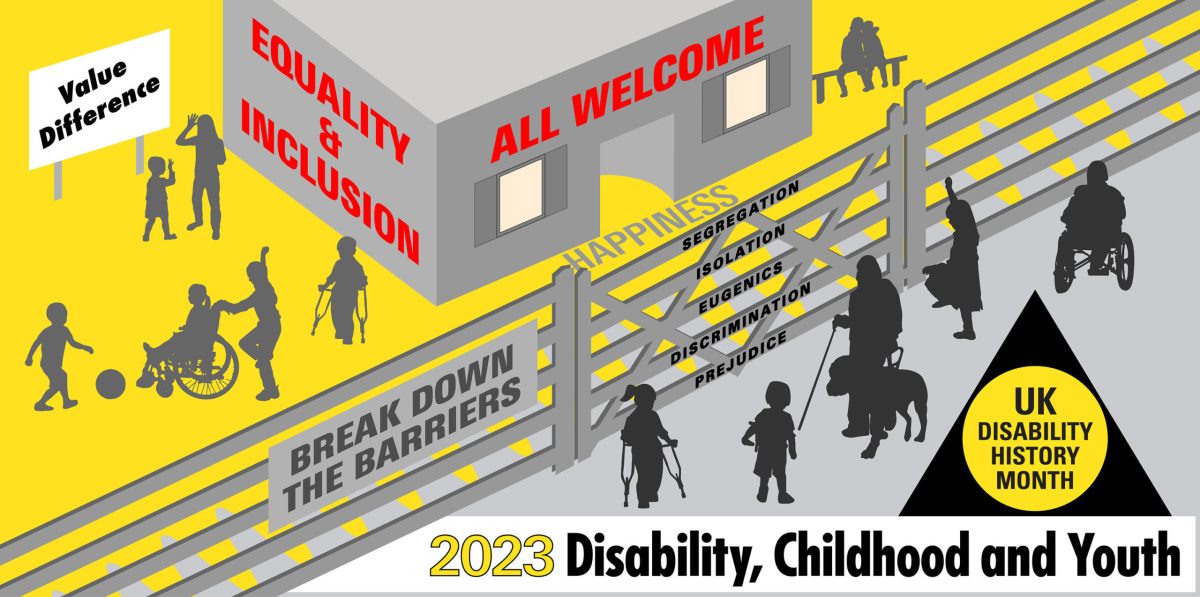
Celebrating UK Disability History Month (UKDHM)

From Thursday 16 November to Saturday 16 December 2023, we will be celebrating UK Disability History Month (UKDHM). This provides a platform for highlighting the struggle disabled people continue to face for equality and human rights.

This year’s UKDHM explores the experiences of disabled children and young people in the past, present, and future. In the UK, there are 16 million disabled people, and 11% of children are disabled. Even though 80% of adults become disabled once they reach working age, some suffer from delayed diagnoses or hidden conditions since childhood.

In recognition of Disability History Month, organisations should reflect on their policies and practices concerning disabled people. Identifying areas for improvement and developing strategies for ensuring the highest quality of care for disabled people can be done by examining the historical context. Involving disabled individuals in decision-making processes, establishing disability-friendly policies, and implementing training programs may be part of this process.

In order to ensure that all children and young people with long term impairments are not subjected to social exclusion due to stigma, stereotypes, negative attitudes, and socially created barriers in the environment and in the way things are organised, Disability History Month draws upon the Social Model/Human Rights approach.

During Disability History Month, disabled individuals are celebrated for their achievements and contributions at work. By celebrating inclusion, stereotypes can be challenged and barriers broken down, leading to a more diverse and equal society.

What can workplace leaders do to better support their disabled staff?

Employee Resource Groups

Staff Disability Networks can play a crucial role in promoting diversity and inclusion in the workplace. Discrimination and inequality in the workplace can be addressed through it as a platform for employee interaction. It is through such networks that a more inclusive and equitable work environment can be created.

Executive sponsors

Executive sponsors can play a crucial role in supporting disability inclusion in the workplace by advocating for, promoting, and implementing policies and practices that enable individuals with disabilities to thrive.

As an executive sponsor, you can have a significant impact on fostering disability inclusion in the workplace. By taking actions such as raising awareness, promoting diversity, supporting employees, and leading by example, you can create a more inclusive and equitable work environment for all employees. Remember that disability inclusion is not just the right thing to do; it is also good for business, as it attracts top talent, enhances employee engagement, and promotes innovation and productivity.

Awareness and Education

1. Educate yourself: Familiarise yourself with disability-related terminology, laws, and regulations.

2. Encourage education and training: Provide opportunities for employees to learn about disability inclusion and accommodations.

3. Promote disability awareness: Organise workshops, conferences, or events to raise awareness about disability inclusion.

Recruitment and Selection

1. Advertise inclusive opportunities: Highlight your commitment to disability inclusion in your job postings and recruitment materials.

2. Encourage diversity: Encourage recruiting managers to consider qualified individuals with disabilities for open positions.

3. Provide accommodations: Offer reasonable adjustments to applicants with disabilities during the recruitment process, such as accessible interview venues or interpreters for interviews.

Employee Support and Accommodations

1. Establish an adjustments process: Develop a formal process to request and provide reasonable workplace adjustments to employees with disabilities.

2. Promote accessible workplace: Ensure that the workplace is physically and technologically accessible, including accessible entrances, elevators, and assistive technology.

3. Provide equal access to benefits: Ensure that individuals with disabilities have equal access to employee benefits, such as training, flexible working and professional development opportunities.

Leadership and Communication

1. Lead by example: Model inclusive behaviour and actively support individuals with disabilities.

2. Include disability in diversity initiatives: Include disability in your overall diversity initiatives, such as employee resource groups or diversity training programs.

3. Actively communicate: Keep employees informed about disability inclusion efforts, policies, and progress.

Collaboration and Engagement

1. Partner with disability organisations: Collaborate with disability organisations, advocacy groups, and individuals with disabilities themselves to gain insights and best practices.

2. Empower employees: Encourage employees with disabilities to share their perspectives and actively participate in decision-making processes.

3. Recognition and rewards: Recognise the contributions of individuals with disabilities and celebrate their achievements.

Time to Act

During UKDHM, leaders should take the opportunity to work with their disabled colleagues and hold up a mirror to the organisation and ask yourself what you are doing to be more inclusive of those with a disability or long term condition.

JD

Unveiling the Layers of Structural Inequality in the UK

Structural inequality is an issue that plagues societies around the world, and the United Kingdom is no exception. Despite being one of the world’s leading economies, the UK continues to grapple with deep-rooted disparities that affect various aspects of people’s lives. This blog post aims to shed light on the structural inequalities present within the UK and the implications they have on individuals and communities.

1. Education Disparities:

Education serves as a crucial pillar for social mobility and equal opportunities. However, structural inequalities within the UK education system contribute to disparities that perpetuate social divisions. Research has shown that students from disadvantaged backgrounds often face limited access to quality education, resulting in lower academic achievement and reduced prospects for future success. This perpetuates a cycle of inequality that is difficult to break.

2. Income and Wealth Inequality:

A significant aspect of structural inequality in the UK revolves around income and wealth disparities. Despite economic growth, the gap between the richest and poorest continues to widen. This inequality is reflected in unequal wages, limited job opportunities, and the concentration of wealth in the hands of a few. The impact of this inequality is felt in various aspects of life, including access to healthcare, housing, and basic necessities.

3. Housing Inequality:

The housing market in the UK has long been plagued by structural inequality. Skyrocketing house prices, limited affordable housing options, and an increasing number of people living in insecure accommodation contribute to a cycle of housing inequality. This disparity disproportionately affects marginalized communities, leading to overcrowding, homelessness, and a lack of stability.

4. Racial and Ethnic Inequality:

Another dimension of structural inequality in the UK is racial and ethnic disparities. Despite being a diverse society, racial and ethnic minorities often face discrimination and unequal treatment in various spheres of life, including employment, healthcare, and the criminal justice system. These inequalities not only hinder social cohesion but also perpetuate systemic barriers that limit opportunities for marginalized communities.

5. Health Inequities:

Health outcomes in the UK are significantly influenced by structural inequalities. Socioeconomic factors such as income, education, and employment opportunities play a crucial role in determining the overall health and well-being of individuals. Research has consistently shown that individuals from lower socioeconomic backgrounds experience poorer health outcomes, including higher rates of chronic diseases and reduced life expectancy.

Addressing structural inequalities at a strategic level

Addressing structural inequality in the UK requires a multifaceted approach that involves policy changes, social awareness, and collective action. By acknowledging and understanding the various dimensions of inequality, we can work towards creating a more equitable society. The fight against structural inequality is not an easy one, but it is a necessary one for building a fairer and more inclusive future for all individuals in the United Kingdom.

Actions that can support reducing structural inequalities

Organisational EDI Strategy

The CIPD recommends a coherent strategy for fostering an inclusive culture that embraces diversity across the organisation. For the strategy to succeed, “it must be supported by organisational values as well as leader and manager behaviour that reflects the importance of EDI”.

Pay Gap Reporting

According to People Magazine, the reporting of pay gaps is one “meaningful way to provide equality data that can be assessed, benchmarked, and used to drive change”.

Law requires organisations with more than 250 employees to report their gender pay gap. This will help an organisation demonstrate a commitment “to tackling pay disparities between men and women by publishing an annual gender pay gap report, which includes an action plan to improve women’s equality and fairness”.

Training and Development

ACAS state that “training, development, and promotion of staff should also consider EDI”. During new staff inductions, organisation should provide EDI training, so everyone is on board with the equality, diversity, and inclusion policy right away. In addition, its good practice to provide training and development for employees and managers so they can access opportunities without prejudice. Training for performance review processes and promotions ensures that no questions arise about an employee’s fit due to their protected characteristic.

Accessible Information

The Office for Disability Issues states that “accessible communication formats (also called alternative formats) is crucial to reaching all your audience”.

By automatically captioning virtual meetings, recording post-events, and adding subtitles to short videos, this can be accomplished. Furthermore, events should advise on speakers, slides, short videos, polls, breakout sessions, and virtual chats, as well as provide prior knowledge about the format of events. On request, the organisation should be able to provide documents in easy-to-read formats and forms in large print. Similarly, an organisations website should reflect this as well, supporting zooming in up to 200% without spilling text off the screen, navigating the website with just a keyboard, using speech recognition software to navigate the website, and using a screen reader to listen to the website. 

JD

Managing neurodiversity in the workplace

According to Harvard HealthNeurodiversity refers to diversity in the human brain and cognition, for instance in sociability, learning, attention, mood, and other mental functions. It provides an inclusive view of cognitive diversity, highlighting the differences at a neuro-biological level while considering the socio-cultural contexts of a human’s lived experience.  

Employers need to be mindful as to how the business set up helps support those with different neurological conditions to create a diverse workforce. This includes:

  • · Understanding the importance of managing neurodiversity at work.
  • · Understanding how to manage neurodiversity at work, and 
  • · Being better able to support those with different neurological conditions. 

In 2021, a Harvard Health report described the idea that people experience and interact with the world around them in many different ways; there is no one “right” way of thinking, learning, and behaving, and differences are not viewed as deficits

The report explains how neurodiversity advocates encourage inclusive, non-judgmental language. While many disability advocacy organizations prefer person-first language (“a person with autism,” “a person with Down syndrome”), some research has found that the majority of the autistic community prefers identity-first language (“an autistic person”).  

Therefore, rather than making assumptions, it is best to ask directly about a person’s preferred language, and how they want to be addressed. Knowledge about neurodiversity and respectful language is also important for clinicians, so they can address the mental and physical health of people with neurodevelopmental differences. 

According to Professor Amanda Kirby, CEO of Do-it Solutions Limited and Campaigner for Neurodiversity, Neurodiversity is the way we think, move, act, communicate and process information. 

She explains, “we are all different. Some people have challenges and strengths associated with conditions such as Attention Deficit Hyperactivity Disorder (ADHD), Dyslexia, Autism, Dyscalculia, Developmental Coordination Disorder/Dyspraxia, Developmental Language Disorder. 

There is not one person or one condition that defines our differences ( or our similarities). We are too often defined by what we can’t do and not by what we can. 

The reality is that some people will gain a diagnosis of Dyslexia, for example, and others diagnosed as having Autism or ADHD. However, who gains a diagnosis often can be a bit of a lottery. It can depend on whether difficulties are identified as a child by a teacher who spots some signs of Dyslexia or Dyspraxia (also known as Developmental Coordination Disorder) or by a parent who knows something about one of these conditions.

It often requires tenacity on the part of the parent or individual and also depends on local waiting lists and service availability. For many people it can be a lengthy and at times costly process in terms of stress. Some people are paying for assessments as an alternative at a high cost. 

For most people the starting position is to understand their challenges and gain some practical strategies to help as soon as possible. By understanding their unique spiky profile, you have a starting point to help to support them to be their best. 

A person-centred approach means that strategies are tailored to EACH PERSON. It also importantly means harnessing strengths, to build confidence, self-esteem and become resilient.” 

Professor Kirby’s research produced an effective guide for employers to making different adjustments for neurodivergent people, where three elements can be easily changed. Take a look at the graphic below and consider what your organisation can do to better understand how to manage neurodiversity at work, and how to support those with different neurological conditions.

I’d love to hear where you are on your journey to becoming an neurodiverse workplace. Let me know in the comments…

Race Equality Week

February 6th marks the start of Race Equality Week. The theme for Race Equality Week 2023 is #ItsEveryonesBusiness. This theme was chosen as 79% of respondents believe it would have a meaningful impact on tackling race inequality.

Race Equality Week is an annual UK-wide movement uniting thousands of organisations and individuals to address the barriers to race equality in the workplace. The events of 2020, including the Black Lives Matter movement and the disproportionate impact of COVID-19 on ethnic minority communities, has heightened public consciousness of race inequality

Since the flurry of pledges many organisations were making back in 2020 to become more inclusive, which for many included black squares, signing charters and race action plans, progress in addressing racial inequality is proving to be a challenge.

Race Equality Matters’ survey highlighted that the majority of respondents felt very little had changed in the last 12 months. Whilst some organisations are now taking a nudge approach, which is starting to impact change. Many have struggled to know where to start.

Thanks to Sy Joshua at Race Equality First for these actions to ensure you are on top of your game when it comes to Race Equality in the Workplace: 

1. Book your team onto Anti-racism training

It’s not enough to be ‘not racist’, what is your team doing to be Anti-racist? Are you taking active steps to remove racial barriers and obstacles from the workplace.

2. Review your diversity & inclusion policy

Too many Diversity and Inclusion policies are a ‘copy & paste’ job. Does your policy contain your organisation’s DNA around EDI? If not, a full review may be overdue!

3. Encourage employee-led initiatives promoting racial equality

Empowering employees towards coproduction and including ‘lived experience,’ is a must in ‘moving the dial’ towards more inclusive spaces.

4. Ensure inclusive initiatives are outcome focused

Don’t forget to measure the impact your initiatives are having on attitudes, behaviour and workplace culture.

I’d love to hear where you are on your journey to becoming an anti-racist workplace. Let me know in the comments…

Equality, Diversity & Human Rights Week 2019, 13-17 May

From 13-17 May 2019 the NHS will be celebrating the eighth Equality, Diversity and Human Rights Week #EQW2019. Co-ordinated by NHS Employers, #EQW2019 is a national platform for organisations to highlight their work to create a fairer, more inclusive NHS for patients and staff.

EQW2019

This week of activity aims to raise awareness of equality, diversity and human rights issues in the NHS and celebrate best practice. As the largest employer in Europe, with over 1.3 million staff, the NHS has a responsibility to remain at the forefront of the inclusion and fairness agenda for patients and staff.

Diverse, inclusive, together

The theme is diverse, inclusive, together and has been chosen to reflect the move across the health and social care sector towards even greater collaboration and integration – as reflected in the publication of the recent NHS Long term Plan. At the heart of the plan is changing culture, with a commitment towards ensuring respect, equality and diversity within the NHS.

Working together makes the NHS stronger, we meet standards, enable change and collectively invest in the creation of a diverse and inclusive NHS workforce to deliver a more inclusive service and improved patient care.

To celebrate the event, my organisation has a range of interactive and informative events across the week.  Throughout #EQW2019, we will have a daily equality and diversity bulletin, each examining a different aspect of equality and diversity; furthermore we have a video webinar on the importance of diversity in the workplace as well as an interactive Q&A session with the Trusts own Equality, Diversity and Inclusion Lead. 

Take a look at the informative video series from John Deffenbaugh (NHS Leadership Academy) who leads a discussion panel on the equality challenges faced by the NHS and the steps that can be undertake to overcome them, discussion 1 is shown below.

JD


Advancing Equality for Disabled Staff – Learning from the NHS

Workplace equality and diversity initiatives have grown in recent years and have focused on a range of protected characteristics identified in the Equality Act 2010. However, much of that focus has been on Race, Sexual Orientation, Gender Reassignment and Religion. Yet, disability affects almost one if five of the UK population and statistically disabled people are more likely to be unemployed or economically inactive.

Primarily, the Equality Act 2010 should focus our work on advancing equality of opportunity between people who share a protected characteristic and people who do not share it as well as fostering good relations between people who share a protected characteristic and people who do not share it.

Disability is still often misunderstood, especially in the case of mental health, and getting a better understanding of the lived experiences of our disabled staff must be a priority for employers. Only by having this understanding and input from staff can we actually advance equality of opportunity for disabled staff in the work place. Furthermore, by raising awareness of disability issues we can encourage organisational wide discussion and foster good relations between people with a disability and those without.

Some facts about disabilities in the UK:

  • There are around 13.3 million disabled people in the UK (almost one in five of the population).
  • 5 million disabled people are in employment, compared to 2.9 million in 2013.
  • In January 2016, the UK employment rate among working age disabled people was 46.5% (4.1 million), compared to 84% of non-disabled people.
  • Disabled adults are nearly three times as likely as non-disabled adults to have no formal qualifications, 30% and 11% respectively.
  • The average income of families with disabled children is £15,270, which is 23.5% below the UK mean income of £19,968. 21.8% have incomes that are less than 50% the UK mean.

NHS England launches the Workforce Disability Standard (WDES)

The NHS has recently launched the Workforce Disability Equality Standard (WDES) which is a set of ten specific measures (metrics) that will enable NHS organisations to compare the experiences of Disabled and non-disabled staff. This information will then be used by the relevant NHS organisation to develop a local action plan, and enable them to demonstrate progress against the indicators of disability equality.

Making a difference for disabled staff

The NHS employs close to 1.5 million people and so initiatives such as WDES are vital to better understand the experiences of their disabled staff. It will support positive change for existing employees, and enable a more inclusive environment for disabled people working in the NHS. Likewise, it will help identify good practice and compare performance regionally and by type of trust.

What can other sectors learn from the NHS Workforce Disability Equality Standard?

Large organisations need a snapshot of the experiences of their disabled staff in key areas. By providing comparative data between disabled and non-disabled staff, this information can be used to understand where key differences lie; and will provide the basis for the development of action plans, enabling organisations to track progress on a year by year basis. This provides a mirror for the organisation to hold up to itself, to see whether or not it sees a reflection of the communities that it serves.

JD

Who Leads Equality & Diversity in an Organisation?

Hopefully, you do. In a large organisation the leadership of equality and diversity may take a number of different forms ranging from the Head of Equality, Diversity and Inclusion to EDI Coordinator or EDI Lead. Sometimes the role is a dedicated full or part-time role but other times it might be a secondary role of an existing manager. Frequently, with equality and diversity’s focus being on people EDI leadership often falls to the Human Resources department.

Once in post, the EDI lead needs to establish what the expectations of role will be? Are there key performance indicators? How will performance or impact be measured? What does success look like? What is the vision for equality and diversity? However, it is also worth considering that one member of staff cannot singlehandedly change the culture of an organisation. Instead, the EDI lead needs to be able to form effective teams because only through collaboration and effective project management can success be achieved. Furthermore, skills in influencing are vital because often the EDI lead will need to challenge and influence staff who he or she does not directly line manage, this is where high level skills in communication are essential.

When a clear set of goals have been agreed it is important to put together an effective action plan that can drive changes and the success of which is easy to measure. Targets set should be SMART, that is Specific Measurable Achievable Realistic and Time Bound. By using SMART targets, you have a better chance that they can be achieved because by being Specific you can focus on a and specific need which is easy to understand and not open to interpretation. Then, by making the target Measurable you know you can measure its completion or success. It may sound simple but by making the target Achievable you know that you are not asking for the impossible. When a target is Realistic it gives confidence to those who will be tasked with delivering the target that it can be done and in the timescale provided. Finally, when a target is Time-bound it gives you a clear time scale for completion and it is easy to measure whether something has (or has not) met its time scales.

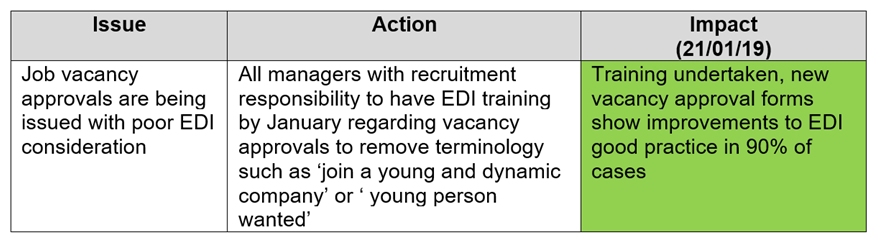
The action plan below demonstrates the use of SMART targets to implement EDI actions in an organisation. RAG rating an impact column is a quick way to see where you are having the most impact and where additional support might be needed.

example action plan

The Human Rights Act

In the UK, the fundamental rights and freedoms of its population are set out in the Human Rights Act 1998 and incorporates those rights as set out in the European Convention on Human Rights (ECHR) and ensures they are covered in domestic British law.

According to the Equality and Human Rights Commission, ‘the Act sets out our human rights in a series of ‘Articles’. Each Article deals with a different right. These are all taken from the ECHR and are commonly known as ‘the Convention Rights’:

  • Article 2: Right to life
  • Article 3: Freedom from torture and inhuman or degrading treatment
  • Article 4: Freedom from slavery and forced labour
  • Article 5: Right to liberty and security
  • Article 6: Right to a fair trial
  • Article 7: No punishment without law
  • Article 8: Respect for your private and family life, home and correspondence
  • Article 9: Freedom of thought, belief and religion
  • Article 10: Freedom of expression
  • Article 11: Freedom of assembly and association
  • Article 12: Right to marry and start a family
  • Article 14: Protection from discrimination in respect of these rights and freedoms
  • Protocol 1, Article 1: Right to peaceful enjoyment of your property
  • Protocol 1, Article 2: Right to education
  • Protocol 1, Article 3: Right to participate in free elections
  • Protocol 13, Article 1: Abolition of the death penalty

The Equality and Human Rights Commission identify three main effects of the Act:

1. You can seek justice in a British court – It incorporates the rights set out in the European Convention on Human Rights (ECHR) into domestic British law. This means that if your human rights have been breached, you can take your case to a British court rather than having to seek justice from the European Court of Human Rights in Strasbourg, France.

2. Public bodies must respect your rights – It requires all public bodies (like courts, police, local authorities, hospitals and publicly funded schools) and other bodies carrying out public functions to respect and protect your human rights.

3. New laws are compatible with Convention rights – In practice it means that Parliament will nearly always make sure that new laws are compatible with the rights set out in the European Convention on Human Rights (although ultimately Parliament is sovereign and can pass laws which are incompatible). The courts will also, where possible, interpret laws in a way which is compatible with Convention rights.

JD

Workplace Bullying and Harassment

Whilst bullying and harassment in the workplace is clearly something no organisation wants to see happening in their own back yard the law can actually confuse the matter further because bullying in the workplace is not actually unlawful but harassment is. However, employers are expected to have a zero tolerance towards bullying and harassment and to take action when it has been identified to protect working relationships.

Bullying and harassment can take different forms, some highly aggressive and obvious whilst others can be more subtle and less obvious. Bullying is rarely isolated and is often a pattern of behaviour where a number of incidents demonstrate that it is taking place. For ACAS, the Advisory, Conciliation and Arbitration Service, bullying and harassment in the workplace may include:

  • spreading malicious rumours, or insulting someone by word or behaviour (particularly on the grounds of age, race, sex, disability, sexual orientation and religion or belief)
  • copying memos that are critical about someone to others who do not need to know
  • ridiculing or demeaning someone – picking on them or setting them up to fail
  • exclusion or victimisation
  • unfair treatment
  • overbearing supervision or other misuse of power or position
  • unwelcome sexual advances – touching, standing too close, the display of offensive materials, asking for sexual favours, making decisions on the basis of sexual advances being accepted or rejected
  • making threats or comments about job security without foundation
  • deliberately undermining a competent worker by overloading and constant criticism
  • preventing individuals progressing by intentionally blocking promotion or training opportunities.

Harassment should not be tolerated in the workplace and under the Equality Act 2010 it is unlawful and whilst an employer has a duty to implement the act it is not required in law to have a policy regarding bullying and harassment. That said, it is certainly good practice to do so and most human resources departments will have one in place in order to be very clear on what is and what is not acceptable so workplace bullies can be held to account.

It is often useful for an EDI lead to examine the records of bullying and harassment claims/allegations in an organisation to see if there is a wider issue that requires intervention, training or policy changes in order to reduced such incidents.

JD