Celebrate Disability Pride: Enhancing Inclusion Year-Round

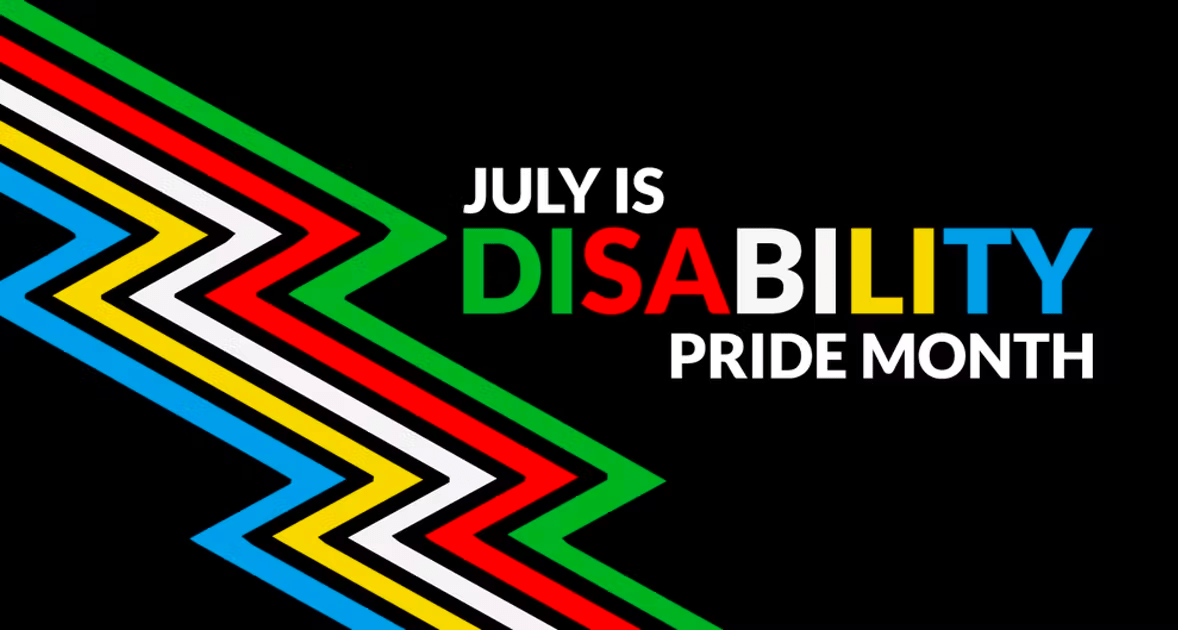
Is your organisation waving a flag during Disability Pride Month in July? Creating an inclusive workplace should not just be an annual event; it’s a year-round moral and strategic imperative.

Is your organisation waving a flag during Disability Pride Month in July? Creating an inclusive workplace should not just be an annual event; it’s a year-round moral and strategic imperative. Improving the experience of disabled staff fosters a culture of belonging, enhances employee well-being, and drives innovation through diverse perspectives. Here are some actionable steps organisations can take to ensure disabled employees thrive.

1. Foster a Culture of Inclusion

  • Leadership Commitment: Senior leaders must visibly champion disability inclusion, setting the tone for the entire organisation.
  • Awareness Campaigns: Celebrate initiatives like Disability Pride Month to educate staff and challenge stigmas.
  • Employee Networks: Support disability-focused employee resource groups to provide peer support and advocacy.

2. Create Accessible Work Environments

  • Physical Accessibility: Ensure offices, meeting rooms, and communal spaces are wheelchair-friendly and equipped with assistive technologies.
  • Digital Accessibility: Utilise accessible software and tools to ensure compatibility with screen readers and other assistive devices.
  • Flexible Working: Offer remote work options and adaptable schedules to accommodate diverse needs.

3. Provide Tailored Support

  • Individual Needs Assessments: Conduct personalised workplace assessments to identify and provide necessary adjustments, such as ergonomic equipment or modified duties.
  • Mental Health Resources: Offer counselling and mental health support tailored to the unique challenges disabled employees may face.
  • Mentorship Programmes: Pair disabled staff with mentors who understand their experiences and can provide guidance.

4. Invest in Training and Development

  • Disability Awareness Training: Equip all staff with the knowledge to foster respectful and inclusive interactions.
  • Unconscious Bias Workshops: Address implicit biases that may affect decision-making in recruitment, promotions, and daily interactions.
  • Leadership Training: Prepare managers to support team members with disabilities and effectively implement inclusive practices.

5. Encourage Open Communication

  • Feedback Mechanisms: Establish safe channels for staff with disabilities to share their experiences and suggest improvements.
  • Regular Check-ins: Managers should regularly discuss well-being and accessibility needs with their team members.
  • Transparent Policies: Communicate policies on reasonable adjustments and reporting discrimination.

6. Celebrate and Amplify Voices

  • Showcase Success Stories: Highlight the achievements of employees with disabilities to inspire and educate others.
  • Collaborate with Advocacy Groups: Partner with disability organisations to stay informed about best practices and emerging needs.
  • Inclusive Events: Host talks, workshops, and cultural events that centre the voices and experiences of disabled individuals.

Why it matters

Organisations that prioritise disability inclusion benefit from increased employee satisfaction, improved retention, and a stronger reputation as an employer of choice. Moreover, diverse teams are more innovative and better equipped to meet the needs of a diverse customer base.

A Call to Action

Improving the experience of disabled staff is an ongoing journey that requires commitment, collaboration, and continuous learning. By taking deliberate steps to foster an inclusive workplace, UK organisations can not only comply with legal standards but also lead the way in creating environments where everyone can thrive.

Let’s work together to build workplaces that reflect the values of equity, respect, and empowerment—not just during Disability Pride Month, but every day.

JD

Unveiling the Layers of Structural Inequality in the UK

Structural inequality is an issue that plagues societies around the world, and the United Kingdom is no exception. Despite being one of the world’s leading economies, the UK continues to grapple with deep-rooted disparities that affect various aspects of people’s lives. This blog post aims to shed light on the structural inequalities present within the UK and the implications they have on individuals and communities.

1. Education Disparities:

Education serves as a crucial pillar for social mobility and equal opportunities. However, structural inequalities within the UK education system contribute to disparities that perpetuate social divisions. Research has shown that students from disadvantaged backgrounds often face limited access to quality education, resulting in lower academic achievement and reduced prospects for future success. This perpetuates a cycle of inequality that is difficult to break.

2. Income and Wealth Inequality:

A significant aspect of structural inequality in the UK revolves around income and wealth disparities. Despite economic growth, the gap between the richest and poorest continues to widen. This inequality is reflected in unequal wages, limited job opportunities, and the concentration of wealth in the hands of a few. The impact of this inequality is felt in various aspects of life, including access to healthcare, housing, and basic necessities.

3. Housing Inequality:

The housing market in the UK has long been plagued by structural inequality. Skyrocketing house prices, limited affordable housing options, and an increasing number of people living in insecure accommodation contribute to a cycle of housing inequality. This disparity disproportionately affects marginalized communities, leading to overcrowding, homelessness, and a lack of stability.

4. Racial and Ethnic Inequality:

Another dimension of structural inequality in the UK is racial and ethnic disparities. Despite being a diverse society, racial and ethnic minorities often face discrimination and unequal treatment in various spheres of life, including employment, healthcare, and the criminal justice system. These inequalities not only hinder social cohesion but also perpetuate systemic barriers that limit opportunities for marginalized communities.

5. Health Inequities:

Health outcomes in the UK are significantly influenced by structural inequalities. Socioeconomic factors such as income, education, and employment opportunities play a crucial role in determining the overall health and well-being of individuals. Research has consistently shown that individuals from lower socioeconomic backgrounds experience poorer health outcomes, including higher rates of chronic diseases and reduced life expectancy.

Addressing structural inequalities at a strategic level

Addressing structural inequality in the UK requires a multifaceted approach that involves policy changes, social awareness, and collective action. By acknowledging and understanding the various dimensions of inequality, we can work towards creating a more equitable society. The fight against structural inequality is not an easy one, but it is a necessary one for building a fairer and more inclusive future for all individuals in the United Kingdom.

Actions that can support reducing structural inequalities

Organisational EDI Strategy

The CIPD recommends a coherent strategy for fostering an inclusive culture that embraces diversity across the organisation. For the strategy to succeed, “it must be supported by organisational values as well as leader and manager behaviour that reflects the importance of EDI”.

Pay Gap Reporting

According to People Magazine, the reporting of pay gaps is one “meaningful way to provide equality data that can be assessed, benchmarked, and used to drive change”.

Law requires organisations with more than 250 employees to report their gender pay gap. This will help an organisation demonstrate a commitment “to tackling pay disparities between men and women by publishing an annual gender pay gap report, which includes an action plan to improve women’s equality and fairness”.

Training and Development

ACAS state that “training, development, and promotion of staff should also consider EDI”. During new staff inductions, organisation should provide EDI training, so everyone is on board with the equality, diversity, and inclusion policy right away. In addition, its good practice to provide training and development for employees and managers so they can access opportunities without prejudice. Training for performance review processes and promotions ensures that no questions arise about an employee’s fit due to their protected characteristic.

Accessible Information

The Office for Disability Issues states that “accessible communication formats (also called alternative formats) is crucial to reaching all your audience”.

By automatically captioning virtual meetings, recording post-events, and adding subtitles to short videos, this can be accomplished. Furthermore, events should advise on speakers, slides, short videos, polls, breakout sessions, and virtual chats, as well as provide prior knowledge about the format of events. On request, the organisation should be able to provide documents in easy-to-read formats and forms in large print. Similarly, an organisations website should reflect this as well, supporting zooming in up to 200% without spilling text off the screen, navigating the website with just a keyboard, using speech recognition software to navigate the website, and using a screen reader to listen to the website. 

JD

Managing neurodiversity in the workplace

According to Harvard HealthNeurodiversity refers to diversity in the human brain and cognition, for instance in sociability, learning, attention, mood, and other mental functions. It provides an inclusive view of cognitive diversity, highlighting the differences at a neuro-biological level while considering the socio-cultural contexts of a human’s lived experience.  

Employers need to be mindful as to how the business set up helps support those with different neurological conditions to create a diverse workforce. This includes:

  • · Understanding the importance of managing neurodiversity at work.
  • · Understanding how to manage neurodiversity at work, and 
  • · Being better able to support those with different neurological conditions. 

In 2021, a Harvard Health report described the idea that people experience and interact with the world around them in many different ways; there is no one “right” way of thinking, learning, and behaving, and differences are not viewed as deficits

The report explains how neurodiversity advocates encourage inclusive, non-judgmental language. While many disability advocacy organizations prefer person-first language (“a person with autism,” “a person with Down syndrome”), some research has found that the majority of the autistic community prefers identity-first language (“an autistic person”).  

Therefore, rather than making assumptions, it is best to ask directly about a person’s preferred language, and how they want to be addressed. Knowledge about neurodiversity and respectful language is also important for clinicians, so they can address the mental and physical health of people with neurodevelopmental differences. 

According to Professor Amanda Kirby, CEO of Do-it Solutions Limited and Campaigner for Neurodiversity, Neurodiversity is the way we think, move, act, communicate and process information. 

She explains, “we are all different. Some people have challenges and strengths associated with conditions such as Attention Deficit Hyperactivity Disorder (ADHD), Dyslexia, Autism, Dyscalculia, Developmental Coordination Disorder/Dyspraxia, Developmental Language Disorder. 

There is not one person or one condition that defines our differences ( or our similarities). We are too often defined by what we can’t do and not by what we can. 

The reality is that some people will gain a diagnosis of Dyslexia, for example, and others diagnosed as having Autism or ADHD. However, who gains a diagnosis often can be a bit of a lottery. It can depend on whether difficulties are identified as a child by a teacher who spots some signs of Dyslexia or Dyspraxia (also known as Developmental Coordination Disorder) or by a parent who knows something about one of these conditions.

It often requires tenacity on the part of the parent or individual and also depends on local waiting lists and service availability. For many people it can be a lengthy and at times costly process in terms of stress. Some people are paying for assessments as an alternative at a high cost. 

For most people the starting position is to understand their challenges and gain some practical strategies to help as soon as possible. By understanding their unique spiky profile, you have a starting point to help to support them to be their best. 

A person-centred approach means that strategies are tailored to EACH PERSON. It also importantly means harnessing strengths, to build confidence, self-esteem and become resilient.” 

Professor Kirby’s research produced an effective guide for employers to making different adjustments for neurodivergent people, where three elements can be easily changed. Take a look at the graphic below and consider what your organisation can do to better understand how to manage neurodiversity at work, and how to support those with different neurological conditions.

I’d love to hear where you are on your journey to becoming an neurodiverse workplace. Let me know in the comments…

D&I Training – Know Your Audience

I am not a fan of the word training, especially as a diversity and inclusion trainer. Too often, when staff hear that they need to undertake compulsory diversity and inclusion training eyes roll, shoulders shrug and attitudes drop. It’s not rocket science to know that we mustn’t regurgitate the same old, tired equality training; instead we should be training for what staff actually need. However, that’s much easier said than done; clearly organisations will need to survey staff to find out what would actually benefit them in their day to day jobs rather than impose generic training content. In larger organisations, especially the public sector, staff surveys are common practice but good practice is to ask staff to self-identify a matrix of development needs where specifics can be recognised and acted upon.

For instance, the LGBT+ community are statically more likely to suffer from mental health difficulties – and those from the Trans community even more so. As such, would front line, clinical, mental health staff in the health care sector benefit from – for example – an awareness of the use of ‘pronouns’ for the LGBT+ community or the importance of not ‘dead naming’ Trans patients. They might benefit from this training but, on the other hand, if they are already aware, they might not need this. Fundamentally then the key thing to effective equality training, where staff are receptive, even evangelical, is not to repeat content, not to provide unnecessary content but to take the time to ask staff what would actually benefit them.

As a diversity and inclusion specialist, I am more interested in what support managers and staff actually want rather than simply putting on training for the sake of it. That support I also write down and publish in this blog on the diversity and inclusion challenges faced in the UK workforce. Though, in a ‘practice what you preach’ moment, I examined which of my diversity and inclusion articles were being read (and which were not) whilst exploring what people who search for diversity and inclusion information online actually wanted.

theequalityblog.co.uk has had over 1000 referrals from Google, Bing and other search engines, with the most popular search terms being ‘equality in faith schools’ and ‘equality protected characteristics’. By itself, it gives a strong indication as to the actual concerns (and the needs) of workforce staff have regarding equality. Specifically, in this case, a need for information  on how faith schools can demonstrate equality whilst being selective in their recruitment and how the protected characteristics, as defined by the Equality Act 2010, impact on staff and what managers need to know to support staff with protected characteristics. Interestingly, the most visited article on the website is Ramadan Mubarak – How to Support Employees Observing Ramadan, which again highlights the support needs of workforce managers in supporting staff who observe Ramadan. Subsequently, in the knowledge of what my audience are actually seeking I can tailor diversity and inclusion articles accordingly. In this way the information is relevant and what people actually need to help them in their day to day operations.

JD

Political Correctness? A Tick-Box Exercise? What is Equality and Diversity?

When leading Equality, Diversity and Inclusion (EDI) in an organisation it is not unusual to face challenges and barriers to achieving your targets from a common misconception as to what equality and diversity is all about. First and foremost, equality, diversity and inclusion is about people and not a ‘tick box’ exercise to satisfy government/employer statistics or legislation.

Perhaps the most common misconception reported by equality and diversity trainers is that EDI is often said – behind closed doors of course – to be ‘just political correctness’ or sometimes ‘political correctness gone mad’. Political correctness can be defined as ‘the avoidance of forms of expression or action that are perceived to exclude, marginalize, or insult groups of people who are socially disadvantaged or discriminated against’. It is often the term ‘forms of expression’ from definitions such as this which some interpret to mean jokes or work place banter. However, where someone is offended by your words it is not open to your interpretation it is open to theirs, as such if your opinion, jokes or workplace banter offends people then it is time keep such options, jokes or work place banter out of the workplace. To those who question whether equality and diversity is merely ‘political correctness gone mad’ I would ask the question whether it is acceptable for woman to be paid less than men for the same job, for part time staff or shift workers to have less opportunities in training, for the LGBTQ+ community to face harassment at work or for those from a minority to be excluded from jobs because of a different place of birth?  Sometimes, EDI needs to focus the minds of those not affected to understand how a lack of EDI impacts those who are affected and demonstrate how they can help bring fairness to their workplace.

However, even when supported, EDI can still be viewed by some in the workplace as ‘box to tick’ exercise or just another thing on a long list of other things that they are required to do by government. This fundamental lack of understanding as to the need for EDI practices often leads to a misunderstanding of intended actions and their outcomes which in its self often leads to a compartmentalised, tick-box approach. Nevertheless, what we are talking about here is implementing good EDI practice across an organisation rather enforcing a legal obligation on the workforce. It is this perception of enforced legislation that increases the risk of compartmentalisation and a tick-box approach. As such, it is this false perception of equality, diversity and inclusion that needs removing and this is where effective communication, workforce training and raising the profile of EDI can have a positive impact on its acceptance.

Hence, improving the understanding of EDI becomes about the message and vision set out by senior leaders. Essentially, EDI is about people and it focuses on treating all people fairly and ensuring there is equality of opportunity across the workforce. Naturally, isn’t this something we should all get on-board with? Unquestionably, fairness and equality of opportunity should be a priority for every organisation. As a result, the message needs to be very clear that EDI impacts on us all whether we be employees, employers, customers or other stakeholders including the communities we serve. For these reasons, we can see why good EDI practices must be embedded in all that we do.

JD

National Centre for Diversity – Grand Awards 2019

Tonight is the National Centre for Diversity’s Grand Awards 2019 where the Grimsby Institute of Further and Higher Education (GIFHE) have been shortlisted for the ‘Most Improved Organisation 2019’ Award.

Last year the Grimsby Institute was awarded Stage 2 Investors in Diversity by the National Centre for Diversity and listed at number 34 on their index of the Top 100 ‘Most Inclusive Organisations.’ This was a great celebration of the considerable efforts of staff across the Grimsby Institute had made to improve their equality and diversity practices.

It’s fantastic to see the improvements made to workplace equality and diversity being celebrated in this way as well as the individuals and organisations being awarded for their contribution. The very best of luck to all the the shortlisted individuals and organisations.

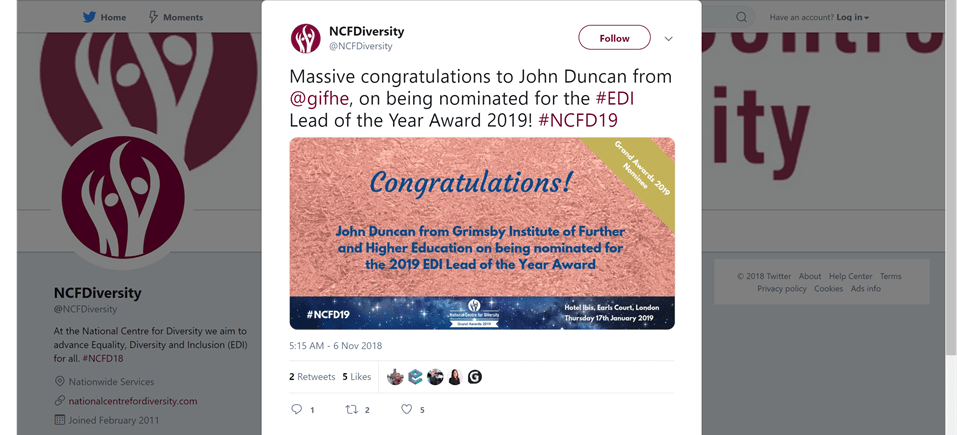
I was very proud to be nominated for the 2019 EDI Lead of the Year award and will be cheering on the Grimsby Institute as the awards are announced tonight.

https://www.nationalcentrefordiversity.com/

JD


Invisible banana skins thrown at black people every day, says John Barnes

Is racism in sport something that the education sector can tackle?

The football charity Kick it Out, football’s equality and inclusion organisation, work extensively with clubs and fan community groups to reduce racism, homophobia and other forms of discrimination through its education programmes.

However, by targeting a captive audience, so to speak, can schools, colleges and universities help organisations, like Kick it Out, challenge racism in sport? As an experienced educator, I am confident that racism is comprehensively challenged in classrooms up and down the country. However, if our educational institutions challenge racism when they hear it… it asks further questions as to why sports professionals are still subjected to racism from people who have been through our educational system. That said, as an experienced equality, diversity and inclusion professional, I am not confident that all workplaces in England would effectively challenge racist attitudes if they heard it in the workplace. As such, if racism is not challenged in the workplace as much as it should be then it is left solely to our educational institutions to drive an zero tolerance policy on racial abuse and racism in general.

More importantly, education is what is needed to help dispel racist attitudes and negative stereotypes amongst those learning skills for the workplace. In that way, we slowly influence the workplace where old fashioned racist attitudes can be challenged and hopefully diminished. A further knock on effect of this would be the impact it has on those who attend sporting events. That said, will sports fans themselves ever be in a position to feel suitably empowered to challenge racist abuse when they hear it in the stands?

Racism in sport recently hit the headlines again with extensive national press coverage when Raheem Sterling was allegedly on the receiving end of racial abuse during his side’s 2-0 defeat at Chelsea. It’s worth noting that in this situation Raheem Sterling is at work and as such is entitled to protection from harassment under the Equality Act 2010. Subsequently, if the allegations are found to be true, the player was racially abused at work and Chelsea football club are duty bound to investigate the incident and report there findings, taking appropriate action where appropriate.

Below is an thought-provoking article from Mandeep Sanghera, BBC Sport, highlighting the similarities between Raheem Sterling’s recent experience at Stamford Bridge and that of fellow Jamaican-born England international John Barns. Barnes famously back heeled a banana skin off the pitch in a game at Everton in 1988 and tells BBC Sport that the problem has not gone away since his playing days.

https://www.bbc.co.uk/sport/football/46504433

JD

Grammar schools given £50m diversity cash have only 2% poor pupils

The Governments drive to demonstrate its commitment to diversity in our schools has rather lost its way in recent years. For example, 16 grammar schools have won a share of a £50 Million expansion fund and yet, according to an analysis by the House of Commons Library, they have some of the worst records of admitting disadvantaged pupils.

The schools in receipt of the extra funding were announced last week and in order to qualify for the additional funding they had to submit a plan that would demonstrate how they would increase the proportion of poorer pupils in their schools. It’s worth remembering that grammar schools are not supposed to be for the privileged only, the private education sector is there to cater for those privileged enough to be able to pay for their children’s education.

However, figures on the schools’ admission of poor children has cast doubt on whether they were as committed to diversifying their intake as they claimed. These figures demonstrated that, on average, only 2% of pupils at the 16 approved schools were eligible for free school meals, which is generally considered the measure of child poverty in schools. For balance, it’s worth noting that, on average, pupils claiming free school meals at all schools in England is around 15%, with annual variations around this figure.

So, how do we tackle the lack of diversity in our grammar schools? Do we allow them to continue to be elitist institutions where entry is based on privilege rather than ability? To those who would argue that grammar schools have an entrance test and so are selective only on ability and not financial circumstances I would ask in that case how do you defend the position that only 2% of pupils in these schools come from a poor background? Is there a suggestion that poor pupils are not bright, are not academic, or not capable of learning at a grammar school level? Or, is this further evidence that the entry system to some of our grammar schools is flawed and based, in some cases, more on privilege that we like to admit?

If we are to ensure that our schooling system, both grammar schools and the academies, are to meet the needs of future generations then we need to ensure that school pupils experience diversity from a young age so they are adequately prepared for the work force of the future.

If we continue to endorse an elitist grammar system, where only the privileged can attended, then we further perpetuate the problems that we currently have in our society. As such, rather than challenge issues of inclusion, ignorance, acceptance and tolerance we naively allow the problems to carry on for a future generation to resolve.

What are your thoughts on this? Should grammar schools be forced to increase diversity in their ranks or should the grammar school system continue to be a stronghold of the well off in society? Answers on a postcard….

JD

University friends: By chance or by design?

It’s well known that students often end up making lifelong friendships with the fellow “freshers” they find themselves placed next to in their accommodation. But as Martin Rosenbaum, BBC Freedom of information specialist, asks ‘what determines who lives along side each other?’

According to the article below, a BBC research initiative has uncovered how some universities have surprising policies on how student rooms are allocated.

One of the significant benefits of going to university is the opportunity to interact with a more diverse range of people than students may be familiar with. That said, starting university, much like any large undertaking, can be a stressful event which is made easier if new students are mixed with people they are familiar with, or more likely to get on with. As such, higher education institutions have to help resolve the dilemma of student integration and happiness as part of their accommodation policies.

Some institutions, such as Bristol University, have an unashamedly explicit policy when it comes to housing their students – one that aspires “to create diverse, balanced communities within the residences with particular reference to nationality, gender, faculty, school type”.

Take a look at the article by Martin Rosenbaum below and let me know what you think… do you think social engineering in student accommodation will aid diversity or would a lack of intervention lead to social norms being further perpetuated?

https://www.bbc.co.uk/news/education-46430204

JD

School exclusions ‘fuelling gang violence’ – Barnardo’s

Councils across England are obliged to make every effort to reduce their NEET (Not in Education  Employment or Training) numbers which identify how many young people in the region are not actively involved in education, employment or training. In the main, Councils will work closely with schools to identify pupils who are at risk of not being involved in education, employment or training when they leave school whilst supporting the schools intervention strategies. Worryingly, where schoolchildren are excluded from education there is a significant rise in their likely hood to become NEET.

However, a recent report by Barnardo’s highlights a worrying trend that excluded schoolchildren are at serious risk of becoming involved in knife crime, the children’s charity has warned. Barnardo’s says excluded children are also at risk of “being groomed and exploited by criminal gangs”.

The charity said 47 councils, about one in three in England, had no spaces in pupil referral units (PRU), which look after excluded children. The government said a review of school exclusions and their impact on children was ongoing.

The research, which was carried out in collaboration with the All Party Parliamentary Group on Knife Crime, shows a 56% rise in exclusions in England since 2014. The group’s chairwoman, Sarah Jones, said knife crime was at its highest level on record and “our schools are on the front line”. She added: “Exclusions are rising and in many cases there is literally nowhere for those children to go. This is heartbreaking.” She said excluded children were “marked as failures”, and added professionals often talk about the “PRU to prison pipeline”.

Barnardo’s chief executive, Javed Khan, said: “We know children excluded from mainstream schools are at serious risk of being groomed and exploited by criminal gangs.” He urged the government to reduce the number of pupils excluded from schools and to improve alternative provisions so “vulnerable young people get the help they need to achieve of positive future”.

A government spokesperson said: “Permanently excluding a child from mainstream school should only ever be a last resort, and we support teachers in making these difficult decisions where they are justified.” They added the government was undergoing a review of exclusions led by the former education minister Edward Timpson.

The spokesperson said: “We are transforming alternative provision to improve outcomes for these children which helps them to flourish, backed by our £4m innovation fund that has created nine new projects around the country.”

https://www.bbc.co.uk/news/uk-46027265

JD