The Human Rights Act

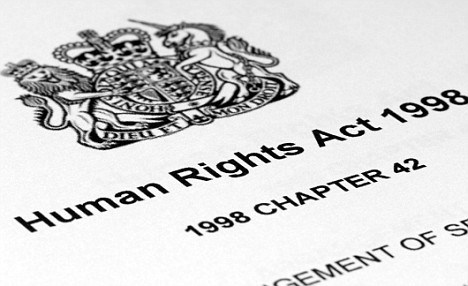
In the UK, the fundamental rights and freedoms of its population are set out in the Human Rights Act 1998 and incorporates those rights as set out in the European Convention on Human Rights (ECHR) and ensures they are covered in domestic British law.

According to the Equality and Human Rights Commission, ‘the Act sets out our human rights in a series of ‘Articles’. Each Article deals with a different right. These are all taken from the ECHR and are commonly known as ‘the Convention Rights’:

  • Article 2: Right to life
  • Article 3: Freedom from torture and inhuman or degrading treatment
  • Article 4: Freedom from slavery and forced labour
  • Article 5: Right to liberty and security
  • Article 6: Right to a fair trial
  • Article 7: No punishment without law
  • Article 8: Respect for your private and family life, home and correspondence
  • Article 9: Freedom of thought, belief and religion
  • Article 10: Freedom of expression
  • Article 11: Freedom of assembly and association
  • Article 12: Right to marry and start a family
  • Article 14: Protection from discrimination in respect of these rights and freedoms
  • Protocol 1, Article 1: Right to peaceful enjoyment of your property
  • Protocol 1, Article 2: Right to education
  • Protocol 1, Article 3: Right to participate in free elections
  • Protocol 13, Article 1: Abolition of the death penalty

The Equality and Human Rights Commission identify three main effects of the Act:

1. You can seek justice in a British court – It incorporates the rights set out in the European Convention on Human Rights (ECHR) into domestic British law. This means that if your human rights have been breached, you can take your case to a British court rather than having to seek justice from the European Court of Human Rights in Strasbourg, France.

2. Public bodies must respect your rights – It requires all public bodies (like courts, police, local authorities, hospitals and publicly funded schools) and other bodies carrying out public functions to respect and protect your human rights.

3. New laws are compatible with Convention rights – In practice it means that Parliament will nearly always make sure that new laws are compatible with the rights set out in the European Convention on Human Rights (although ultimately Parliament is sovereign and can pass laws which are incompatible). The courts will also, where possible, interpret laws in a way which is compatible with Convention rights.

JD

Workplace Bullying and Harassment

Whilst bullying and harassment in the workplace is clearly something no organisation wants to see happening in their own back yard the law can actually confuse the matter further because bullying in the workplace is not actually unlawful but harassment is. However, employers are expected to have a zero tolerance towards bullying and harassment and to take action when it has been identified to protect working relationships.

Bullying and harassment can take different forms, some highly aggressive and obvious whilst others can be more subtle and less obvious. Bullying is rarely isolated and is often a pattern of behaviour where a number of incidents demonstrate that it is taking place. For ACAS, the Advisory, Conciliation and Arbitration Service, bullying and harassment in the workplace may include:

  • spreading malicious rumours, or insulting someone by word or behaviour (particularly on the grounds of age, race, sex, disability, sexual orientation and religion or belief)
  • copying memos that are critical about someone to others who do not need to know
  • ridiculing or demeaning someone – picking on them or setting them up to fail
  • exclusion or victimisation
  • unfair treatment
  • overbearing supervision or other misuse of power or position
  • unwelcome sexual advances – touching, standing too close, the display of offensive materials, asking for sexual favours, making decisions on the basis of sexual advances being accepted or rejected
  • making threats or comments about job security without foundation
  • deliberately undermining a competent worker by overloading and constant criticism
  • preventing individuals progressing by intentionally blocking promotion or training opportunities.

Harassment should not be tolerated in the workplace and under the Equality Act 2010 it is unlawful and whilst an employer has a duty to implement the act it is not required in law to have a policy regarding bullying and harassment. That said, it is certainly good practice to do so and most human resources departments will have one in place in order to be very clear on what is and what is not acceptable so workplace bullies can be held to account.

It is often useful for an EDI lead to examine the records of bullying and harassment claims/allegations in an organisation to see if there is a wider issue that requires intervention, training or policy changes in order to reduced such incidents.

JD

Workplace Bias

Generally speaking, bias is a preference or prejudice for or against one person or group, especially in a way considered to be unfair. For example, an employer may give preferential treatment to potential employees from the same socioeconomic background as themselves. Alternatively, a manager my show bias through only offering development opportunities to female members of staff.

According to Robert Booth and Aamna Mohdin, writing for the Guardian newspaper in 2018, the extent to which ethnic minorities still suffer from bias is quite staggering. They commissioned a survey for the Guardian newspaper of 1,000 people from minority ethnic backgrounds who found they were consistently more likely to have faced negative everyday experiences – all frequently associated with racism – than white people in a comparison poll.

The survey found that 43% of those from a minority ethnic background had been overlooked for a work promotion in a way that felt unfair in the last five years – more than twice the proportion of white people (18%) who reported the same experience. Furthermore, the results show that ethnic minorities are three times as likely to have been thrown out of or denied entrance to a restaurant, bar or club in the last five years, and that more than two-thirds believe Britain has a problem with racism.

The article went on to explain, the Runnymede Trust, a racial equality think tank, described the findings as “stark” and said they illustrated “everyday micro-aggressions” that had profound effects on Britain’s social structure.  What’s more, the survey revealed that Muslims living in Britain – a large minority at around 2.8 million people – are more likely to have negative experiences than other religious groups. They are more likely than Christians, people with no religion and other smaller religions to be stopped by the police, left out of social functions at work or college and find that people seem not to want to sit next to them on public transport.

The effects of bias are not the same for all ethnicities. Half of black and mixed-race people felt they had been unfairly overlooked for a promotion or job application, compared with 41% of people from Asian backgrounds. Black people were more likely to feel they had to work harder to succeed because of their ethnicity.

It also found troubling levels of concern about bias in the workplace, with 57% of minorities saying they felt they had to work harder to succeed in Britain because of their ethnicity, and 40% saying they earned less or had worse employment prospects for the same reason.

Workplace bias needs to be combated by both training and a change in attitudes across an organisation. Where a culture of inclusion exists in an organisation you will find bias is greatly reduced and staff survey results will indicate a better level of satisfaction from groups open to historical workplace bias.

JD

Stereotypes and Stereotyping

Regrettably, stereotyping still occurs in our workplaces and is, in general, because of outdated and inaccurate views of certain groups in society. A stereotype can be said to be a commonly held but oversimplified image or idea of a particular type of person or social group.

Some stereotypes are regarding a different culture such as the concept of the Frenchman always wearing a black beret with a string of onions around his neck. Whereas, other stereotypes are about individuals or social groups such the stereotype that woman are carers, or men are strong and do all the work, or all Arabs and Muslims are terrorists, Irish people are drunks and eat potatoes, or that any feminine man is gay and any masculine woman is a lesbian. Stereotypes can sometimes be misinterpreted by others as just prejudice because they too are based upon a prior assumption about people from different cultures and races. However, where prejudice is a deliberate act stereotyping can come from ignorance of the facts or a lack of education around the subject.

Most cultures have some form of negative stereotype associated with them including black people, the Irish, those from the Middle East, the Polish, the Travelling community and Jewish people. However, gender stereotyping occurs where, for example, if you say that all women like to cook, you are stereotyping women. Similarly, stereotypes regarding a person’s sexual orientation are common and these stereotypes occur when someone has negative views on gays, lesbians, and transgender individuals.

Combating Negative Stereotypes in the Workplace

Stereotyping can lead people to hide some aspects of their lives from society, for example members of the gay or lesbian community may be afraid to admit their sexuality for fear of being judged. This can lead to the victims of stereotyping to have their lives led by fear.

As such, stereotypes have no place in the modern workplace and it is important that an organisation is seen as inclusive where a woman can work in construction, a man can work as a nurse, a man can work part-time, or be a caregiver and a wheelchair is no barrier to opportunity. A strong message from senior leaders is needed to demonstrate this vision and reinforce that negative stereotyping will not be tolerated.

Training can help where negative stereotypes are prevalent and certain industry sectors are more likely to attract a workforce with negative stereotypes than others. However, it is wrong to assume a more educated workforce means a more inclusive one, the well-educated can be as equally likely to hold some negative stereotypes of others as low skilled or poorly educated members of the workforce.

To this end, if you need to identify where negative stereotypes are prevalent in your organisation then a staff survey can help point you in the right direction. Certainly, it will help you identify, albeit anonymously, areas of the organisation who feel they are victims of stereotyping which is a start in being able to educate a workforce and remove negative and damaging stereotypes from the workplace.

JD

Discrimination in the Workplace

Discrimination is where an individual or group of individuals are treated differently due to their perceived membership of a certain group or social category. For example, an individual or group of individuals may suffer discrimination because they are from the Travelling Community. Under the Equality Act 2010, is it unlawful to discriminate against any individual (or group) based upon any of the protected characteristics.  In the workplace, this can take many forms including, for example,  black workers not being offered the same opportunity as white workers, women being paid less than men for doing the same job but can include age, colour, convictions, height, disability, ethnicity, family status, gender identity, genetic characteristics, marital status, nationality, race, religion, sex or sexual orientation.

Direct Discrimination

Direct discrimination is where an individual is treated differently or worse than others for certain reasons, it is often easy to spot such as being refused entry to a hotel because you are gay. The Citizens Advice Bureau describes direct discrimination through the following example: ‘You’re a saleswoman and you inform your employer that you want to spend the rest of your life living as a man. As a result of this, you’re moved to a role without client contact against your wishes. This is less favourable treatment because of gender reassignment. It would still be less favourable treatment even if your employer were to increase your salary to make up for the loss of job status.’

Indirect Discrimination

However, there are other times when you appear to be treated equally and in the same way as others but it actually has a worse impact on you because of who you are. This is known as indirect discrimination where a workplace practice, policy or rule applies to all but it has a worse effect on some than others. The Citizens Advice Bureau describes indirect discrimination through the following example: ‘A health club only accepts customers who are on the electoral register. This applies to all customers in the same way. But Gypsies and Travellers are less likely to be on the electoral register and therefore they’ll find it more difficult to join. This could be indirect discrimination against Gypsies and Travellers because of the protected characteristic of race. The rule seems fair, but it has a worse effect on this particular group of people.’

Justifying Discrimination

Not all discrimination is unlawful, if an employer treats you unfairly because of who you are they might have a good enough reason but may have to justify their discrimination. The Citizens Advice Bureau describes justifying discrimination through the following example: ‘A hospital advertises a surgeon’s job for which it requires at least ten years’ experience. You can’t meet this requirement because you’ve taken time off work to care for your children. As you’re a woman, this looks like indirect discrimination because of sex. But the hospital may be able to justify this, if it can show that the job can’t be done properly without that amount of experience. This is likely to be a legitimate aim.’

JD

Political Correctness? A Tick-Box Exercise? What is Equality and Diversity?

When leading Equality, Diversity and Inclusion (EDI) in an organisation it is not unusual to face challenges and barriers to achieving your targets from a common misconception as to what equality and diversity is all about. First and foremost, equality, diversity and inclusion is about people and not a ‘tick box’ exercise to satisfy government/employer statistics or legislation.

Perhaps the most common misconception reported by equality and diversity trainers is that EDI is often said – behind closed doors of course – to be ‘just political correctness’ or sometimes ‘political correctness gone mad’. Political correctness can be defined as ‘the avoidance of forms of expression or action that are perceived to exclude, marginalize, or insult groups of people who are socially disadvantaged or discriminated against’. It is often the term ‘forms of expression’ from definitions such as this which some interpret to mean jokes or work place banter. However, where someone is offended by your words it is not open to your interpretation it is open to theirs, as such if your opinion, jokes or workplace banter offends people then it is time keep such options, jokes or work place banter out of the workplace. To those who question whether equality and diversity is merely ‘political correctness gone mad’ I would ask the question whether it is acceptable for woman to be paid less than men for the same job, for part time staff or shift workers to have less opportunities in training, for the LGBTQ+ community to face harassment at work or for those from a minority to be excluded from jobs because of a different place of birth?  Sometimes, EDI needs to focus the minds of those not affected to understand how a lack of EDI impacts those who are affected and demonstrate how they can help bring fairness to their workplace.

However, even when supported, EDI can still be viewed by some in the workplace as ‘box to tick’ exercise or just another thing on a long list of other things that they are required to do by government. This fundamental lack of understanding as to the need for EDI practices often leads to a misunderstanding of intended actions and their outcomes which in its self often leads to a compartmentalised, tick-box approach. Nevertheless, what we are talking about here is implementing good EDI practice across an organisation rather enforcing a legal obligation on the workforce. It is this perception of enforced legislation that increases the risk of compartmentalisation and a tick-box approach. As such, it is this false perception of equality, diversity and inclusion that needs removing and this is where effective communication, workforce training and raising the profile of EDI can have a positive impact on its acceptance.

Hence, improving the understanding of EDI becomes about the message and vision set out by senior leaders. Essentially, EDI is about people and it focuses on treating all people fairly and ensuring there is equality of opportunity across the workforce. Naturally, isn’t this something we should all get on-board with? Unquestionably, fairness and equality of opportunity should be a priority for every organisation. As a result, the message needs to be very clear that EDI impacts on us all whether we be employees, employers, customers or other stakeholders including the communities we serve. For these reasons, we can see why good EDI practices must be embedded in all that we do.

JD

Leading Equality, Diversity & Inclusion – A Practical Guide for Managers

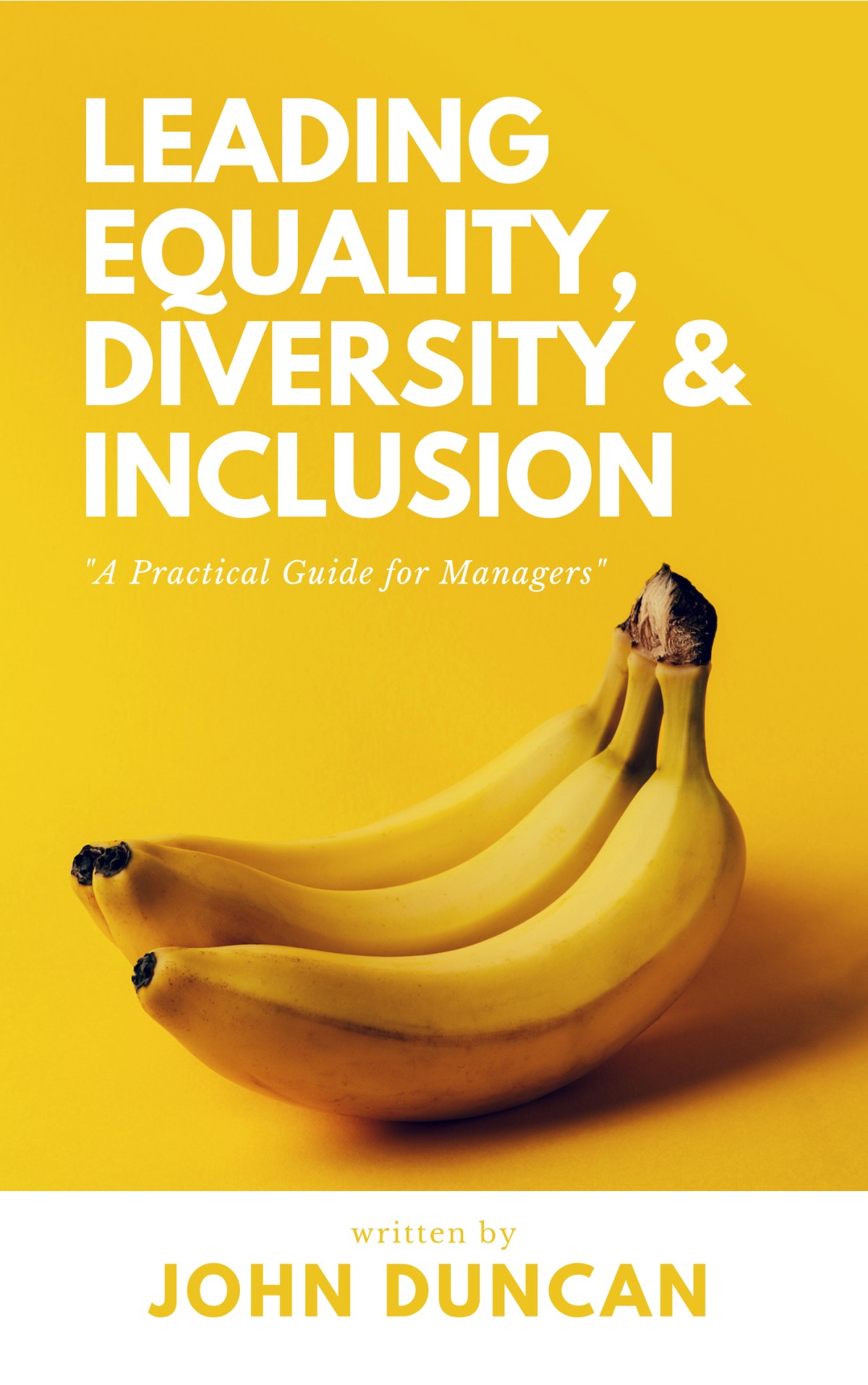
I am delighted to announce that my book ‘Leading Equality, Diversity & Inclusion – A Practical Guide for Managers’ is now available on Amazon.co.uk as an ebook download for Kindle.  The origins of this book come directly from this very blog and I will be sharing aspects of the book over the coming weeks. However, in the mean time, if you are involved with workplace EDI then please take a look at the book, it has a range of proven strategies that will hep build an inclusive culture in your workplace.

The books blurb goes something like this. ‘It’s easy to get lost in the rhetoric of equality and diversity, launching initiatives, giving training and explaining your vision. However, in truth, success is about what impact these initiatives, training and vision actually have. Have your actions made the workplace better for people? Getting traction for your initiatives is vital so that you can measure the success of equality actions. This ‘how to guide’ will help managers and those with responsibility for equality, diversity and inclusion make an impact in their workplace. Firstly, it explores the Equality Act 2010 before examining how you can effectively embed good practice in the workplace through a range of strategies that will help you to build an inclusive workplace.’

JD

The Equality Act 2010 – The Protected Characteristics

Through the ‘Protected Characteristics’ the Equality Act 2010 ensures that it is unlawful to discriminate against someone because of any of these characteristics which are defined by the University of Sheffield as:

  1. Age – The Act protects people of all ages. However, different treatment because of age is not unlawful direct or indirect discrimination if you can justify it (for example if you can demonstrate that it is a proportionate means of meeting a legitimate aim). Age is the only protected characteristic that allows employers to justify direct discrimination.
  2. Disability – The Act has made it easier for a person to show that they are disabled and protected from disability discrimination. Under the Act, a person is disabled if they have a physical or mental impairment which has a substantial and long term adverse effect on their ability to carry out normal day-to-day activities, which would include things like using a telephone, reading a book or using public transport.
  3. Gender reassignment – The Act provides protection for transsexual people. A transsexual person is someone who proposes to, starts or has completed a process to change his or her gender. The Act no longer requires a person to be under medical supervision to be protected– so a woman who decides to live as a man but does not undergo any medical procedures would be covered.
  4. Marriage and civil partnership – The Act protects employees who are married or in a civil partnership against discrimination. Single people are not protected.
  5. Pregnancy and maternity – A woman is protected against discrimination on the grounds of pregnancy and maternity during the period of her pregnancy and any statutory maternity leave to which she is entitled. During this period, pregnancy and maternity discrimination cannot be treated as sex discrimination. You must not take into account an employee´s period of absence due to pregnancy-related illness when making a decision about her employment.
  6. Race – For the purposes of the Act `race´ includes colour, nationality and ethnic or national origins.
  7. Religion or belief – In the Equality Act, religion includes any religion. It also includes no religion, in other words employees or jobseekers are protected if they do not follow a certain religion or have no religion at all. Additionally, a religion must have a clear structure and belief system.
  8. Sex – Both men and women are protected under the Act.
  9. Sexual orientation – The Act protects bisexual, gay, heterosexual and lesbian people.

JD

National Centre for Diversity – Grand Awards 2019

Tonight is the National Centre for Diversity’s Grand Awards 2019 where the Grimsby Institute of Further and Higher Education (GIFHE) have been shortlisted for the ‘Most Improved Organisation 2019’ Award.

Last year the Grimsby Institute was awarded Stage 2 Investors in Diversity by the National Centre for Diversity and listed at number 34 on their index of the Top 100 ‘Most Inclusive Organisations.’ This was a great celebration of the considerable efforts of staff across the Grimsby Institute had made to improve their equality and diversity practices.

It’s fantastic to see the improvements made to workplace equality and diversity being celebrated in this way as well as the individuals and organisations being awarded for their contribution. The very best of luck to all the the shortlisted individuals and organisations.

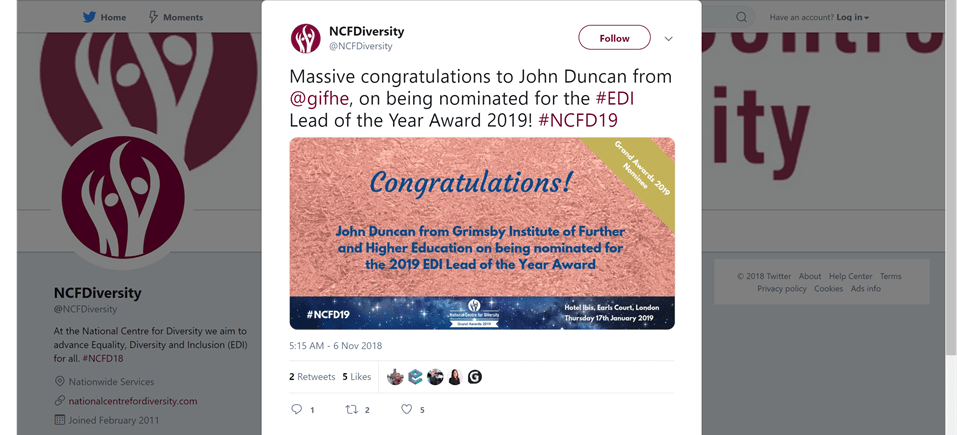
I was very proud to be nominated for the 2019 EDI Lead of the Year award and will be cheering on the Grimsby Institute as the awards are announced tonight.

https://www.nationalcentrefordiversity.com/

JD