The Gender Pay Gap

Equality & Diversity initiatives are designed to redress the balance where decades of inequality have led to high levels of disparity in the workplace. Gender Pay Gap reporting is no different and the Equality Act 2010 makes it a statutory duty for organisations with more than 250 employees to report on their gender pay gap, which looks to redress the long standing percentage difference between average hourly earnings for men and women. Currently, the national average mean gender pay gap is 17.9%, which indicates – on average – woman in the UK earn 17.9% less than men. In fact, the Guardian (April 2019) reported that a quarter of companies and public sector bodies have a pay gap of more than 20% in favour of men. However, according to the Financial Times (23 April 2019), Government policymakers hoped the transparency would shame large employers into taking swift action to narrow the difference between what they pay men and women.

What is the Gender Pay Gap?

The gender pay gap shows the difference between the average (mean or median) earnings of men and women. This is expressed as a percentage of men’s earnings e.g. women earn 15% less than men. Used to its full potential, gender pay gap reporting is a valuable tool for assessing levels of equality in the workplace, female and male participation, and how effectively talent is being maximised.

What is the difference between the gender pay gap and equal pay?

It’s worth noting that a gender pay gap isn’t the same as unequal pay. Equal pay – where men and women doing the same job should be paid the same – has been a legal requirement for nearly fifty years. Under the Equal Pay Act 1970, and more recently, the Equality Act 2010, it is unlawful to pay people unequally because they are a man or a woman. This applies to all employers, no matter how small.  As such, a company might have a gender pay gap if a majority of men are in top jobs, despite paying male and female employees the same amount for similar roles.

The gender pay gap shows the differences in the average pay between men and women. If a workplace has a particularly high gender pay gap, this can indicate there may be a number of issues to deal with, and the individual calculations may help to identify what those issues are. In some cases, the gender pay gap may include unlawful inequality in pay but this is not necessarily the case.

What is the Median pay gap?

The median pay gap is the difference in pay between the middle-ranking woman and the middle-ranking man.

If you place all the men and women working at a company into two lines in order of salary, the median pay gap will be the difference in salary between the woman in the middle of her line and the man in the middle of his.

What is the Mean pay gap?

The mean pay gap is the difference between a company’s total wage spend-per-woman and its total spend-per-man.

The number is calculated by taking the total wage bill for each and dividing it by the number of men and women employed by the organisation.

Why is there a Gender Pay Gap?

According to the BBC, there’s no one reason behind the gender pay gap – it’s a complex issue.

The Fawcett Society, a group which campaigns for equality, says caring responsibilities can play a big part. Women often care for young children or elderly relatives. This means women are more likely to work in part-time roles, which are often lower paid or have fewer opportunities for progression.  Another important factor is a divided labour market. Women are still more likely to work in lower-paid and lower-skilled jobs. Women currently make up 62% of those earning less than the living wage, according to the Living Wage Foundation. Discrimination is another cause of the gender pay gap. The Equality and Human Rights Commission (ECHR) has previously found that one in nine new mothers were either dismissed, made redundant or treated so poorly they felt they had to leave their job. This can create a gap in experience, leading to lower wages when women return to work.

Men also tend to take up the majority of the most senior roles at a company, which are the highest paid.

Who has to publish Gender Pay Gap data?

As stated earlier, it is a legal requirement for all employers (with 250 or more employees) to publish their gender pay report within one year of the ‘snapshot’ date: this year’s date being 31st March 2019.  However, whilst all employers must comply with the reporting regulations – for employers whose headcount varies they must comply with the reporting regulations for any year where they had a headcount of 250 or more employees on the ‘snapshot’ date.

What information needs to be published?

The following information must be reported by organisations:

  • Their mean gender pay gap
  • Their median gender pay gap
  • Their mean bonus gender pay gap
  • Their median bonus gender pay gap
  • Their proportion of males receiving a bonus payment
  • Their proportion of females receiving a bonus payment
  • Their proportion of males and females in each quartile pay band
  • A written statement, authorised by an appropriate senior person, which confirms the accuracy of their calculations. However, this requirement only applies to employers subject to the Equality Act 2010 (Gender Pay Gap Information) Regulations 2017.

Can companies be punished for a wide gender pay gap?

According to Lorna Jones, Business Reporter, BBC News, companies can’t be punished for a wide gender pay gap. But they might be punished for failing to publish their data, or for publishing inaccurate or misleading figures.

The Equality and Human Rights Commission (EHRC) is responsible for ensuring employers publish their pay gap figures. The EHRC set out plans for its enforcement policy in December. The EHRC says it will approach employers informally at first, but businesses could ultimately face “unlimited fines and convictions”.

As the EHRC is still consulting on these plans, it remains to be seen whether they can or will punish companies in this way. At the moment, there is no enforcement mechanism in the regulations on publishing pay gap data. The UK government says it will also publish sector-specific league tables, highlighting companies failing to address pay differences between men and women.

What can organisations do to reduce the Gender Pay Gap?

According to Dharishini David, Economics Correspondent with the BBC, gender pay gap reporting may not be enough: the government may need to get tougher. Ask gender pay specialists how to solve the problem and they’ll tell you there are many initiatives that companies can take – tackling unconscious bias, offering more flexible working and encouraging shared parental leave.

However, the issue doesn’t end at the office door. The experts say society needs to change.

For example, schools could encourage girls to take more STEM subjects: science, technology, engineering and maths. There should be more flexible, affordable childcare options. And men could take on more of the household chores.

However, societal change takes time, sometimes a generation, and currently we can report on the organisations gender pay gaps and look for short term internal solutions but overall society needs to change its attitude to gender, specifically in relation to employment, if we are to have pay equality across gender.

JD


LGBT Inclusion Tips for the Workplace – Stonewall

I have recently been working with Stonewall, the leading lesbian, gay, bisexual and transgender rights charity in the United Kingdom, in order for my organisation to partner with their Diversity Champions Programme.

stonewall-diversitychampion-logo-black-250As I looked further into setting up my own staff networks for protected characteristics I came across the following ten tips to help build an LGBT inclusive culture in an organisation via Stonewalls website and wanted to share it.

People perform better when they can be themselves, and if you’re looking to make sure that lesbian, gay, bi and trans (LGBT) people are fully included in your workplace, Stonewall have got some tips to help.

  1. Ensure that your policies are fully inclusive of LGBT people

This includes pensions, family and leave policies, health insurance and relocation allowances. You should make sure your policies explicitly mention LGBT people.

  1. Get people involved across your organisation

This could include setting up a network group specifically for LGBT employees; they’ll help you know where you’re doing well and which areas may need a new approach.

  1. Reward those involved in your LGBT network group

Embed their involvement in their appraisals; make being part of the network a desirable thing to be.

  1. Decide upon a clear strategy and tactics

Whether you want to increase the number of staff who are open about being LGBT, or revise your policies to make them fully inclusive, it’s crucial to know where you want to be and how you’re going to get there.

  1. Engage staff members who don’t identify as LGBT

Allies, as we call them, are a crucial element of ensuring inclusion for all. They can help spread the message that diversity is celebrated by your organisation.

  1. Ensure senior support

Making certain your senior leaders actively communicate their support for LGBT inclusion sends a positive message of acceptance for all across your organisation.

  1. Speak to your staff

Consulting employees – both LGBT and non-LGBT – about what inclusion looks like in your organisation will help ensure your strategy is appropriate and that all staff share your vision.

  1. Understand your staff

Getting to know the make-up of your staff through techniques such as monitoring will help ensure you effectively cater to any needs they may have.

  1. Celebrate your successes

Making sure your organisation is LGBT-inclusive is an ongoing journey, so it’s important to celebrate your successes, whatever size they may be, along the way. Every step is a step towards acceptance without exception for LGBT people.

  1. Become a Stonewall Diversity Champion

Diversity Champions is Britain’s leading programme for ensuring that your workplace is truly inclusive.

JD

Flexible Working for New Dads

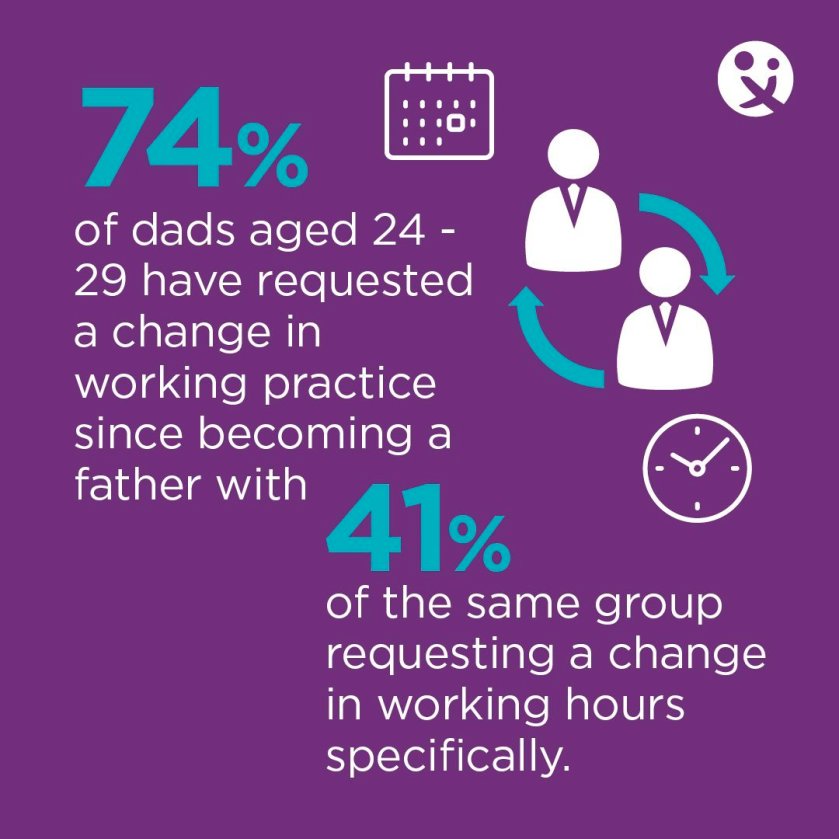
The role of the working mum is well-established; however in recent years we have seen the rise of the working dad. Increasingly, dads are making more requests for flexible working arrangements than ever before. In fact, a recent study by daddilife.com, produced in association with Deloitte, found that nearly two thirds (63%) of dads have requested a change in working pattern since becoming a father.

According to the study, modern day fathers are more involved in parenting than ever before. In fact, the study claims 87% of the dads surveyed are either mostly or fully involved in day to day parenting duties.  So much so that dads are increasingly putting fatherhood ahead of their careers, or at least accepting the need for a better balance between work and home life after the birth of a child.

Requests for flexible working patterns might include asking to spend a day or two working from home every week. Perhaps so they’re present for the nursery run, or for half an hour of play and interaction at lunchtime. Likewise, the need for flexible working could be for compressed or reduced hours, so new dads can spend more time with their children during those crucial early years. Whatever it is, new dads are asking for more flexible working in record numbers. This is because, more than ever, they value time spent with their young families.

Millennial-Dad-at-Work-SOCIALS13-1

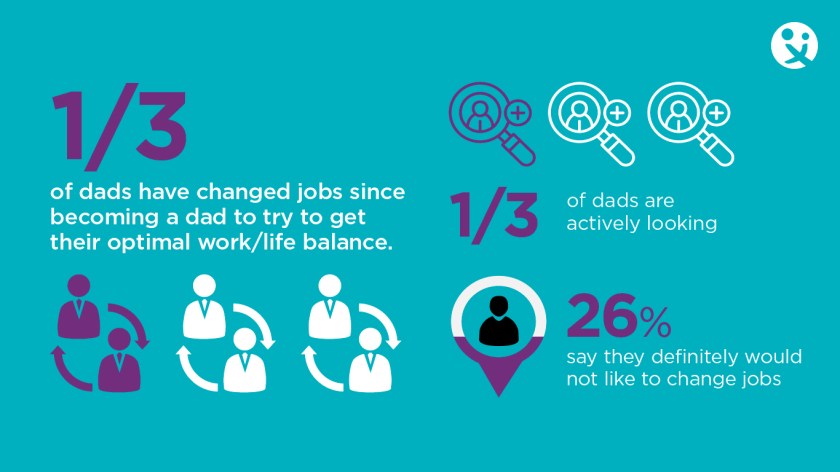
The study suggests that millennial dads are prepared to take drastic action to make sure they achieve a lifestyle that is good for work and good for their families. The research found that a third of dads had already changed jobs since becoming a father. In addition to that a further third were actively looking to change jobs. That’s an interesting finding as far as employers are concerned. It shows that offering flexible working for parents (both mums and dads) is likely to help them retain their top talent.

The study also suggests that, at the moment, too many organisations are letting good workers drift into the arms of other organisations. Specifically, the ones who are more sympathetic to the need for better flexibility at work.

Millennial-Dad-at-Work-BANNERS8-1

The worry is that not all employers are getting the message. For instance, the Deloitte research reveals that, while 14% of dads have requested to work from home on one or two days a week, less than one in five (19%) have had the request granted. Similarly, 40% of the dads interviewed have requested a change in working hours but nearly half of them (44%) have been turned down.

Millennial-Dad-at-Work-SOCIALS4

Dads are increasingly reporting  that the greatest life satisfaction comes from being an involved and present parent. Too often though, they bump up against a workplace environment that is sadly out of touch with that sentiment.

Millennial-Dad-at-Work-BANNERS3

Nearly half (45%) of working fathers regularly experience tension from their employer when trying to balance work and family life, while 37% regularly experience tension from colleagues, and 45% with their partners.

Millennial-Dad-at-Work-BANNERS6-1

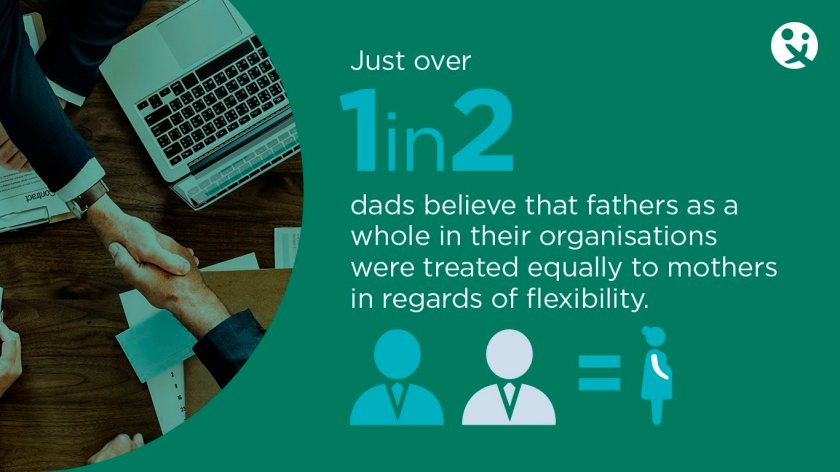
Society may be gradually more accepting of the fundamental role that fathers play in creating happy, well-adjusted children, but many workplaces are lagging behind.  As a result, dads are suffering because of that, and organisations are too. Unhappy workers are never at their most productive. As we’ve seen, businesses who fail to offer better work/life balance for parents risk losing top talent to more enlightened competitors.

Thanks to Hugh Wilson at daddilife.com for his excellent insight and commentary on the Millennial Dad at Work Report, which I have summarised here, to check out Hugh’s full article, click here. Hopefully reports such as this will lead to greater understanding and increased flexibility for working dads.

Logotype@2x

You can also check out the full published report by daddilife.com, in association with Deloitte, by clicking here.

JD

Equality, Diversity & Human Rights Week 2019, 13-17 May

From 13-17 May 2019 the NHS will be celebrating the eighth Equality, Diversity and Human Rights Week #EQW2019. Co-ordinated by NHS Employers, #EQW2019 is a national platform for organisations to highlight their work to create a fairer, more inclusive NHS for patients and staff.

EQW2019

This week of activity aims to raise awareness of equality, diversity and human rights issues in the NHS and celebrate best practice. As the largest employer in Europe, with over 1.3 million staff, the NHS has a responsibility to remain at the forefront of the inclusion and fairness agenda for patients and staff.

Diverse, inclusive, together

The theme is diverse, inclusive, together and has been chosen to reflect the move across the health and social care sector towards even greater collaboration and integration – as reflected in the publication of the recent NHS Long term Plan. At the heart of the plan is changing culture, with a commitment towards ensuring respect, equality and diversity within the NHS.

Working together makes the NHS stronger, we meet standards, enable change and collectively invest in the creation of a diverse and inclusive NHS workforce to deliver a more inclusive service and improved patient care.

To celebrate the event, my organisation has a range of interactive and informative events across the week.  Throughout #EQW2019, we will have a daily equality and diversity bulletin, each examining a different aspect of equality and diversity; furthermore we have a video webinar on the importance of diversity in the workplace as well as an interactive Q&A session with the Trusts own Equality, Diversity and Inclusion Lead. 

Take a look at the informative video series from John Deffenbaugh (NHS Leadership Academy) who leads a discussion panel on the equality challenges faced by the NHS and the steps that can be undertake to overcome them, discussion 1 is shown below.

JD


Advancing Equality for Disabled Staff – Learning from the NHS

Workplace equality and diversity initiatives have grown in recent years and have focused on a range of protected characteristics identified in the Equality Act 2010. However, much of that focus has been on Race, Sexual Orientation, Gender Reassignment and Religion. Yet, disability affects almost one if five of the UK population and statistically disabled people are more likely to be unemployed or economically inactive.

Primarily, the Equality Act 2010 should focus our work on advancing equality of opportunity between people who share a protected characteristic and people who do not share it as well as fostering good relations between people who share a protected characteristic and people who do not share it.

Disability is still often misunderstood, especially in the case of mental health, and getting a better understanding of the lived experiences of our disabled staff must be a priority for employers. Only by having this understanding and input from staff can we actually advance equality of opportunity for disabled staff in the work place. Furthermore, by raising awareness of disability issues we can encourage organisational wide discussion and foster good relations between people with a disability and those without.

Some facts about disabilities in the UK:

  • There are around 13.3 million disabled people in the UK (almost one in five of the population).
  • 5 million disabled people are in employment, compared to 2.9 million in 2013.
  • In January 2016, the UK employment rate among working age disabled people was 46.5% (4.1 million), compared to 84% of non-disabled people.
  • Disabled adults are nearly three times as likely as non-disabled adults to have no formal qualifications, 30% and 11% respectively.
  • The average income of families with disabled children is £15,270, which is 23.5% below the UK mean income of £19,968. 21.8% have incomes that are less than 50% the UK mean.

NHS England launches the Workforce Disability Standard (WDES)

The NHS has recently launched the Workforce Disability Equality Standard (WDES) which is a set of ten specific measures (metrics) that will enable NHS organisations to compare the experiences of Disabled and non-disabled staff. This information will then be used by the relevant NHS organisation to develop a local action plan, and enable them to demonstrate progress against the indicators of disability equality.

Making a difference for disabled staff

The NHS employs close to 1.5 million people and so initiatives such as WDES are vital to better understand the experiences of their disabled staff. It will support positive change for existing employees, and enable a more inclusive environment for disabled people working in the NHS. Likewise, it will help identify good practice and compare performance regionally and by type of trust.

What can other sectors learn from the NHS Workforce Disability Equality Standard?

Large organisations need a snapshot of the experiences of their disabled staff in key areas. By providing comparative data between disabled and non-disabled staff, this information can be used to understand where key differences lie; and will provide the basis for the development of action plans, enabling organisations to track progress on a year by year basis. This provides a mirror for the organisation to hold up to itself, to see whether or not it sees a reflection of the communities that it serves.

JD

Who Leads Equality & Diversity in an Organisation?

Hopefully, you do. In a large organisation the leadership of equality and diversity may take a number of different forms ranging from the Head of Equality, Diversity and Inclusion to EDI Coordinator or EDI Lead. Sometimes the role is a dedicated full or part-time role but other times it might be a secondary role of an existing manager. Frequently, with equality and diversity’s focus being on people EDI leadership often falls to the Human Resources department.

Once in post, the EDI lead needs to establish what the expectations of role will be? Are there key performance indicators? How will performance or impact be measured? What does success look like? What is the vision for equality and diversity? However, it is also worth considering that one member of staff cannot singlehandedly change the culture of an organisation. Instead, the EDI lead needs to be able to form effective teams because only through collaboration and effective project management can success be achieved. Furthermore, skills in influencing are vital because often the EDI lead will need to challenge and influence staff who he or she does not directly line manage, this is where high level skills in communication are essential.

When a clear set of goals have been agreed it is important to put together an effective action plan that can drive changes and the success of which is easy to measure. Targets set should be SMART, that is Specific Measurable Achievable Realistic and Time Bound. By using SMART targets, you have a better chance that they can be achieved because by being Specific you can focus on a and specific need which is easy to understand and not open to interpretation. Then, by making the target Measurable you know you can measure its completion or success. It may sound simple but by making the target Achievable you know that you are not asking for the impossible. When a target is Realistic it gives confidence to those who will be tasked with delivering the target that it can be done and in the timescale provided. Finally, when a target is Time-bound it gives you a clear time scale for completion and it is easy to measure whether something has (or has not) met its time scales.

The action plan below demonstrates the use of SMART targets to implement EDI actions in an organisation. RAG rating an impact column is a quick way to see where you are having the most impact and where additional support might be needed.

example action plan

The Human Rights Act

In the UK, the fundamental rights and freedoms of its population are set out in the Human Rights Act 1998 and incorporates those rights as set out in the European Convention on Human Rights (ECHR) and ensures they are covered in domestic British law.

According to the Equality and Human Rights Commission, ‘the Act sets out our human rights in a series of ‘Articles’. Each Article deals with a different right. These are all taken from the ECHR and are commonly known as ‘the Convention Rights’:

  • Article 2: Right to life
  • Article 3: Freedom from torture and inhuman or degrading treatment
  • Article 4: Freedom from slavery and forced labour
  • Article 5: Right to liberty and security
  • Article 6: Right to a fair trial
  • Article 7: No punishment without law
  • Article 8: Respect for your private and family life, home and correspondence
  • Article 9: Freedom of thought, belief and religion
  • Article 10: Freedom of expression
  • Article 11: Freedom of assembly and association
  • Article 12: Right to marry and start a family
  • Article 14: Protection from discrimination in respect of these rights and freedoms
  • Protocol 1, Article 1: Right to peaceful enjoyment of your property
  • Protocol 1, Article 2: Right to education
  • Protocol 1, Article 3: Right to participate in free elections
  • Protocol 13, Article 1: Abolition of the death penalty

The Equality and Human Rights Commission identify three main effects of the Act:

1. You can seek justice in a British court – It incorporates the rights set out in the European Convention on Human Rights (ECHR) into domestic British law. This means that if your human rights have been breached, you can take your case to a British court rather than having to seek justice from the European Court of Human Rights in Strasbourg, France.

2. Public bodies must respect your rights – It requires all public bodies (like courts, police, local authorities, hospitals and publicly funded schools) and other bodies carrying out public functions to respect and protect your human rights.

3. New laws are compatible with Convention rights – In practice it means that Parliament will nearly always make sure that new laws are compatible with the rights set out in the European Convention on Human Rights (although ultimately Parliament is sovereign and can pass laws which are incompatible). The courts will also, where possible, interpret laws in a way which is compatible with Convention rights.

JD

Workplace Bullying and Harassment

Whilst bullying and harassment in the workplace is clearly something no organisation wants to see happening in their own back yard the law can actually confuse the matter further because bullying in the workplace is not actually unlawful but harassment is. However, employers are expected to have a zero tolerance towards bullying and harassment and to take action when it has been identified to protect working relationships.

Bullying and harassment can take different forms, some highly aggressive and obvious whilst others can be more subtle and less obvious. Bullying is rarely isolated and is often a pattern of behaviour where a number of incidents demonstrate that it is taking place. For ACAS, the Advisory, Conciliation and Arbitration Service, bullying and harassment in the workplace may include:

  • spreading malicious rumours, or insulting someone by word or behaviour (particularly on the grounds of age, race, sex, disability, sexual orientation and religion or belief)
  • copying memos that are critical about someone to others who do not need to know
  • ridiculing or demeaning someone – picking on them or setting them up to fail
  • exclusion or victimisation
  • unfair treatment
  • overbearing supervision or other misuse of power or position
  • unwelcome sexual advances – touching, standing too close, the display of offensive materials, asking for sexual favours, making decisions on the basis of sexual advances being accepted or rejected
  • making threats or comments about job security without foundation
  • deliberately undermining a competent worker by overloading and constant criticism
  • preventing individuals progressing by intentionally blocking promotion or training opportunities.

Harassment should not be tolerated in the workplace and under the Equality Act 2010 it is unlawful and whilst an employer has a duty to implement the act it is not required in law to have a policy regarding bullying and harassment. That said, it is certainly good practice to do so and most human resources departments will have one in place in order to be very clear on what is and what is not acceptable so workplace bullies can be held to account.

It is often useful for an EDI lead to examine the records of bullying and harassment claims/allegations in an organisation to see if there is a wider issue that requires intervention, training or policy changes in order to reduced such incidents.

JD

Workplace Bias

Generally speaking, bias is a preference or prejudice for or against one person or group, especially in a way considered to be unfair. For example, an employer may give preferential treatment to potential employees from the same socioeconomic background as themselves. Alternatively, a manager my show bias through only offering development opportunities to female members of staff.

According to Robert Booth and Aamna Mohdin, writing for the Guardian newspaper in 2018, the extent to which ethnic minorities still suffer from bias is quite staggering. They commissioned a survey for the Guardian newspaper of 1,000 people from minority ethnic backgrounds who found they were consistently more likely to have faced negative everyday experiences – all frequently associated with racism – than white people in a comparison poll.

The survey found that 43% of those from a minority ethnic background had been overlooked for a work promotion in a way that felt unfair in the last five years – more than twice the proportion of white people (18%) who reported the same experience. Furthermore, the results show that ethnic minorities are three times as likely to have been thrown out of or denied entrance to a restaurant, bar or club in the last five years, and that more than two-thirds believe Britain has a problem with racism.

The article went on to explain, the Runnymede Trust, a racial equality think tank, described the findings as “stark” and said they illustrated “everyday micro-aggressions” that had profound effects on Britain’s social structure.  What’s more, the survey revealed that Muslims living in Britain – a large minority at around 2.8 million people – are more likely to have negative experiences than other religious groups. They are more likely than Christians, people with no religion and other smaller religions to be stopped by the police, left out of social functions at work or college and find that people seem not to want to sit next to them on public transport.

The effects of bias are not the same for all ethnicities. Half of black and mixed-race people felt they had been unfairly overlooked for a promotion or job application, compared with 41% of people from Asian backgrounds. Black people were more likely to feel they had to work harder to succeed because of their ethnicity.

It also found troubling levels of concern about bias in the workplace, with 57% of minorities saying they felt they had to work harder to succeed in Britain because of their ethnicity, and 40% saying they earned less or had worse employment prospects for the same reason.

Workplace bias needs to be combated by both training and a change in attitudes across an organisation. Where a culture of inclusion exists in an organisation you will find bias is greatly reduced and staff survey results will indicate a better level of satisfaction from groups open to historical workplace bias.

JD

Stereotypes and Stereotyping

Regrettably, stereotyping still occurs in our workplaces and is, in general, because of outdated and inaccurate views of certain groups in society. A stereotype can be said to be a commonly held but oversimplified image or idea of a particular type of person or social group.

Some stereotypes are regarding a different culture such as the concept of the Frenchman always wearing a black beret with a string of onions around his neck. Whereas, other stereotypes are about individuals or social groups such the stereotype that woman are carers, or men are strong and do all the work, or all Arabs and Muslims are terrorists, Irish people are drunks and eat potatoes, or that any feminine man is gay and any masculine woman is a lesbian. Stereotypes can sometimes be misinterpreted by others as just prejudice because they too are based upon a prior assumption about people from different cultures and races. However, where prejudice is a deliberate act stereotyping can come from ignorance of the facts or a lack of education around the subject.

Most cultures have some form of negative stereotype associated with them including black people, the Irish, those from the Middle East, the Polish, the Travelling community and Jewish people. However, gender stereotyping occurs where, for example, if you say that all women like to cook, you are stereotyping women. Similarly, stereotypes regarding a person’s sexual orientation are common and these stereotypes occur when someone has negative views on gays, lesbians, and transgender individuals.

Combating Negative Stereotypes in the Workplace

Stereotyping can lead people to hide some aspects of their lives from society, for example members of the gay or lesbian community may be afraid to admit their sexuality for fear of being judged. This can lead to the victims of stereotyping to have their lives led by fear.

As such, stereotypes have no place in the modern workplace and it is important that an organisation is seen as inclusive where a woman can work in construction, a man can work as a nurse, a man can work part-time, or be a caregiver and a wheelchair is no barrier to opportunity. A strong message from senior leaders is needed to demonstrate this vision and reinforce that negative stereotyping will not be tolerated.

Training can help where negative stereotypes are prevalent and certain industry sectors are more likely to attract a workforce with negative stereotypes than others. However, it is wrong to assume a more educated workforce means a more inclusive one, the well-educated can be as equally likely to hold some negative stereotypes of others as low skilled or poorly educated members of the workforce.

To this end, if you need to identify where negative stereotypes are prevalent in your organisation then a staff survey can help point you in the right direction. Certainly, it will help you identify, albeit anonymously, areas of the organisation who feel they are victims of stereotyping which is a start in being able to educate a workforce and remove negative and damaging stereotypes from the workplace.

JD