Unveiling the Layers of Structural Inequality in the UK

Structural inequality is an issue that plagues societies around the world, and the United Kingdom is no exception. Despite being one of the world’s leading economies, the UK continues to grapple with deep-rooted disparities that affect various aspects of people’s lives. This blog post aims to shed light on the structural inequalities present within the UK and the implications they have on individuals and communities.

1. Education Disparities:

Education serves as a crucial pillar for social mobility and equal opportunities. However, structural inequalities within the UK education system contribute to disparities that perpetuate social divisions. Research has shown that students from disadvantaged backgrounds often face limited access to quality education, resulting in lower academic achievement and reduced prospects for future success. This perpetuates a cycle of inequality that is difficult to break.

2. Income and Wealth Inequality:

A significant aspect of structural inequality in the UK revolves around income and wealth disparities. Despite economic growth, the gap between the richest and poorest continues to widen. This inequality is reflected in unequal wages, limited job opportunities, and the concentration of wealth in the hands of a few. The impact of this inequality is felt in various aspects of life, including access to healthcare, housing, and basic necessities.

3. Housing Inequality:

The housing market in the UK has long been plagued by structural inequality. Skyrocketing house prices, limited affordable housing options, and an increasing number of people living in insecure accommodation contribute to a cycle of housing inequality. This disparity disproportionately affects marginalized communities, leading to overcrowding, homelessness, and a lack of stability.

4. Racial and Ethnic Inequality:

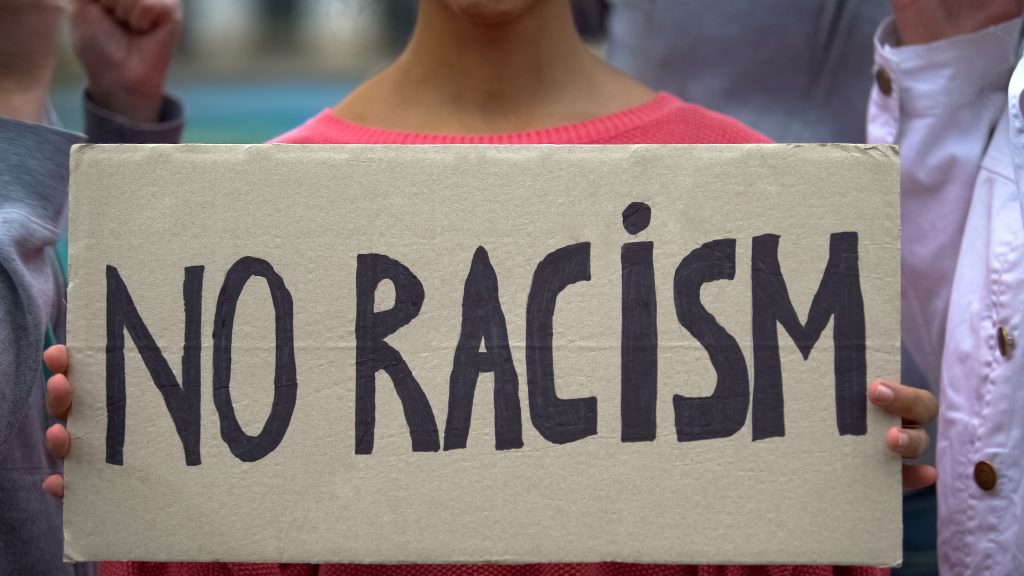
Another dimension of structural inequality in the UK is racial and ethnic disparities. Despite being a diverse society, racial and ethnic minorities often face discrimination and unequal treatment in various spheres of life, including employment, healthcare, and the criminal justice system. These inequalities not only hinder social cohesion but also perpetuate systemic barriers that limit opportunities for marginalized communities.

5. Health Inequities:

Health outcomes in the UK are significantly influenced by structural inequalities. Socioeconomic factors such as income, education, and employment opportunities play a crucial role in determining the overall health and well-being of individuals. Research has consistently shown that individuals from lower socioeconomic backgrounds experience poorer health outcomes, including higher rates of chronic diseases and reduced life expectancy.

Addressing structural inequalities at a strategic level

Addressing structural inequality in the UK requires a multifaceted approach that involves policy changes, social awareness, and collective action. By acknowledging and understanding the various dimensions of inequality, we can work towards creating a more equitable society. The fight against structural inequality is not an easy one, but it is a necessary one for building a fairer and more inclusive future for all individuals in the United Kingdom.

Actions that can support reducing structural inequalities

Organisational EDI Strategy

The CIPD recommends a coherent strategy for fostering an inclusive culture that embraces diversity across the organisation. For the strategy to succeed, “it must be supported by organisational values as well as leader and manager behaviour that reflects the importance of EDI”.

Pay Gap Reporting

According to People Magazine, the reporting of pay gaps is one “meaningful way to provide equality data that can be assessed, benchmarked, and used to drive change”.

Law requires organisations with more than 250 employees to report their gender pay gap. This will help an organisation demonstrate a commitment “to tackling pay disparities between men and women by publishing an annual gender pay gap report, which includes an action plan to improve women’s equality and fairness”.

Training and Development

ACAS state that “training, development, and promotion of staff should also consider EDI”. During new staff inductions, organisation should provide EDI training, so everyone is on board with the equality, diversity, and inclusion policy right away. In addition, its good practice to provide training and development for employees and managers so they can access opportunities without prejudice. Training for performance review processes and promotions ensures that no questions arise about an employee’s fit due to their protected characteristic.

Accessible Information

The Office for Disability Issues states that “accessible communication formats (also called alternative formats) is crucial to reaching all your audience”.

By automatically captioning virtual meetings, recording post-events, and adding subtitles to short videos, this can be accomplished. Furthermore, events should advise on speakers, slides, short videos, polls, breakout sessions, and virtual chats, as well as provide prior knowledge about the format of events. On request, the organisation should be able to provide documents in easy-to-read formats and forms in large print. Similarly, an organisations website should reflect this as well, supporting zooming in up to 200% without spilling text off the screen, navigating the website with just a keyboard, using speech recognition software to navigate the website, and using a screen reader to listen to the website. 

JD
The Stonewall debate – trans rights versus gender-critical beliefs

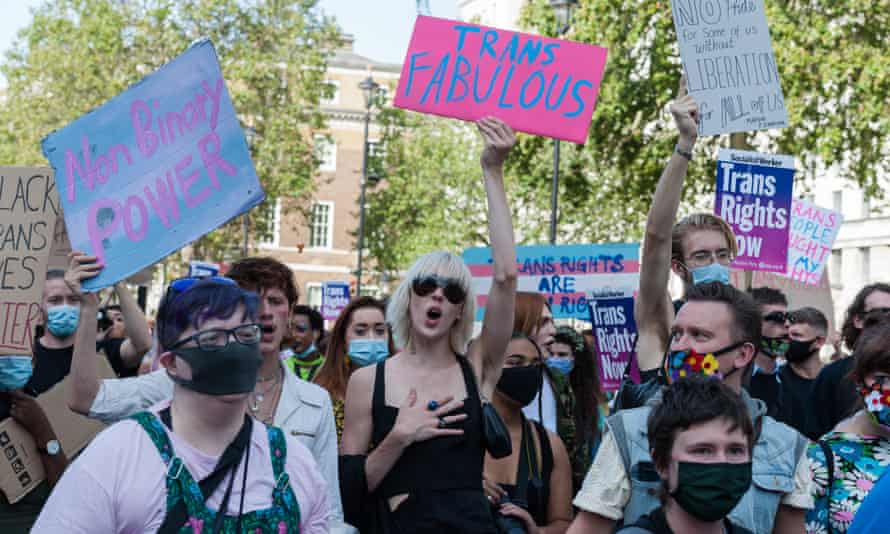
In recent months, Stonewall – Europe’s leading LGBTQ Rights organsaition – have found themselves at the centre of some very public controversy regarding trans rights. It doesn’t look like it is going away anytime soon either.

In brief, Stonewall have been accused of shutting down gender-critical beliefs (and subsequent debate over trans rights) as transphobia, subsequently the Government equalities minister (Liz Truss) has urged government departments to withdraw from Stonewall’s flagship Diversity Champions programme.

According to the Guardian the debate centres on trans rights campaigners on one side and gender-critical feminists – who disagree with the view that gender identity should be prioritised over biological sex – on the other.

The debate is a complex one but in recent months critics believe Stonewalls stance on trans rights is over-aggressive and seeks to shut down debate but which the charity and its defenders believe is putting it on the right side of history.

In law, ‘Gender identity or trans status’ are not protected, only ‘gender reassignment’ is protected under the Equality Act 2010. However, Matthew Parris, one of Stonewall’s 14 founders, wrote in the Times that the charity had been “cornered into an extremist stance” on the subject of trans rights. He argued that Stonewall should stay out of the issue, sticking to LGB rights without the T. Whilst the right to change one’s legal gender was established in the UK in the 2004 Gender Recognition Act, it was only six years ago that Stonewall announced that it would work for trans equality and apologised for its past failure to do so.

In recent months, Liz Truss, the equalities minister, urged all government departments to quit the Diversity Champions programme. This was followed by a report that accused Stonewall of giving incorrect advice on equality law. This was further complicated when the Equality and Human Rights Commission (EHRC) quit the Diversity Champions programme in May 2021.

Yet, suggestions emerged that employers were leaving the Diversity Champions programme because of disquiet over its transgender inclusion training. The Telegraph reported that six public-sector organisations had left out of about 850 members listed on Stonewall’s website, although those exits were since 2019 and none had publicly cited the issue of trans rights as motivation for leaving.

Stonewall accused the Equality and Human Rights Commission (EHRC) of defending gender-critical beliefs and suggesting that they are “protected beliefs” under the Equality Act, a position the signatories said was a “kick in the teeth to trans people”.

Prof Kathleen Stock, a professor of philosophy at the University of Sussex who has written a book criticising theories of gender identity, said Stonewall had encouraged a definition of transphobia that was far too wide. “Through its Diversity Champions scheme it’s disseminated this very widespread idea that an attack on the theory – or an attack on the particular interpretation – of identity is an attack on trans people. And that has really made the whole discourse incredibly toxic, given its enormous reach within national institutions,” she said.

In a recent interview with the BBC, Nancy Kelley, head of Stonewall, attracted more criticism by comparing gender-critical beliefs to antisemitism. She said, “With all beliefs, including controversial beliefs, there is a right to express those beliefs publicly and where they’re harmful or damaging – whether it’s antisemitic beliefs, gender-critical beliefs, beliefs about disability – we have legal systems that are put in place for people who are harmed by that.”

Kelley, who said Stonewall believed in freedom of speech but “not without limit”, said the comparison was apt as people were protected on the basis of their gender identity in the same way as people are on the basis of their race.

On the antisemitism comparison made by Kelley, veteran gay rights campaigner Peter Tatchell said. “Those who deny trans people’s existence, misgender them and advocate anti-trans discrimination echo the prejudice of racists and homophobes.”

The question for UK based organisations is do they continue with their association with Stonewall and the Diversity Champions Programme? If your organsaition has a strong stance on supporting trans people will staying with stonewall support that, or does the organsaition risk being dragged into a debate regarding gender-critical beliefs?

JD

February 2021 is LGBT+ history month

February is LGBT+ history month! It was founded by Schools Out in 2005 as a celebration of LGBT+ history and to ensure that children were receiving this education in school where so often they were not. The theme for this year is ‘Body, Mind and Spirit’.

This time of year takes us back to 1988 when Section 28 was made law, which prevented teachers talking about same sex relationships in schools, often forcing teachers and others to deny their sexuality and possibly losing their jobs. All the while the backdrop to this was the HIV/AIDS crisis, leading to futher marginalisation of this community. Section 28 was successfully repealed in 2000, however the repercusions of it still remain, with similar narratives of ‘protecting children’ being used today to deny them of a well rounded education, inclusive of LGBT+ history.

Discrimination, hate crime and abuse are still rife in the country with further mobilisation of anti LGBT+ groups and pro-conversion therapy. This demonstrates the continued need for history month to ensure the voices of the LGBT+ community are never silenced but are instead valued.

LGBT+ history month isn’t just for schools or children, there’s lots of opportunities for everyone to learn.

You can download and display in your workplace the ‘Voices and Visibility’ wall chart which is downloadable here: Wall-Chart-A0_V7.6.pdf (lgbtplushistorymonth.co.uk)

There is also further stories from the LGBT+ community available here: STO-the legacy book (stonewall.org.uk)

There are various resources available via Stonewall in their elearning section, including a workshop on delivering LGBT+ inclusive services wich is available here: STO-the legacy book (stonewall.org.uk)

With the popularity of the current Channel 4 show ‘It’s a Sin’ and it’s portrayal of the HIV crisis, Yorkshire MESMAC are running a session on the impact of HIV within the LGBT+ community across Yorkshire which you can register for here: A short history of HIV within the LGBT+ Community Tickets, Sun 28 Feb 2021 at 15:00 | Eventbrite and are also running a session on LGBT+ awareness which you can register for here: LGBT+ Awareness Tickets, Mon 15 Feb 2021 at 14:00 | Eventbrite

JD

The Importance of Diversity Training in the Workplace

Diversity training has gained a lot of attention lately, and companies are starting to realize just how important it is to have an inclusive workforce. Workplace discrimination can result in missed opportunities when people fail to recognize talent or potential because of a person’s background. It also makes people feel undervalued and can impact work performance and job satisfaction. The most serious affect discrimination can have on a company results in legal costs, settlement compensation, and a negative public image. 

Incorporating diversity training into employee management is a great way to get people to examine diversity and equality barriers within the company. 

What exactly is diversity training?

Diversity training educates employees on all the unique aspects of their coworkers from race, religion, sexual orientation, age, gender, nationality, and more. During the training, employees learn about common cultural assumptions, prejudices, and more seen in the workplace and how these biases and discriminatory mentalities impact coworkers as well as the company. By bringing awareness to diversity issues, employees are encouraged to be more inclusive and collaborate with people who have different qualities and skill sets apart from their own. 

Why is diversity training necessary?

Diversity programs should be incorporated into every company’s annual training plan. Successful diversity training has a number of benefits for an organization from increased morale and employee retention to a more inclusive and accepting workspace. It’s also been known to cut down on workplace harassment as people become more aware of how their behavior and language is offensive to others. 

When a company is clearly dedicated to diversity and equality in the workplace, it also enhances recruiting efforts. Recruiters not only have an easier time attracting top talent to the business, but they’re also more conscious about being inclusive in their recruitment efforts. 

Diversity has also been shown to financially benefit companies. According to a report by McKinsey & Company, a business is 35 percent more likely to have financial returns above their respective national industry medians if the company is racially and ethnically diverse. This is likely due to the fact that more diverse groups of people bring a broader perspective to problem solving and idea creation. 

How to incorporate diversity training

Company leaders know diversity training is important, but it can admittedly be difficult to incorporate. Training topics can be overwhelming to some employees, and if not done properly there is a risk that workers will come out of the training defensive and more divided. 

Before choosing a diversity program at random, it’s helpful to conduct a needs assessment which will help you prioritize certain topics. The needs assessment will also make it more apparent which specific issues are most pressing within your company. By focusing on a few equality and diversity issues at a time, you limit the risk of overwhelming employees and encourage understanding. 

Design a diversity training program that fits your company’s needs and makes people feel heard and included. Everyone deserves to be respected and treated fairly at work, so embrace the value that diversity and inclusivity bring to your company. Show employees their worth through training programs that not only bring awareness to employee differences but also encourage understanding and respect. 

JD

Challenging Workplace Racism

It’s sad that in 2020 racism in the workplace is still a very real thing. Whether it is appointing managers or promotion panels subconsciously overlooking black, Asian and minority ethnic (BAME) candidates, or the occurrence of overt instances of discrimination and harassment on the office/shop floor, it’s undeniable that there is still a lot of work to be done on this front.

While nearly all companies have legally binding anti-discrimination policies set up, and governments have issued directives and legislation to try and eradicate this issue, it’s still worth taking the time to highlight the cases where things have gone – or are going – terribly wrong. With that in mind, here are four signs that racism may be an issue in your workplace:

1. STEREOTYPING

Managers must look out for examples of stereotyping in the workplace, which can provide the basis for racial discrimination to occur. Often based on misconceptions and incomplete information, stereotyping is particularly harmful as it portrays false generalisations, and attributes the same characteristics to all members of a group, ignoring the receivers of racism as individuals in their own right.

Be wary of the language used, and topics discussed, by colleagues. Are terms like “they” and “us” “your lot” used often to create a divide? Also, are workers making derogatory comments about elements of a person’s culture or customs?

2. HOSTILITY

Whether it is a black woman who is informed that she is too aggressive, a Muslim man criticised for not drinking during social events or an Indian immigrant/Eastern European mocked for their accent, managers should be able to spot unfair criticism and hostility towards BAME persons.

Victims of racism in the workplace can be subject to accusations of being out-of-place, and not fitting in the office/workplace culture. Moreover, BAME people tend to find that normal differences of opinion or failing to get along with a co-worker may be treated as more serious due to the hostility held towards them in a racially charged work environment.

3. OVERCRITICAL

With the increasing pressures of the modern time-poor, stress-rich business world, criticisms of employee performance from team leaders and peers is common.

Managers must be mindful, however, of how fair the criticism is to all staff, particularly minority groups, reacting quickly to criticisms that go a step too far. Victims of racial discrimination at work have reported being vilified for doing their work.

4. CONSISTENTLY OVERLOOKED

The “glass ceiling” is a prolonged issue that ties together all the previous points, and results in many talented, ambitious and well-educated BAME men and women failing to gain jobs, promotions or salary boosts, compared to their white counterparts.

But when the opportunities do finally arise, victims of racism note that their authority is constantly challenged and undermined by those both above and below them on the career ladder.

Thanks to Equality and Diversity UK for these signs on how to identify if racism may be an issue in your workplace.

JD

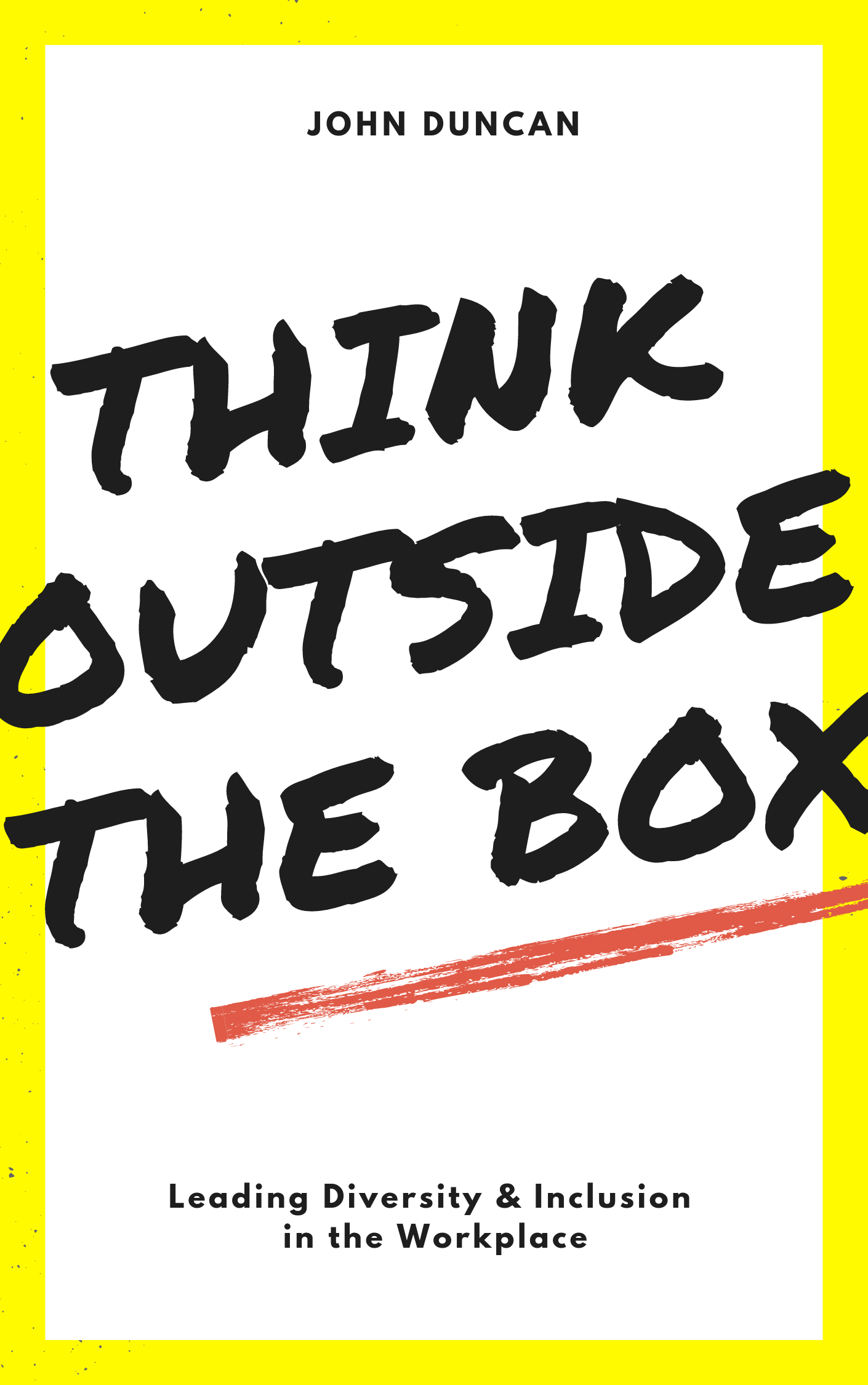
Think Outside the Box – Leading Diversity & Inclusion in the Workplace

Diversity & Inclusion Book Cover

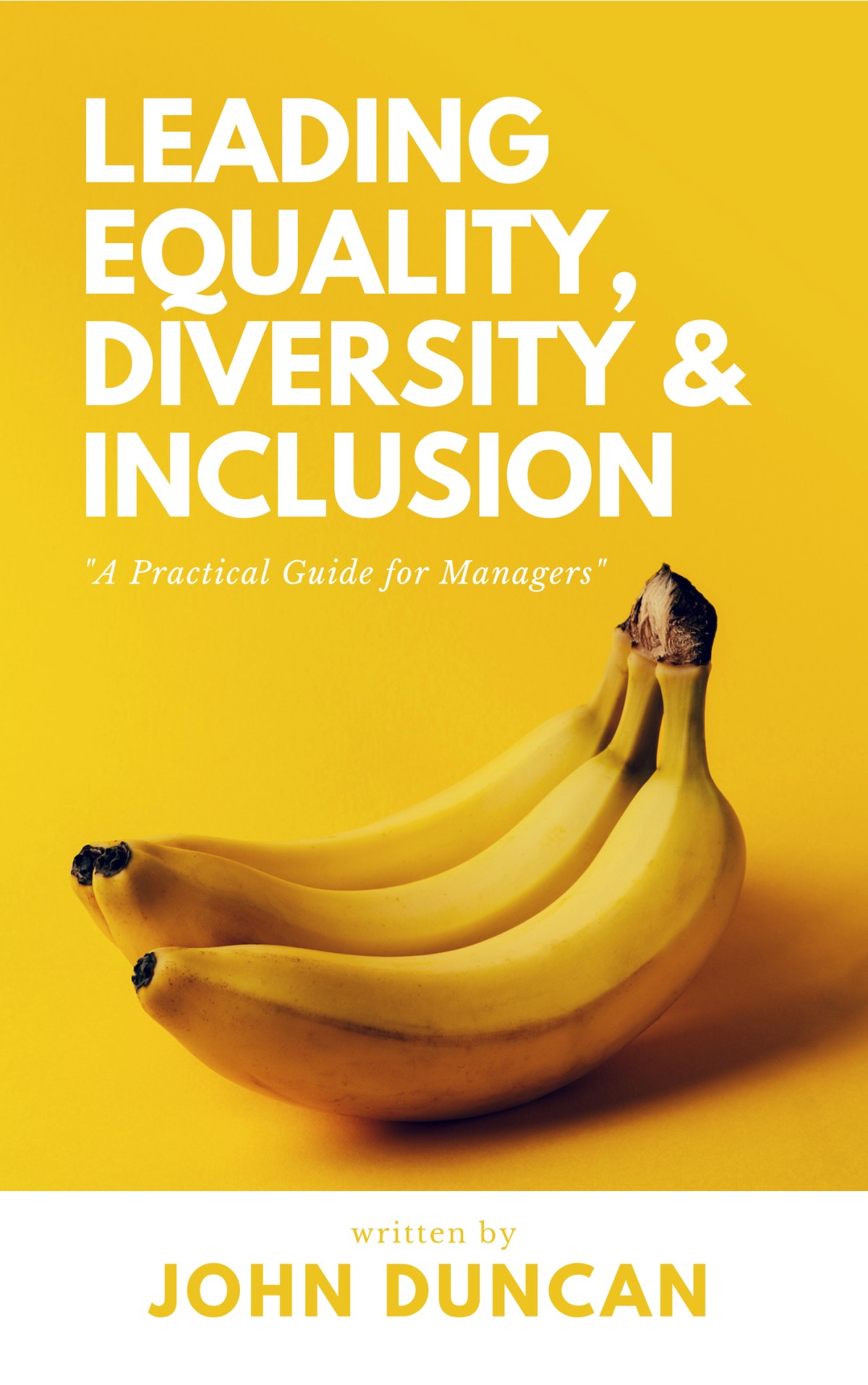
I am delighted to announce that following on from my previous book ‘Leading Equality, Diversity & Inclusion – A Practical Guide for Managers’,  my new book ‘Think Outside The Box – Leading Diversity & Inclusion in the Workplace’ is now available as a hard copy,  paperback book on amazon.co.uk.

The origins of this book come directly from this very blog and I will be sharing aspects of the book over the coming weeks. However, in the meantime, if you are involved with workplace diversity and inclusion then please take a look at the book; it has a range of proven strategies that will help build an inclusive culture in your workplace.

The books blurb goes something like this. ‘In practise, equality, diversity and inclusion can sometimes be perceived – quite inaccurately – as political correctness or an exercise in government ‘box ticking’. Yet, in recent years, organisations have become increasingly aware of the business case for being a fully inclusive workplace, where employees feel valued, opportunities are available for all and diversity is celebrated.

In this case, diversity and inclusion initiatives become less about compliance with legislation and more about leading change, improvement initiatives, engaging, motivating and improving the potential of staff.

‘Think Outside The Box – Leading Diversity & Inclusion in the Workplace’ provides an up-to-date source of diversity and inclusion best practice for workplace leaders and gets to the heart of the diversity issues facing the UK workforce with clear strategies and practical guidance to creating a fully inclusive workplace.

Author – John Duncan – is a Diversity and Inclusion specialist leading on strategy and policy development with over 15 years substantial experience of providing advice, support and training within the public sector. ‘

JD


Discrimination casts a shadow over football

The English Football League kicked of last week but the opening weekend was marred with a number of incidents of racist abuse. Like any other employer in the UK, a professional football club has a duty under the Equality Act 2010 to protect its staff from racial abuse. The Equality Act makes no distinction as to the type of workplace, a football player is a member of staff and the football pitch is a workplace.

On Saturday 3rd August, Southend United’s Jamaican striker Theo Robinson claims he was abused “in front of family, friends and their kids” at St Andrew’s, the first match Coventry have played in their ground-sharing arrangement with Birmingham City.  Similarly, Stoke City’s James McClean, Barnsley’s Bambo Diaby and the sister of Fulham’s Cyrus Christie were also victims of what’s been described as “unacceptable discriminatory abuse”.

Anti-racism charity Kick It Out said “On the first weekend of the season, these incidents should be a reminder for everyone in football that racism and discrimination cannot be ignored. Clubs and the football authorities must be relentless in calling out this disgraceful behaviour, and be prepared to issue strong sanctions and education sessions to any supporter involved. Discrimination casts a shadow over football in this country, and we will not stop highlighting the problem while it remains rife in the game.”

Whilst in this case the racial abuse is coming from a minority of fans in reality a football fan is a customer of the club and a consumer of the clubs product or service. As such, this is no different from hospital staff receiving racial abuse from a patient or service user. In such cases, NHS Trusts work to support staff and reduce racial abuse happening and football clubs must do the same. However, we hear much more outrage from the public and political leaders when NHS staff are racially abused. Why then are footballers, as well as other sports men and woman, seen as fair game to abuse at work?

Certainly, the money involved in football infuriates many fans, especially when they are being charged £40 a ticket and another £50 for a replica club shirt. They see the elite football players earning the big bucks and see themselves as effectively their employers. Oddly, if they were the employers then by law they should treat their staff better. That said, we know that when a football team is doing well the fans sign their praises from the stands but when things are not going well a minority of fans abuse the players, regardless of ethnic origin. This abuse from the stands has almost become a ‘norm’ but race is a protected characteristic under the Equality Act and harassment on the basis of it is illegal, just as would the abuse of a disabled member of staff, or an LGBT+ member of staff. In fact, I am sure the ongoing situation with racial abuse of players is contributing to the lack of any visible LGBT+ professional football players. Unfortunately, LGBT+ players are not confident enough in being accepted by all fans that they have to hide that aspect of their lives away and as such lead an unauthentic version of themselves, in itself this can lead to anxiety, depression and other mental health issues.

So what are clubs to do? In reality, expulsion from the ground and permanent exclusion from all football grounds is a strong deterrent. Clubs must demonstrate their commitment to stamping out racial abuse but those fans that do not racially abuse players must also be given the confidence to challenge the abusers and show them that this behaviour is not okay.

Either way, the Equality Act 2010 protects all staff from abuse in the workplace and unless clubs do more to protect their players from racial abuse they could be in breach of the Equality Act and subject to legal action.

JD

LGBT Inclusion Tips for the Workplace – Stonewall

I have recently been working with Stonewall, the leading lesbian, gay, bisexual and transgender rights charity in the United Kingdom, in order for my organisation to partner with their Diversity Champions Programme.

stonewall-diversitychampion-logo-black-250As I looked further into setting up my own staff networks for protected characteristics I came across the following ten tips to help build an LGBT inclusive culture in an organisation via Stonewalls website and wanted to share it.

People perform better when they can be themselves, and if you’re looking to make sure that lesbian, gay, bi and trans (LGBT) people are fully included in your workplace, Stonewall have got some tips to help.

  1. Ensure that your policies are fully inclusive of LGBT people

This includes pensions, family and leave policies, health insurance and relocation allowances. You should make sure your policies explicitly mention LGBT people.

  1. Get people involved across your organisation

This could include setting up a network group specifically for LGBT employees; they’ll help you know where you’re doing well and which areas may need a new approach.

  1. Reward those involved in your LGBT network group

Embed their involvement in their appraisals; make being part of the network a desirable thing to be.

  1. Decide upon a clear strategy and tactics

Whether you want to increase the number of staff who are open about being LGBT, or revise your policies to make them fully inclusive, it’s crucial to know where you want to be and how you’re going to get there.

  1. Engage staff members who don’t identify as LGBT

Allies, as we call them, are a crucial element of ensuring inclusion for all. They can help spread the message that diversity is celebrated by your organisation.

  1. Ensure senior support

Making certain your senior leaders actively communicate their support for LGBT inclusion sends a positive message of acceptance for all across your organisation.

  1. Speak to your staff

Consulting employees – both LGBT and non-LGBT – about what inclusion looks like in your organisation will help ensure your strategy is appropriate and that all staff share your vision.

  1. Understand your staff

Getting to know the make-up of your staff through techniques such as monitoring will help ensure you effectively cater to any needs they may have.

  1. Celebrate your successes

Making sure your organisation is LGBT-inclusive is an ongoing journey, so it’s important to celebrate your successes, whatever size they may be, along the way. Every step is a step towards acceptance without exception for LGBT people.

  1. Become a Stonewall Diversity Champion

Diversity Champions is Britain’s leading programme for ensuring that your workplace is truly inclusive.

JD

Leading Equality, Diversity & Inclusion – A Practical Guide for Managers

I am delighted to announce that my book ‘Leading Equality, Diversity & Inclusion – A Practical Guide for Managers’ is now available on Amazon.co.uk as an ebook download for Kindle.  The origins of this book come directly from this very blog and I will be sharing aspects of the book over the coming weeks. However, in the mean time, if you are involved with workplace EDI then please take a look at the book, it has a range of proven strategies that will hep build an inclusive culture in your workplace.

The books blurb goes something like this. ‘It’s easy to get lost in the rhetoric of equality and diversity, launching initiatives, giving training and explaining your vision. However, in truth, success is about what impact these initiatives, training and vision actually have. Have your actions made the workplace better for people? Getting traction for your initiatives is vital so that you can measure the success of equality actions. This ‘how to guide’ will help managers and those with responsibility for equality, diversity and inclusion make an impact in their workplace. Firstly, it explores the Equality Act 2010 before examining how you can effectively embed good practice in the workplace through a range of strategies that will help you to build an inclusive workplace.’

JD

National Centre for Diversity – Grand Awards 2019

Tonight is the National Centre for Diversity’s Grand Awards 2019 where the Grimsby Institute of Further and Higher Education (GIFHE) have been shortlisted for the ‘Most Improved Organisation 2019’ Award.

Last year the Grimsby Institute was awarded Stage 2 Investors in Diversity by the National Centre for Diversity and listed at number 34 on their index of the Top 100 ‘Most Inclusive Organisations.’ This was a great celebration of the considerable efforts of staff across the Grimsby Institute had made to improve their equality and diversity practices.

It’s fantastic to see the improvements made to workplace equality and diversity being celebrated in this way as well as the individuals and organisations being awarded for their contribution. The very best of luck to all the the shortlisted individuals and organisations.

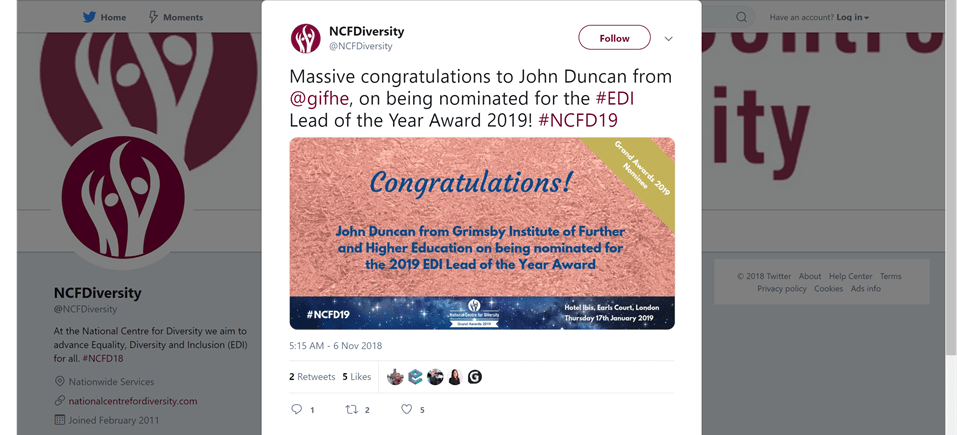
I was very proud to be nominated for the 2019 EDI Lead of the Year award and will be cheering on the Grimsby Institute as the awards are announced tonight.

https://www.nationalcentrefordiversity.com/

JD