
Workplace Inequality – Why Good EDI leadership is in Demand

Recent improvements to workplace equality and diversity practice have helped make UK employers more inclusive but we are still some way off seeing good practice embedded in all sectors. That said, nationally, we are certainly moving in the right direction and with continued support of organisations like the National Centre for Diversity, Stonewall, Diversity UK and Employers Network for Equality and Inclusion, there is no reason why this can’t continue.

In recent years, new job roles such as Equality, Diversity and Inclusion (EDI) Coordinator, EDI Lead or Head of EDI started to appear at the larger employers as they addressed the need for an equality and diversity specialist in their organisation. Clearly, these employers are starting to see the value in having strong equality and diversity leadership in their organisations, especially in light of the poor press high profile failures in EDI receive throughout news and social media reporting.

The need for organisational leaders to take ownership of EDI is still very much in demand because inequality and unfairness in the workplace has not disappeared and as the examples below demonstrate, provided by the Trade Union Congress (TUC), we still have some way to go for true workplace equality.

  • Black workers have fewer training opportunities than white workers and black women get an even worse deal.
  • Older Workers may have been in the job for longer but this may only mean that the longer you are in a job the less training you will receive.
  • Manual workers and/or workers with few qualifications are mainly overlooked for training as those who have a lot of education and training tend to benefit from any training on offer.
  • Part-time workers and temporary workers are often left behind when training is on offer as employers place a greater value on permanent or full-time workers at the cost of temporary or part-time workers. Women make up the majority of part-time workers.
  • Workers for whom English is a second language may find that the only jobs open to them are manual / low skilled jobs. Whilst some will have qualifications, these may have been achieved in another country and employers will often overlook them. A lack of spoken English is often a barrier to moving on.
  • Shift workers are least likely to participate in learning in colleges because of working patterns, or to be offered training by their employer.  They may need to be encouraged when learning is promoted and shift times taken into account when onsite learning takes place.
  • Discrimination often plays a role when access to job and training opportunities are based on negative stereotypes and perceptions of what people can and can’t do.

JD
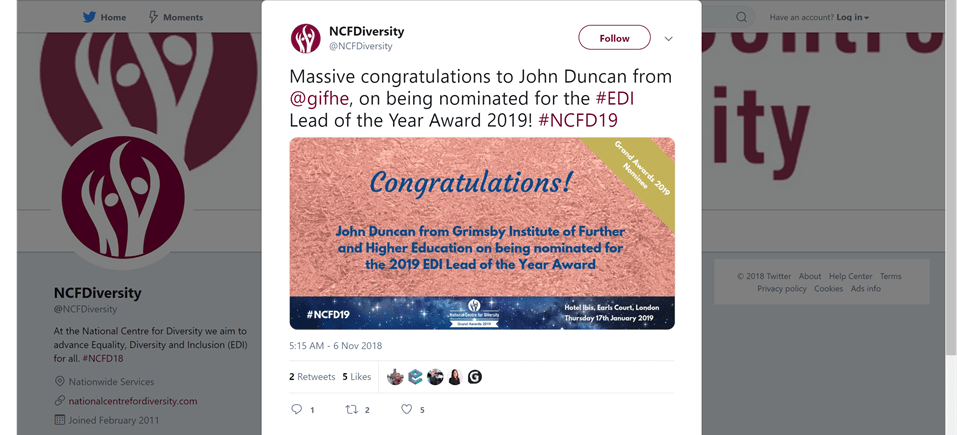
National Centre for Diversity – Grand Awards 2019

Tonight is the National Centre for Diversity’s Grand Awards 2019 where the Grimsby Institute of Further and Higher Education (GIFHE) have been shortlisted for the ‘Most Improved Organisation 2019’ Award.

Last year the Grimsby Institute was awarded Stage 2 Investors in Diversity by the National Centre for Diversity and listed at number 34 on their index of the Top 100 ‘Most Inclusive Organisations.’ This was a great celebration of the considerable efforts of staff across the Grimsby Institute had made to improve their equality and diversity practices.

It’s fantastic to see the improvements made to workplace equality and diversity being celebrated in this way as well as the individuals and organisations being awarded for their contribution. The very best of luck to all the the shortlisted individuals and organisations.

I was very proud to be nominated for the 2019 EDI Lead of the Year award and will be cheering on the Grimsby Institute as the awards are announced tonight.

https://www.nationalcentrefordiversity.com/

JD


Equality and Diversity in the Workforce

Increasingly, the term ‘Equal Opportunities’ is making way for discussions on ‘Diversity’ as this term is much broader in its scope and gets to the heart of the integration challenges the country faces.

Over the past five decades our society has become increasingly complex and diverse. The UK population is growing rapidly and subsequently becoming more diverse and with an aging population. Changes to immigration laws and better health care are contributing factors to the changing makeup of Great Britain and our subsequent workforce.

When asked, staff often perceive diversity as being a focus on ethnicity and race whereas issues of gender equality are often overlooked or misunderstood. Subsequently, diversity is actually a much broader term than a few labels and includes those other – difficult to define – human qualities that are dissimilar to our own perceptions or those of our communities but are widely prevalent in other communities. It is this fundamental difference that Diversity looks to both celebrate and accept alongside our own perceptions.

Whilst recent equality laws have helped to challenge discrimination and prejudice we still face equality gaps in the workplace, some larger than others. In response to the increasingly diverse needs of our communities the government have delegated a duty of responsibility on councils and their partners, including publicly funded bodes, such as the education and health care sectors, to be more accountable for ensuring everyone has an equal chance in life regardless of background.

To this end, in order to meet both government legislation and the diverse needs of our workforce, organisations need to ensure they build an inclusive culture where diversity is celebrated and everyone has equal opportunity. That said, this is clearly easier said than done, so here are six values that can help an organisations better promote a culture of equality and diversity.

  1. Value Feedback – Seek regular opportunities for staff feedback to impact on organisational practices and change behaviours.
  2. Value Experience – Create an inclusive culture by including staff in both strategic and operational planning ensuring they have equal access to opportunities to enable staff to fully participate.
  3. Value Fairness – equality comes when staff are confident their employer’s policies, procedures and practices are fair to all and don’t discriminate.
  4. Value Development – enable all staff to develop to their full potential though equal opportunities for training, empowerment and progression.
  5. Value Planning – make certain that staff resources do not discriminate against any individuals, groups or reinforce negative stereotypes.
  6. Value Collaboration – through effective training equip all staff with the skills to challenge inequality and discrimination in their workplace.

JD