
Supporting staff who observe Ramadan 2021

Ramadan 2021

This year, the month of Ramadan will begin on the evening of Tuesday 13th April and end on the evening of Wednesday 12th May 2021.

Ramadan involves a daily period of fasting for Muslims starting at sunrise and finishing at sunset over the month. This means abstaining from food, drink (including water) and smoking. While fasting is an important part of Ramadan, it is also a time of self-reflection and self-evaluation for Muslims.

This year will be very different for staff who are Muslim and observe fasting during Ramadan, as traditionally communal activities and prayer are observed and encouraged. Due to the current Covid-19 crisis, access to prayer facilities, quiet rooms and multi faith rooms internally and externally have been largely suspended. These restrictions may have a negative impact on staff wellbeing during an already difficult period. Line managers should encourage staff to talk to their chaplaincy team for support.

Accommodating religious belief and practices during Ramadan is about being responsive to employee’s needs. It does not necessarily mean extra time off; it is about offering flexibility around existing holiday entitlement, working patterns or break periods. Unlike previous years, this may prove more challenging if resources are reduced due to staff absence from self-isolation and illness.

Similarly, staff should also be aware of the health issues related to fasting, so that they are able to make more informed choices, minimise complications and maximise the benefit of their fast as well as operational effectiveness. Those who are ill with COVID-19 won’t be able to take part in daily fasting, as fasting is not compulsory or advisable for anyone who is ill or has a medical condition.

Frequently asked questions on Ramadan

What is Ramadan?

Ramadan is the 9th month of the Islamic lunar year and is the month of fasting. Fasting is a duty upon all adults and healthy Muslims. In the UK this year Ramadan will start on 13rd April 2021.  This means that no water or food is to be consumed from sunrise to sunset this totals to almost twenty hours per day without food or drink. People that are ill, those that are travelling long distance, pregnant and breast feeding women may be exempt.

One of the main benefits of Ramadan is an increased awareness of God. It is an opportunity for self-purification and reflection and a renewed focus on spirituality; and for compassion for those in need of the necessities of life. Muslims also appreciate the feeling of togetherness shared by family and friends throughout the month. Perhaps the greatest practical benefit is the yearly lesson in self- restraint and discipline that can carry forward to other aspects of a Muslim’s life such as work and education.

Religion and Belief is a protected characteristic of the Equality Act 2010, which means that festivals like Ramadan, as well as Easter, Yom Kippur, Vaisakhi and Diwali, and the other religious days and periods, give us an opportunity not just to support those who observe them, but also to learn and understand more about the people we work with and increase our understanding of the communities we serve.

Fasting, in one form or another, has always been important and often necessary part of religious life, discipline and experience in every faith.  Many of the key fasting considerations transfer to all primary faiths and practices including Christianity and the sacrifices of ‘Lent’ Judaism and fasting during Yom Kippur and Tish’ah B’av.

Working and Ramadan

Working has a great importance and value in Islam.  The importance of lawful earnings is emphasised by numerous instructions of God in the Quran to earn a living through lawful means.

The Prophet Mohammed taught Muslims that one needs to be balanced and harmonised between their worship and work.  Muslims have to remain constant in acts of worship, and also to work hard to earn a living and support their families.  Prophet Mohammed made it clear that being in a position to purchase day to day provisions from one’s own work is actually a commendable act of worship.

Ramadan should not be used as an excuse for not working to one’s usual level of commitment and productivity and it is important to remember one’s obligations to employers.

I manage and/or work with staff that are fasting, what do I need to know?

Fasting in the summer months is combined with disturbances in normal sleep pattern that can leave individuals feeling more tired than normal particularly mid-afternoon and towards the end of the day. Also, towards the latter part of the day some individuals that are fasting might feel a little light headed.

If you have Muslim staff in your department or ward, it may be worth approaching them and allowing them to discuss their needs and the impact this may have on their working patterns.

If it is operationally feasible an agreement to requests for slight adjustments to shift patterns during Ramadan will be appreciated.  For example, many Muslims like to be with their families for the end of the fast therefore may need some flexibility with shift arrangements to enable them to spend this time with their families. To be able to finish early they may prefer to start earlier and/or have a shorter lunch break.

It is very considerate to avoid holding events involving food such as get-togethers which may include food and drink during Ramadan. If it is unavoidable please do not be offended if Muslim staff members are unable to participate in such events. If any training day or a key meeting is unavoidable, any special arrangements for Muslim staff that are fasting will always be greatly appreciated.

It is not necessary for individuals that are not fasting to abstain from eating or drinking in the presence of Muslims that are fasting. However, during the month of Ramadan it would not be appropriate to require a Muslim staff member who is fasting to join you in taking a working lunch for example, or to offer food or drinks

To fast along with Muslim colleagues, even for part of the day, is a good way of enhancing understanding, and can be used as a wonderful way of fundraising for a charitable cause during the month of Ramadan. Ramadan is the month of generosity, giving charity and benevolence.

Many Muslims will endeavour to practice their faith more during Ramadan than they might for the remainder of the year. As a consequence of this more Muslim staff might wish to offer prayers during the day. This will normally be around 1:00 pm and 6:00pm in the summer months for a few minutes each for which the staff member(s) will require a small private area or access to Trust’s chaplaincy facilities for prayer and quiet contemplation.

How do I express best wishes to colleagues and patients?

The appropriate way to express best wishes to a Muslim colleague for Ramadan is to say: “Ramadan Mubarak”

What happens when Ramadan ends?

The end of Ramadan is marked by the festival of Eid-Ul-Fitr for which some Muslim staff members will wish to take leave from work. The actual day that Eid falls on will depend on when the new moon is sighted. For this reason it might not be possible for the staff member to be very specific about the day he/she would like to be away from work and therefore some flexibility may be necessary.

There are different schools of thought who may celebrate Eid on different days depending on which school of thought they follow. This year Eid may fall on 13th  May or 14th May depending on the sighting of the moon, therefore Eid can be celebrated on either days.

Please try to accommodate any requests for annual leave during this time.

The appropriate way to express best wishes to a Muslim colleague for Eid is to say: “Eid Mubarak”

JD


February 2021 is LGBT+ history month

February is LGBT+ history month! It was founded by Schools Out in 2005 as a celebration of LGBT+ history and to ensure that children were receiving this education in school where so often they were not. The theme for this year is ‘Body, Mind and Spirit’.

This time of year takes us back to 1988 when Section 28 was made law, which prevented teachers talking about same sex relationships in schools, often forcing teachers and others to deny their sexuality and possibly losing their jobs. All the while the backdrop to this was the HIV/AIDS crisis, leading to futher marginalisation of this community. Section 28 was successfully repealed in 2000, however the repercusions of it still remain, with similar narratives of ‘protecting children’ being used today to deny them of a well rounded education, inclusive of LGBT+ history.

Discrimination, hate crime and abuse are still rife in the country with further mobilisation of anti LGBT+ groups and pro-conversion therapy. This demonstrates the continued need for history month to ensure the voices of the LGBT+ community are never silenced but are instead valued.

LGBT+ history month isn’t just for schools or children, there’s lots of opportunities for everyone to learn.

You can download and display in your workplace the ‘Voices and Visibility’ wall chart which is downloadable here: Wall-Chart-A0_V7.6.pdf (lgbtplushistorymonth.co.uk)

There is also further stories from the LGBT+ community available here: STO-the legacy book (stonewall.org.uk)

There are various resources available via Stonewall in their elearning section, including a workshop on delivering LGBT+ inclusive services wich is available here: STO-the legacy book (stonewall.org.uk)

With the popularity of the current Channel 4 show ‘It’s a Sin’ and it’s portrayal of the HIV crisis, Yorkshire MESMAC are running a session on the impact of HIV within the LGBT+ community across Yorkshire which you can register for here: A short history of HIV within the LGBT+ Community Tickets, Sun 28 Feb 2021 at 15:00 | Eventbrite and are also running a session on LGBT+ awareness which you can register for here: LGBT+ Awareness Tickets, Mon 15 Feb 2021 at 14:00 | Eventbrite

JD

The Importance of Diversity Training in the Workplace

Diversity training has gained a lot of attention lately, and companies are starting to realize just how important it is to have an inclusive workforce. Workplace discrimination can result in missed opportunities when people fail to recognize talent or potential because of a person’s background. It also makes people feel undervalued and can impact work performance and job satisfaction. The most serious affect discrimination can have on a company results in legal costs, settlement compensation, and a negative public image. 

Incorporating diversity training into employee management is a great way to get people to examine diversity and equality barriers within the company. 

What exactly is diversity training?

Diversity training educates employees on all the unique aspects of their coworkers from race, religion, sexual orientation, age, gender, nationality, and more. During the training, employees learn about common cultural assumptions, prejudices, and more seen in the workplace and how these biases and discriminatory mentalities impact coworkers as well as the company. By bringing awareness to diversity issues, employees are encouraged to be more inclusive and collaborate with people who have different qualities and skill sets apart from their own. 

Why is diversity training necessary?

Diversity programs should be incorporated into every company’s annual training plan. Successful diversity training has a number of benefits for an organization from increased morale and employee retention to a more inclusive and accepting workspace. It’s also been known to cut down on workplace harassment as people become more aware of how their behavior and language is offensive to others. 

When a company is clearly dedicated to diversity and equality in the workplace, it also enhances recruiting efforts. Recruiters not only have an easier time attracting top talent to the business, but they’re also more conscious about being inclusive in their recruitment efforts. 

Diversity has also been shown to financially benefit companies. According to a report by McKinsey & Company, a business is 35 percent more likely to have financial returns above their respective national industry medians if the company is racially and ethnically diverse. This is likely due to the fact that more diverse groups of people bring a broader perspective to problem solving and idea creation. 

How to incorporate diversity training

Company leaders know diversity training is important, but it can admittedly be difficult to incorporate. Training topics can be overwhelming to some employees, and if not done properly there is a risk that workers will come out of the training defensive and more divided. 

Before choosing a diversity program at random, it’s helpful to conduct a needs assessment which will help you prioritize certain topics. The needs assessment will also make it more apparent which specific issues are most pressing within your company. By focusing on a few equality and diversity issues at a time, you limit the risk of overwhelming employees and encourage understanding. 

Design a diversity training program that fits your company’s needs and makes people feel heard and included. Everyone deserves to be respected and treated fairly at work, so embrace the value that diversity and inclusivity bring to your company. Show employees their worth through training programs that not only bring awareness to employee differences but also encourage understanding and respect. 

JD

Challenging Workplace Racism

It’s sad that in 2020 racism in the workplace is still a very real thing. Whether it is appointing managers or promotion panels subconsciously overlooking black, Asian and minority ethnic (BAME) candidates, or the occurrence of overt instances of discrimination and harassment on the office/shop floor, it’s undeniable that there is still a lot of work to be done on this front.

While nearly all companies have legally binding anti-discrimination policies set up, and governments have issued directives and legislation to try and eradicate this issue, it’s still worth taking the time to highlight the cases where things have gone – or are going – terribly wrong. With that in mind, here are four signs that racism may be an issue in your workplace:

1. STEREOTYPING

Managers must look out for examples of stereotyping in the workplace, which can provide the basis for racial discrimination to occur. Often based on misconceptions and incomplete information, stereotyping is particularly harmful as it portrays false generalisations, and attributes the same characteristics to all members of a group, ignoring the receivers of racism as individuals in their own right.

Be wary of the language used, and topics discussed, by colleagues. Are terms like “they” and “us” “your lot” used often to create a divide? Also, are workers making derogatory comments about elements of a person’s culture or customs?

2. HOSTILITY

Whether it is a black woman who is informed that she is too aggressive, a Muslim man criticised for not drinking during social events or an Indian immigrant/Eastern European mocked for their accent, managers should be able to spot unfair criticism and hostility towards BAME persons.

Victims of racism in the workplace can be subject to accusations of being out-of-place, and not fitting in the office/workplace culture. Moreover, BAME people tend to find that normal differences of opinion or failing to get along with a co-worker may be treated as more serious due to the hostility held towards them in a racially charged work environment.

3. OVERCRITICAL

With the increasing pressures of the modern time-poor, stress-rich business world, criticisms of employee performance from team leaders and peers is common.

Managers must be mindful, however, of how fair the criticism is to all staff, particularly minority groups, reacting quickly to criticisms that go a step too far. Victims of racial discrimination at work have reported being vilified for doing their work.

4. CONSISTENTLY OVERLOOKED

The “glass ceiling” is a prolonged issue that ties together all the previous points, and results in many talented, ambitious and well-educated BAME men and women failing to gain jobs, promotions or salary boosts, compared to their white counterparts.

But when the opportunities do finally arise, victims of racism note that their authority is constantly challenged and undermined by those both above and below them on the career ladder.

Thanks to Equality and Diversity UK for these signs on how to identify if racism may be an issue in your workplace.

JD

Remote working solutions to support employees with disabilities

I was recently asked to contribute towards the workforce blog of texthelp.com – who provide inclusive technology designed to help people read, write, express their thoughts and share information more accurately & fluently.

The full article can be found here but I wanted to share it with you here as it may be relevant in your workplace where disabled employees – much like the rest of the country – are likely to be working remotely.

Guest blog article2

The nation’s wholesale shift to remote working in response to the unprecedented March 2020 lockdown has demonstrated unmistakably that remote working is a real possibility for many. Tools such as Microsoft Teams, Skype, Zoom and House Party have become synonymous with online meetings, virtual conferences and remote interviews.

Whilst this new found independence has been a revelation for many, the disabled community have long been discriminated against because of a lack of opportunities for remote working. Historically, in some cases, this stems from a reluctance by employers to embrace the opportunities remote working could provide for disabled staff.

However, we find ourselves in new territories and as so often happens with that comes challenges, and in some cases significant barriers to successful remote working. Disability can sometimes compound these challenges and subsequently employers must ensure they have remote working solutions to support employees with disabilities.

Below are five considerations that will ensure employers are better supporting their employees with disabilities when working remotely.

1. Set boundaries

When new to working remotely, the most commonly reported issue by staff is the lack of boundaries between being on duty and off duty. As such, it is vital that managers support staff to be off duty in the evenings through verbal reminder and, most importantly, through role modelling this behaviour themselves by sticking to those office hours. Conversations can be had with teams to identify an informal working space in their homes, one that can easily be packed away or not seen when it’s time to leave work and be at home with their families.

2. Accept that it is difficult

Working from home has its challenges and it’s important that you take the time to acknowledge the difficulties. Ensure that you have communicated your plan and clarify that you’re not expecting to have conference calls or get a similar level of engagement as you would in a face to face environment. Your staff will value the knowledge that it’s perfectly okay to find this time difficult and that they can – and are expected – to talk about it with each other and their manager.

For some, they may be prone to missing social signals, and as such using remote communication technologies like text, email or phone can be beset with problems of misinterpreting or misunderstanding colleagues. Managers need to support their teams more than normal in the early days of remote working to ensure they avoid conflict.

3. Think about how we communicate

Lengthy phone calls can have a cognitive overload effect and video conferencing is often a much lighter load. If you are unable to do that and a phone conversation is the only option then consider providing some simple visuals that employees can review whilst you are talking. In this case, even some basic bullet points via a word document will help reduce cognitive overload and support people who need that visual linking with the discussion. Furthermore, it’s important to take breaks during long conference calls. That’s something that would be common in the office, but is often forgotten when online in a lengthy virtual meeting. Also consider that disabled staff may require longer for such breaks.

It’s imperative also that managers are considerate of those staff with vision or hearing impairment, because remote working could be highly disadvantageous to them without the tools they rely on day in and day out. To mitigate potential problems, it’s vital that we reach out directly to staff affected and have a conversation about how we can better accommodate them, as we would with any reasonable adjustments process.

4. Reasonable adjustments are still important

When staff are working remotely, it’s vital that employers do not defer reasonable adjustments in process. Those staff who are undergoing assessment for reasonable adjustment will still need to be actioned, and this can still be completed remotely with recommendations being carried out. Similarly, where you would allow time out of the working day to accommodate a disability under normal circumstances, you still need to do so during remote working. Also, for staff plunged into remote working due to the national lockdown, maintaining the disability support that has been in progress might be a critical factor to performing at their best in this difficult period.

5. Make wellbeing a priority 

Isolation is a problem and employees are going to need support to ensure their wellbeing is high. The mental health of remote workers is so important and there are so many ways in which managers can check the wellbeing of their teams. For example, meetings could start with an informal check-in, asking your team how they are, before moving on to the business at hand. In fact, a great way to get staff to talk about this is by sharing any challenges you’re facing yourself. If employees do open up, give them time to do so and let them get their personal frustration out.

Furthermore, making time for virtual social meetings is a great way of allowing teams to talk about life at home when working remotely; thereby ensuring any issues regarding wellbeing can be discussed. Even a ten minute virtual tea break with the whole team can help ensure isolation is held at bay, whilst providing an environment for casual conversations that – during normal office based interaction – we would rely on so much.

JD

#BlackLivesMatter

In relation to the tragic events of May 25th in Minnesota, I support the black community at this difficult time and remain committed to using my voice to effect real change. It should not take a video of a man being killed and thousands of people in the street for us to pay attention.

I am inspired by the strength and character of the black community in the face of these senseless tragedies and am committed to standing up for what is right and not just standing by.  Shallow, tokenistic commitment is worse than silence. If you are interested in racism only when it is trending, keep your solidarity to yourself.

I encourage all the community, where you see racism and racist behaviour then call it out, challenge it and if it’s in the workplace tell someone. Silence is no longer an option and we will step up for our black colleagues, now more than ever.

If you are not Black, please remember your voice is needed right now—being anti-racist means speaking up, being an ally and challenging the injustices that may not directly affect you. Stand up, make noise about the events happening right now, educate family and friends and continue to push for change. Recognising white privilege has become a major focus in building a fairer society, but we also need to recognise the privilege of living in the west.

Now is not the time to be silent, neither is it the time to jump on a bandwagon. It’s a time for real reflection and care with regards  standing by the black community at this time and move forward with real steps to end racism and injustice. Racism can only be addressed together, we can not afford to stand on the sidelines making excuses.

Let’s unite to confront and stop the spread of race-related hatred, violence and systemic injustice.

As, Kehinde Andrews, writing for the Guardian, says “It is time to radically rethink society to make it value black life. History tells us that the oppressed won’t wait for ever. It is time to get on the bus or get out of the way. ”

Black lives matter.

No individual can solve the deeply embedded issue of racism but if you want to see real change then you must be that change, don’t wait another second for others to lead you. Be the change you want to see, challenge your community, challenge your workplace to be better. With racism so deeply rooted in our social order, there can be no quick fixes – but here are some steps you can take in the workplace.

  1. Be clear and concise-we’re talking about Black issues

Make it clear we are talking about Black issues, not “people of colour.” This is not the time for digressing or diluting the issue for non-Black comfort. There is no place for this—ever. Step up in a direct and empathetic way.

  1. Talk about this, openly

Make it clear why this is a crucial conversation to have. Do not post in Black/race-focused groups only. This is relevant for everyone. Talk about systemic racism, sharing links to Black-driven research, making it clear this is a structural issue we all must address.

  1. Create a safe space for colleagues to vent, and be open, if they want to be

Violence on Black colleagues is not an anomaly—people are emotionally scared and physically exhausted. As we’re all mostly working remotely, this may mean having open-diary slots with managers or creating an open space on your communication platform for folks to talk if they want to.

  1. Signpost mental health support

Talking to colleagues isn’t enough. People need to know what professional mental health support is available to them and how to access it as soon as possible.

  1. Managers must step up

Ensure managers are giving space to Black colleagues in particular, right now. Managers play a huge role in supporting people with everything happening in society—empathy is key. What affects or doesn’t affect you does not necessarily map to everyone else.

  1. Do not centre yourself

Do not focus on yourself in these conversations. If you are not Black, your pain and hurt is not the priority right now. This may be an anomaly for you—it is not an anomaly for Black colleagues who live this life, every day.

  1. Senior leaders must step up, especially if they are white or non-Black

Senior leadership must actively speak about this, whether they are uncomfortable or not. Their privilege must be used to make a difference. They should also signpost resources / donation links. They have a responsibility to show up for everyone. Keep in mind, most in leadership are white or non-Black, therefore their role as allies are important. They have the privilege of being listened to. They must amplify, learn and talk to their fellow white and non-Black colleagues to invoke real change.

  1. Analyse your data

Remember that one post doesn’t fix systemic racism. Highlight your compulsory anti-racism training (not opt-in, which is not useful). Gather our data across different protected characteristics to allow for analysis of bias in hiring, probation and promotion processes. Use this data to challenge our processes. If Black colleagues aren’t being treated in the same way as others, share this transparently and spend time creating an action plan to challenge.

  1. Do not add emotional/educational labour to Black colleagues

Every single person is different. That means people are processing this in many ways right now. Please make sure you’re not forcing Black colleagues to engage. This is emotionally/physically exhausting. If they want to, that is fine. If not, that is also fine. There is no onus on them to educate us.

JD

Supporting staff who observe Ramadan during the Covid-19 crisis

Religion and Belief is a protected characteristic of the Equality Act 2010, which means that festivals like Ramadan, as well as Easter, Yom Kippur, Vaisakhi and Diwali, and the other religious days and periods, give us an opportunity not just to support those who observe them, but also to learn and understand more about the people we work with and increase our understanding of the communities and patients we serve.

Fasting, in one form or another, has always been important and often necessary part of religious life, discipline and experience in every faith.  Many of the key fasting considerations transfer to all primary faiths and practices including Christianity and the sacrifices of ‘Lent’ Judaism and fasting during Yom Kippur and Tish’ah B’av.

Ramadan 2020

This year, the month of Ramadan will begin on the evening of Thursday 23 April and end on the evening of Saturday 23 May 2020.

Ramadan involves a daily period of fasting for Muslims starting at sunrise and finishing at sunset over the month. This means abstaining from food, drink (including water) and smoking. While fasting is an important part of Ramadan, it is also a time of self-reflection and self-evaluation for Muslims.

This year will be very different for staff who are Muslim and observe fasting during Ramadan, as traditionally communal activities and prayer are observed and encouraged. Due to the current Covid-19 crisis, access to prayer facilities, quiet rooms and multi faith rooms internally and externally have been largely suspended. These restrictions may have a negative impact on staff wellbeing during an already difficult period. Line managers should encourage staff to talk to their chaplaincy team for support.

Accommodating religious belief and practices during Ramadan is about being responsive to employee’s needs. It does not necessarily mean extra time off; it is about offering flexibility around existing holiday entitlement, working patterns or break periods. Unlike previous years, this may prove more challenging if resources are reduced due to staff absence from self-isolation and illness.

Similarly, staff should also be aware of the health issues related to fasting, so that they are able to make more informed choices, minimise complications and maximise the benefit of their fast as well as operational effectiveness. Those who are ill with COVID-19 won’t be able to take part in daily fasting, as fasting is not compulsory or advisable for anyone who is ill or has a medical condition.

Frequently asked questions on Ramadan

What is Ramadan?

Ramadan is the 9th month of the Islamic lunar year and is the month of fasting. Fasting is a duty upon all adults and healthy Muslims. In the UK this year Ramadan will start on 23rd April 2020.  This means that no water or food is to be consumed from sunrise to sunset this totals to almost twenty hours per day without food or drink. People that are ill, those that are travelling long distance, pregnant and breast feeding women may be exempt.

One of the main benefits of Ramadan is an increased awareness of God. It is an opportunity for self-purification and reflection and a renewed focus on spirituality; and for compassion for those in need of the necessities of life. Muslims also appreciate the feeling of togetherness shared by family and friends throughout the month. Perhaps the greatest practical benefit is the yearly lesson in self- restraint and discipline that can carry forward to other aspects of a Muslim’s life such as work and education.

Working and Ramadan

Working has a great importance and value in Islam.  The importance of lawful earnings is emphasised by numerous instructions of God in the Quran to earn a living through lawful means.

The Prophet Mohammed taught Muslims that one needs to be balanced and harmonised between their worship and work.  Muslims have to remain constant in acts of worship, and also to work hard to earn a living and support their families.  Prophet Mohammed made it clear that being in a position to purchase day to day provisions from one’s own work is actually a commendable act of worship.

Ramadan should not be used as an excuse for not working to one’s usual level of commitment and productivity and it is important to remember one’s obligations to employers.

I manage and/or work with staff that are fasting, what do I need to know?

Fasting in the summer months is combined with disturbances in normal sleep pattern that can leave individuals feeling more tired than normal particularly mid-afternoon and towards the end of the day. Also, towards the latter part of the day some individuals that are fasting might feel a little light headed.

If you have Muslim staff in your department or ward, it may be worth approaching them and allowing them to discuss their needs and the impact this may have on their working patterns.

If it is operationally feasible an agreement to requests for slight adjustments to shift patterns during Ramadan will be appreciated.  For example, many Muslims like to be with their families for the end of the fast therefore may need some flexibility with shift arrangements to enable them to spend this time with their families. To be able to finish early they may prefer to start earlier and/or have a shorter lunch break.

It is very considerate to avoid holding events involving food such as get-togethers which may include food and drink during Ramadan. If it is unavoidable please do not be offended if Muslim staff members are unable to participate in such events. If any training day or a key meeting is unavoidable, any special arrangements for Muslim staff that are fasting will always be greatly appreciated.

It is not necessary for individuals that are not fasting to abstain from eating or drinking in the presence of Muslims that are fasting. However, during the month of Ramadan it would not be appropriate to require a Muslim staff member who is fasting to join you in taking a working lunch for example, or to offer food or drinks

To fast along with Muslim colleagues, even for part of the day, is a good way of enhancing understanding, and can be used as a wonderful way of fundraising for a charitable cause during the month of Ramadan. Ramadan is the month of generosity, giving charity and benevolence.

Many Muslims will endeavour to practice their faith more during Ramadan than they might for the remainder of the year. As a consequence of this more Muslim staff might wish to offer prayers during the day. This will normally be around 1:00 pm and 6:00pm in the summer months for a few minutes each for which the staff member(s) will require a small private area or access to Trust’s chaplaincy facilities for prayer and quiet contemplation.

How do I express best wishes to colleagues and patients?

The appropriate way to express best wishes to a Muslim colleague or Patient for Ramadan is to say: “Ramadan Mubarak”

What happens when Ramadan ends?

The end of Ramadan is marked by the festival of Eid-Ul-Fitr for which some Muslim staff members will wish to take leave from work. The actual day that Eid falls on will depend on when the new moon is sighted. For this reason it might not be possible for the staff member to be very specific about the day he/she would like to be away from work and therefore some flexibility may be necessary.

There are different schools of thought who may celebrate Eid on different days depending on which school of thought they follow. This year Eid may fall on 23rd May or 24th May depending on the sighting of the moon, therefore Eid can be celebrated on either days.

Please try to accommodate any requests for annual leave during this time.

The appropriate way to express best wishes to a Muslim colleague or Patients for Eid is to say:

“Eid Mubarak”

JD


Co-production, Collaboration and Staff Engagement with the Equality Agenda

I lead Equality, Diversity and Inclusion in my organisation and I often talk about the importance of co-production and engaging staff when setting organisational strategic objectives.  If you want sustainability and buy in from stakeholders to change then it is vital that you involve those stakeholder who it directly affects, no matter how challenging.

There in lies the first barrier often encountered, that it is challenging to get staff to attend and show engagement in strategic planning and the strategic direction of the organisation. This is an issue of trust between employee and organisation and requires some ground work to build up that trust – however it is staff engagement activities like this that can help build that trust, albeit over time. In reality, what you do with the information gathered at these events is vital as it is this that builds trust, a demonstration of how you have used the information, ideas and suggestions from staff previously to make a positive impact on the organisation, staff and or customer.

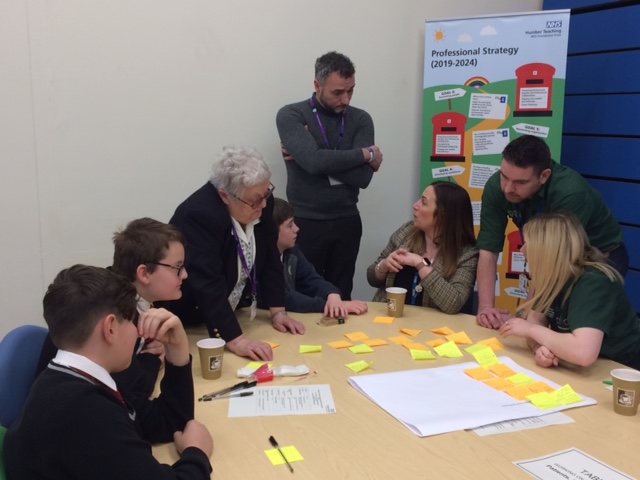
Recently, I did just that and co-facilitated a morning workshop with over ninety NHS patients, service users, carers and staff with the purpose of setting the organisations equality, diversity and inclusion priorities for the next 12 months.

EDI Priorities workshop image 1

We invited a wide range of stakeholders from across the area including; patients, carers, service users, staff and partner organisations so that we could have conversations about what our equality, diversity and inclusion priorities should look like for the next year.

The event was an enormous success where patients, service users, carers and staff held topical and emotive discussions around the subject of equality, diversity and inclusion.

EDI Priorities workshop image 6

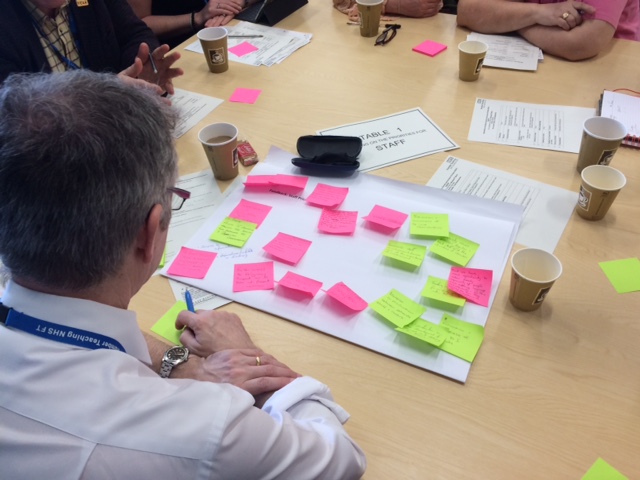
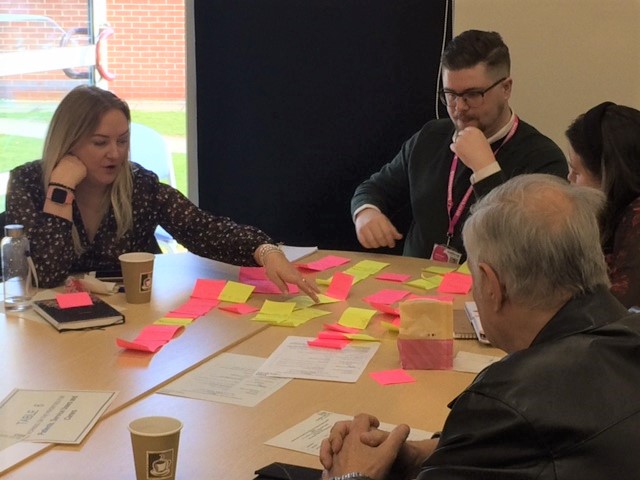
The room was divided into eight tables, four for staff and four for patients, service users and carers. Each and every idea was committed to post it notes before tables discussed in more depth the themes emerging from their conversations before narrowing down their ideas into three key themes, which they then fedback to the whole room.

EDI Priorities workshop image 2

This produced a wealth of information from our patients, service users, carers and staff which was collected and from it the organisation can produce a range of equality, diversity and inclusion priorities confident in the knowledge that these have not been produced in isolation. In doing so, we can ensure that our equality agenda is truly co-produced in collaboration with our primary stakeholders and that our key drivers for improvement are the experiences of our valued patients, service users, carers and staff.

EDI Priorities workshop image 5a

Senior buy in is important for these events because it demonstrates their own commitment to equality, diversity and inclusion to stakeholders.  The event was well supported by our board with the event opened by the Chair of the Board and closing remarks provided by our Chief Executive.

Our next step will be to analyse the key priorities identified and put together a coherent and robust strategy to deliver on these priorities over the coming 12 months as well as ensuring we communicate our progress over the year.

So, when considering setting equality actions for the year ahead, ensure you involve the primary stakeholders who will be impacted the most by your actions – they are the best guides as to whether what you are doing will have any positive and lasting impact.

JD

February is LGBT+ History Month

February is LGBT History Month! This annual month-long observance of lesbian, gay, bisexual and transgender history, as well as the history of the gay rights and related civil rights movements provides role models, builds community, and represents a civil rights statement about the contributions of the LGBT community.

LGBT History Month sets out to:

·        Increase the visibility of lesbian, gay, bisexual and transgender (“LGBT+”) people, their history, lives and their experiences in the curriculum and culture of educational and other institutions, and the wider community;

·        Raise awareness and advance education on matters affecting the LGBT+ community;

·        Work to make educational and other institutions safe spaces for all LGBT+ communities; and

·        Promote the welfare of LGBT+ people, by ensuring that the education system recognises and enables LGBT+ people to achieve their full potential, so they contribute fully to society and lead fulfilled lives, thus benefiting society as a whole.

Why do we use the rainbow as a symbol of LGBT equality?

Rainbow flags tend to be used as a sign of a new era, of hope, or of social change”. Rainbow flags have been used in many places over the centuries: in the German Peasants’ War in the 16th century, as a symbol of the Cooperative movement; as a symbol of peace, especially in Italy; to represent the Tawantin Suyu, or Inca territory, mainly in Peru and Bolivia; by some Druze communities in the Middle east; by the Jewish Autonomous Oblast; to represent the International Order of Rainbow for Girls since the early 1920s; and as a symbol of gay pride and LGBT social movements since the 1970s.

Today, the flag is flown as a sign of inclusion and welcome. When flown outside businesses, or placed in shop windows, it tells LGBT people they can relax, and feel safe to do what others’ take for granted: to hold hands or kiss their partners, to rent a hotel room together, to book a table for Valentines day, to demonstrate their love without hate. As an image, it reminds us of not only the diversity of sexual orientation but also of the diversity of human characteristics as a whole.

The Colour of Characteristics

Characteristics help shape identity. The flag’s 6 colours represent different aspects of LGBT communities, but the rainbow is also a symbolic representation of the variety of human expression, in all its hues and shades. Characteristics might be thought of as primary colours of our psyche which when mixed together form the different shades of our identities. Our experiences throughout life, especially during childhood, affect the saturation and brightness of those identities.

JD


Include ‘ethical veganism’ in diversity policies, experts warn

Below is a recent article by Maggie Baska for People Management regarding a high profile case where experts are subsequently advising  organisations to include ‘ethical veganism’ in diversity policies. I am interested in what policy writers think about this?

‘Lawyers advise businesses to give the lifestyle choice the same protection as other beliefs after tribunal rules it falls under discrimination laws. Employers should look to review their diversity policies to include ‘ethical veganism’, employment laywers have said, after an employment tribunal (ET) ruled it is a philosophical belief that is protected by discrimination law.

The ruling came from the Norwich ET as part of a wider unfair dismissal case brought by Jordi Casamitjana (pictured), a former employee of animal rights charity the League Against Cruel Sports (LACS), who claimed he was unfairly sacked after he raised concerns that its pension fund was invested in companies involved in animal testing.

Casamitjana argued that his ethical veganism – which covers his broader lifestyle rather than just diet – was an integral part of his life, and this therefore made his dismissal discriminatory.

The judgment does not settle Casamitjana’s unfair dismissal claim, but it does lay the ground for a substantive hearing into his case.

Experts said the ruling widened the scope of the Equality Act, and employers needed to take a close look at their existing policies to ensure ethical vegans were afforded the same protections as employees with other religious or philosophical beliefs.
While both dietary and ethical vegans eat a plant-based diet, excluding all animal-based foods or byproducts, ethical vegans exclude all forms of animal exploitation including avoiding clothing made from wool or leather, or toiletries from companies involved in animal testing.

Victoria Albon, associate at Dentons, said it was not surprising the tribunal found ethical veganism was protected, and said the definition of a philosophical belief was “open to a fairly wide interpretation”, highlighting a tribunal ruling in 2009 that found belief in man-made climate change should be classed as a belief and protected under the Equality Act.

The Act says a philosophical belief must be genuinely held – not just an opinion or viewpoint. It must also be cogent, serious and apply to an important aspect of human life or behaviour. This belief must be worthy of respect in a democratic society and not affect other people’s fundamental rights.

Although it could still be appealed, the ruling provides useful commentary on the level of legal protection that ethical vegans should receive in the workplace. But Carl Atkinson, partner at law firm Gunnercooke, told People Management tribunal judges in similar cases have been careful to state in their judgment that a case will be fact specific to the individual involved.

“It has become apparent that the way tribunals will judge if the belief system of a particular claimant is covered by equality law will depend on the specifics of that case, meaning one vegan could have a set of views that fall within the definition a philosophical belief while another did not,” Atkinson explained.

He said, in the present case, Casamitjana’s lawyers had published his witness statement online so it was apparent his veganism had become determinative of the way he lived his life.

While all vegans might not be protected by the recent ruling, Kate Palmer, associate director of advisory at Peninsula, advised businesses to review how they supported ethical vegans in their company and if any changes were required.

“It should be remembered that no employee should feel mistreated at work,” Palmer said. “Aside from the potential legal implications as seen here, catering for a diverse workforce can be critical in both attracting and retaining key talent.”

Casamitjana’s unfair dismissal case is still being heard by the tribunal. Slater and Gordon, the law firm representing Casamitjana, said further hearings into the case are planned for February.

Rhys Wyborn, employment partner at Shakespeare Martineau and who acted for the LACS, said the company did not contest the issue of whether ethical veganism itself should be a protected belief, but said it was “irrelevant” to the core reason behind Casamitjana’s dismissal.

“The league is now looking ahead to the substantive hearing in this case and to addressing the reason for Casamitjana’s dismissal, which it maintains was down to his misconduct and not the belief he holds,” Wyborn said.

Casamitjana said he was “extremely happy” with the current ruling and added that he hoped fellow vegans “would benefit” from the tribunal’s decision.’

The full article from People Management can be found here.

JD