
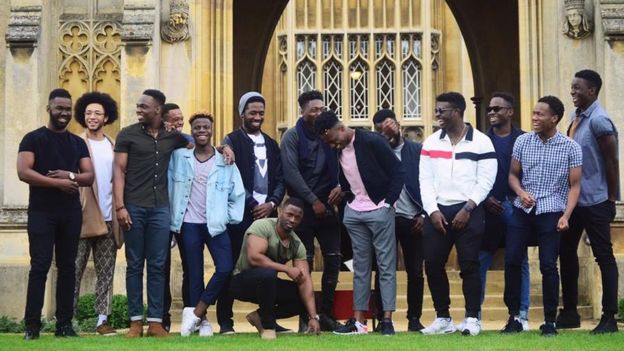
According to Cambridge’s own statistics, of 3,449 students accepted into Cambridge during the 2015/2016 academic year, 38 defined themselves as black, fractionally over 1%. For a highly traditional, elitist institution such as Cambridge this is a real shift in the right direction, certainly there is still much work to be done as 1% is hardly representative of the wider community. That said, many of our most famous academic institutions have always been dogged by questions of inclusion, diversity and ultimately inequality.
Here, the Cambridge University African-Caribbean are trying to change that. A recent article, bhis was the intended message behind a photo of 14 black male students from the University that has been liked more than 2,000 times on Facebook. The group posed for several images that were shared in a bid to encourage more black students to apply to the university.
Accusations of inequality have dogged Cambridge University for many years, as they have Russell Group Universities. The high standard for entry to such prestigious institutions practically bars entry to those who’s formative years were economically or socially deprived. Statistically, those from economically or socially deprived areas are less like to do well at school and subsequently less likely to meet the high standards of a University like Cambridge. So, when such institutions brag about scholarships and bursaries for the under privileged the recipients still need to meet the university’s high entrance criteria. As such, these underprivileged students still need the support at home in order to attain the grades needed to enter Cambridge. It is statistically supported, though controversial, for me to say learners who have a stable and supportive home life achieve better than their disadvantaged peers. So, the really underprivileged learners who have challenging economic or social difficulties have, statistically, very little chance of meeting the entrance criteria for our elite institutions, let alone play polo or compete in dressage. What then are the Russell group and Oxbridge doing about this? How can they better support learners from really disadvantaged backgrounds over come that disadvantage and get in to Cambridge on talent alone, not grades and not on extra curricula pursuits.
However, there is some light at the end of the tunnel when groups such as the Cambridge University African-Caribbean can show case the positive steps taken. On the other hand, our prestigious institutions need to demonstrate that inequality is important to them by working with education providers in economically deprived parts of the country.
JD

 The Equality Blog